
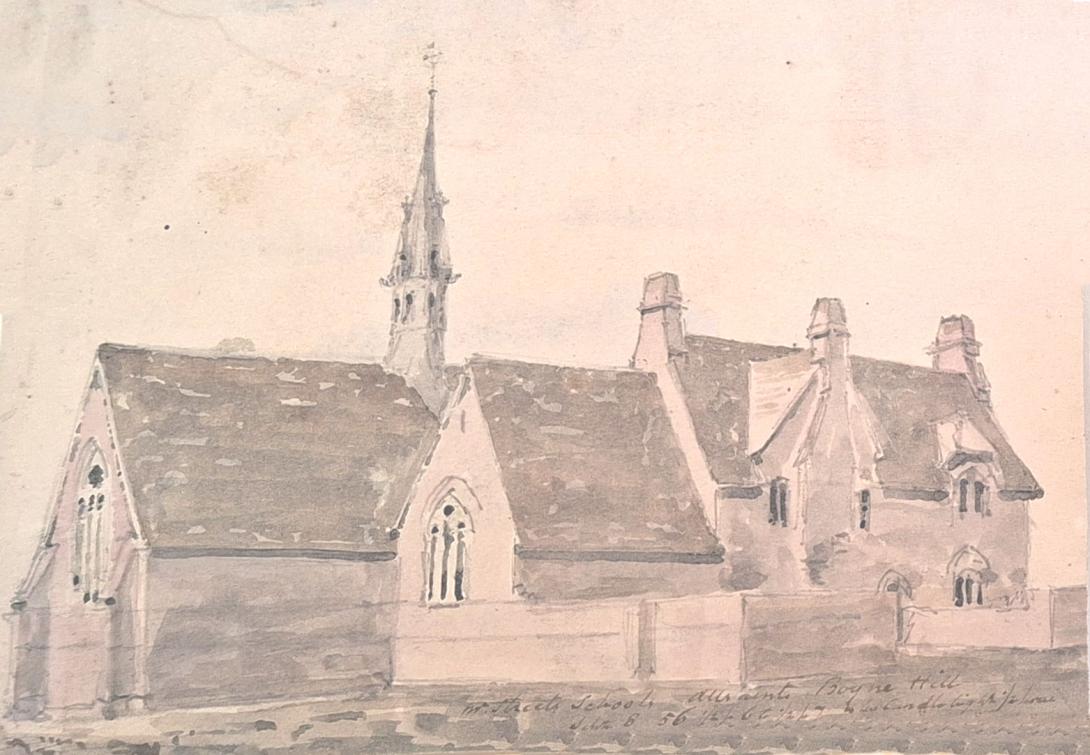
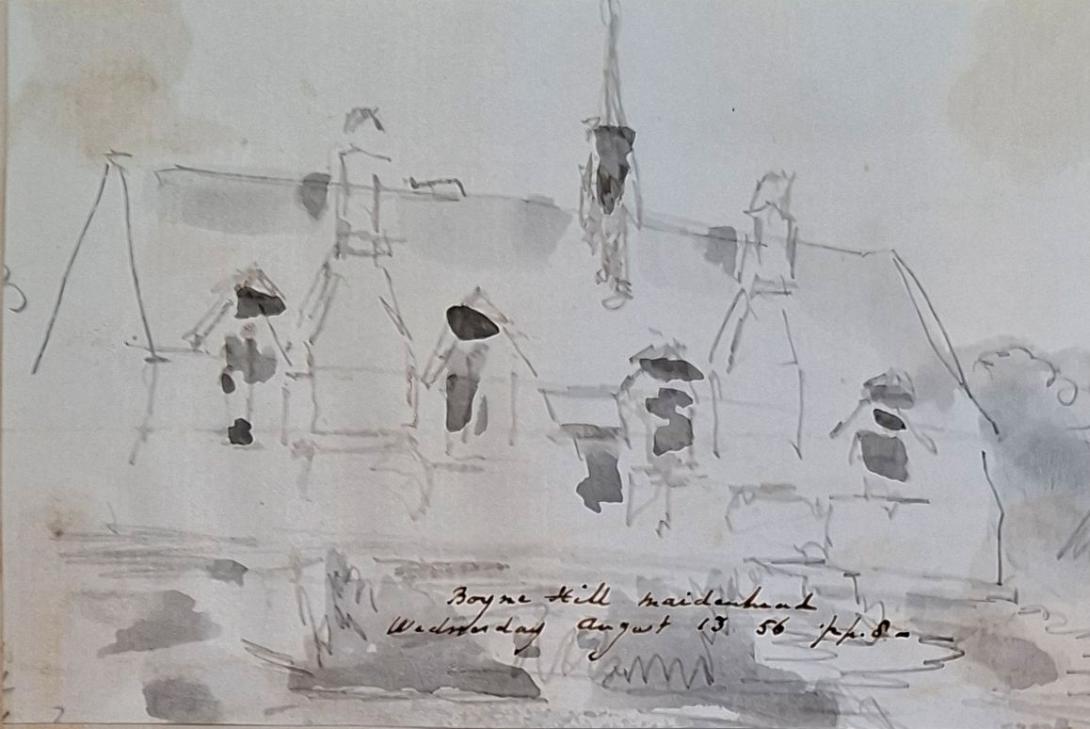
"Mr Stciks school All saints Boyne Hill Sept 8 1856
(Formerly listed as Parish Centre, Church Close, BOYN HILL ROAD (south-east side), previously listed as Boyn Hill Infants School) Former school, adjoining vicarage and contemporary to it (1854-57) in the same style but with slightly simpler treatment by same architect (G.E Street). Single-storey north-west elevation, gabled dormers breaking eaves. Polychromatic brick arches over openings. Three brick chimneys projecting from the wall. At the south-west end, an extension by A.E Street in 1885, incorporating an original traceried window on the west gable by G.E Street.
All Saints Boyne Hill is one of the finest examples of the early work of the architect G. E. Street and was completed in 1857. The site is also regarded by many as the premier architectural site in Maidenhead. The unique complex consists of the Church surrounded on the south side by the Old Vicarage, a school (which was converted to the Parish Centre in 1979), and 2 clergy houses. On the south western boundary is an almshouse referred to in the following text.
Street was originally an assistant to Sir Gilbert Scott (1810-1877), perhaps the most famous architect of the period. (English Church Architecture, A Visual Guide, Mark Child, published by Batsford 1981). Street was influenced by Italian styles and materials and he published Brick and Marble Architecture of the Middle Ages in Italy in 1855. One of the assistants in his practice was the designer and writer William Morris who came to prominence slightly later in the period.
Boyne Hill was originally in the Parish of Bray (as indicated on a milestone at the churchyard boundary on the Bath Road.) The Parish of Bray stretched east to west from the outskirts of Windsor to Maidenhead Thicket. It was the vision of the then Vicar the Revd. Austen Leigh to make worship possible for those living furthest away from the Parish Church of St. Michael in Bray. The actual site was chosen by the Bishop of Oxford, Samuel Wilberforce, from a shortlist provided. The site was generously given by Mr Charles Grenfell of Taplow and the benefactors were Emily and Maria Hulme, spinster daughters of the Revd William Hulme one time Vicar of Holy Trinity Reading. The ladies were desirous of a Church to be built for “advanced religion” by which they meant the Oxford Movement.
They also commissioned a house for themselves in Boyn Hill Avenue that became part of the East Berkshire College. That house became Grade 2 listed shortly before the college site became a housing development completed in 2015.The original house has been converted into 3 linked homes and is visible from the eastern end of the site in Boyn Hill Avenue. It is believed that the Hulme sisters never appeared to live in it but let it to the Misses Lamotte referred to later. The Church was consecrated on 2nd December 1857 by Bishop Samuel Wilberforce and became the first Ecclesiastical Parish in the Borough of Maidenhead.
Of the seven sacraments of the church the one most central to the design of the building was the celebration of Holy Communion. The high altar and the sanctuary are the focal point for the congregation. The viewpoint for the congregation is a large, stained glass east window; the central and largest panel shows Christ on the Crucifix, and the surrounding panels represent the events of Maundy Thursday, through the Crucifixion to Easter. This window and others recall the medieval age of faith in their classical design. The east wall is decorated in patterns of black enamel let into stone and interspersed with coloured marble. (Church Guide Book; now out of print). Behind the brass cross on the high altar is a discrete (from a distance) but elaborately carved stone cross let into the wall panel. In the north wall is a decorated Aumbrey, where the reserved sacrament is kept (consecrated Bread and Wine used for sick visiting) and a votive candle is always lit, as a sign of Christ’s presence in the consecrated sacrament. In the south wall an arcade of three sedilia (seats) is supported by polished marble columns. The roof of the Sanctuary is highly decorated with alternate green and red decorated panels almost certainly from a colourway of wallpaper designed by A W N Pugin c1845-48 known as the ‘Gothic Sun’ pattern. (Gothic Revival, Megan Aldrich, Phaidon Press, 1994 p228) The decoration of the chancel walls is dominated by the use of polychromatic brick and highly glazed encaustic tiles. Beneath this decoration is a continuation of the stencil effect in a mediaeval style which is also seen in the nave roof. The choir stalls have richly carved ends with the foliage of trees. In the north wall are four panel glass panels of saints holding bibles. The floor is made from highly glazed decorated tiles.
Worshippers would have received communion at the high altar kneeling at an ornate, wrought iron rail. As they waited to go forward to receive the sacrament the effect of the decoration around them would have contributed to the sense of creating a little bit of heaven on earth. The overall effect was surely intended to overwhelm the senses of sight, sound from the choir and smell from the use of incense.
The choir is entered under a Gothic arch and separated from the nave by wrought iron gates and a screen of Bath stone supported by more decorative iron work and candles. The current choir divide is some five feet forward of the original position. (Church Guide Book) The chancel and sanctuary is approximately one third of the length of the original church building; although the nave was subsequently extended in 1907. The elevated position of the high altar is emphasised by a total of five steps from the level of the nave. A striking feature in the nave are the 12 carved stone “Scenes of the Passion” the work of Thomas Earp who was also responsible for the Pulpit and the large stone carving of the Resurrection on the West End wall. The two blank tablets on the South Wall in the extension were obviously intended for the last two Stations of the Cross making up to the traditional 14 but these have never been completed.
At the time the church was designed the only part of the service taken by the priest in the nave would have been the sermon. The pulpit (left) is decorated in keeping with the rest of the church by use of bath stone, inlaid coloured marble and sculptured flowers. The brass lectern, an outstretched eagle of massive proportions, would have had the approval of the Ecclesiological Society.
In keeping with Tractarian churches, the nave was designed for all the people with no segregation for different classes in contrast to the conventional Protestant churches. The gothic archway into the chancel is repeated along either side of the central aisle with four arches on either side separating the side aisles. Above the stone arches the brick work detail is clearly influenced by Street’s researches in Italy. (Gothic Revival, Megan Aldrich, Phaidon Press, 1994, p183) The bench ends have a discrete gothic theme moulding. The nave stained glass windows continue a teaching theme. A striking feature of the nave is the use of carved stone plaques to describe the 12 stations of the cross. The nave roof is decorated in a mediaeval style stencil design in red and blue between the timbers.
The west end window shows Christ enthroned in Majesty surrounded by hosts of saints, apostles, martyrs and prophets. Under the window is a large stone carved tableau of the resurrection. These features were in the original building.
Richard Suter was born in Greenwich, Kent on 30th March 1798, to William Suter and his wife Sarah Knights. On 7th January 1825 he married Anne Ruth Burn.
English architect. As Surveyor to The Fishmongers' Company he designed the severe Presbyterian churches for Ballykelly (1825–7) and Banagher (1825) on the Company's Estate in County Londonderry, drawings of which were exhibited at the Royal Academy in 1827. He was also responsible for the Model Farm (1823–4), the Lancasterian Schools (1828–30), the Company Agent's House (1830–2—now a hotel, much altered), a range of houses on the south side of the main road (1823–4), the lodge in the Presbyterian churchyard (1828), and the Dispensary (1829), all at Ballykelly, and all Classical. As Surveyor to Trinity House Corporation, he designed houses that were erected by Thomas Cubitt in 1821–3 on a site adjoining Trinity House. For The Fishmongers' Company he designed St Peter's Almshouses, Wandsworth, London (1849–51), and The Old School-House, Gresham's School, Holt, Norfolk(1859), in an Elizabethan style.
On the 1841 Census Richard, an architect and lawyer, can be found living in London with his wife Ann (listed as Ruth) and their two children, Richard George and Andrew Burn. Living with them is Edward D Suter. 1851 finds the family living in Tottenham Court in London, by this time Andrew had left the home, but I am unable to trace him on the 1851 Census. In 1860 Andrew marries Amelia Damaris Harrison. Both Richard George and Andrew were to become ordained ministers, with Andrew later becoming a Bishop and emigrating to New Zealand. Sadly in 1854 Anne Ruth was to pass away. In 1861, widowed Richard, Justice of the Peace for Maidenhead, is living at Castle Hill, Maidenhead, Berkshire. In 1862 he married Elizabeth Anne Pocock. In 1871 and 1881 Richard and Elizabeth are still living in Castle Hill. Richard was to pass away on 1st March1883.
Richard Suter & Annesley Voysey, architects, had their office at number 35 Fenchurch Street, but they did not have it all to themselves as they shared the premises with W.C. Franks, a tea broker, who will get a separate post some other time. The earliest mention I found of Richard Suter in Fenchurch Street is in 1832 when he is listed at that address in a list of contributing members of the Society for the Propagation of the Gospel in Foreign Parts. It says that he had been a member since 1829, but that does not mean he was already at 35 Fenchurch Street in that year.(1) In fact, that seems unlikely as the Sun Fire Office records give Messrs. Short and Co., merchants, as paying the insurance premium on the premises in May 1830. The Directory of British Architects 1834-1914 give the year 1827, but I do not know on what evidence. When Suter and Voysey became partners is also uncertain, but they had known each other since at least 1825 as Suter is named as one of the executors of Voysey’s will which was dated 22 July, 1825. The address given for Suter in the will is Suffolk Street, Southwark. Voysey then lives at Conway Street, Fitzroy Square.