
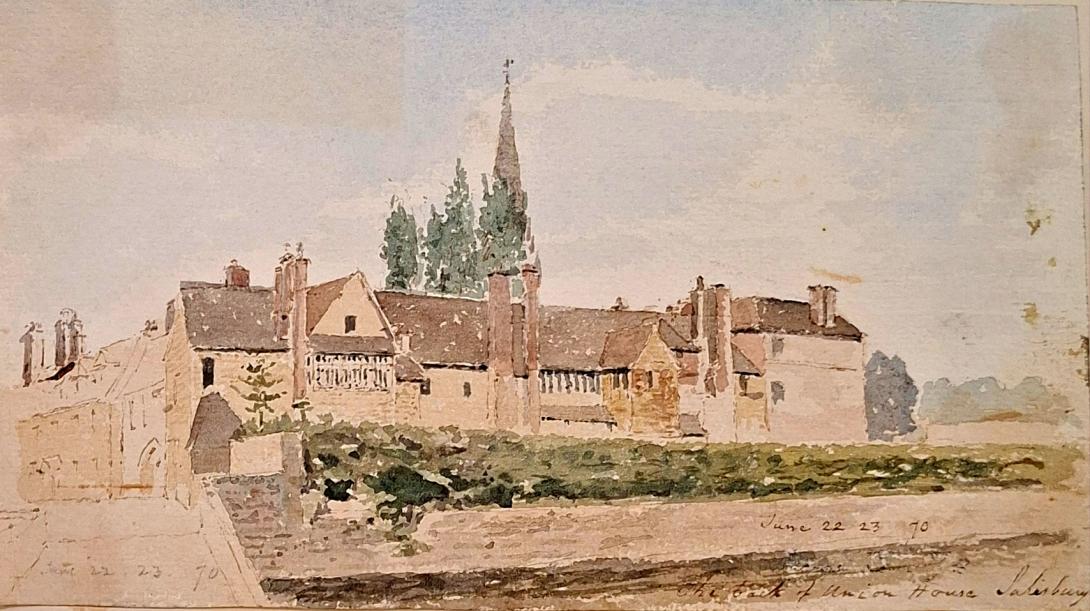
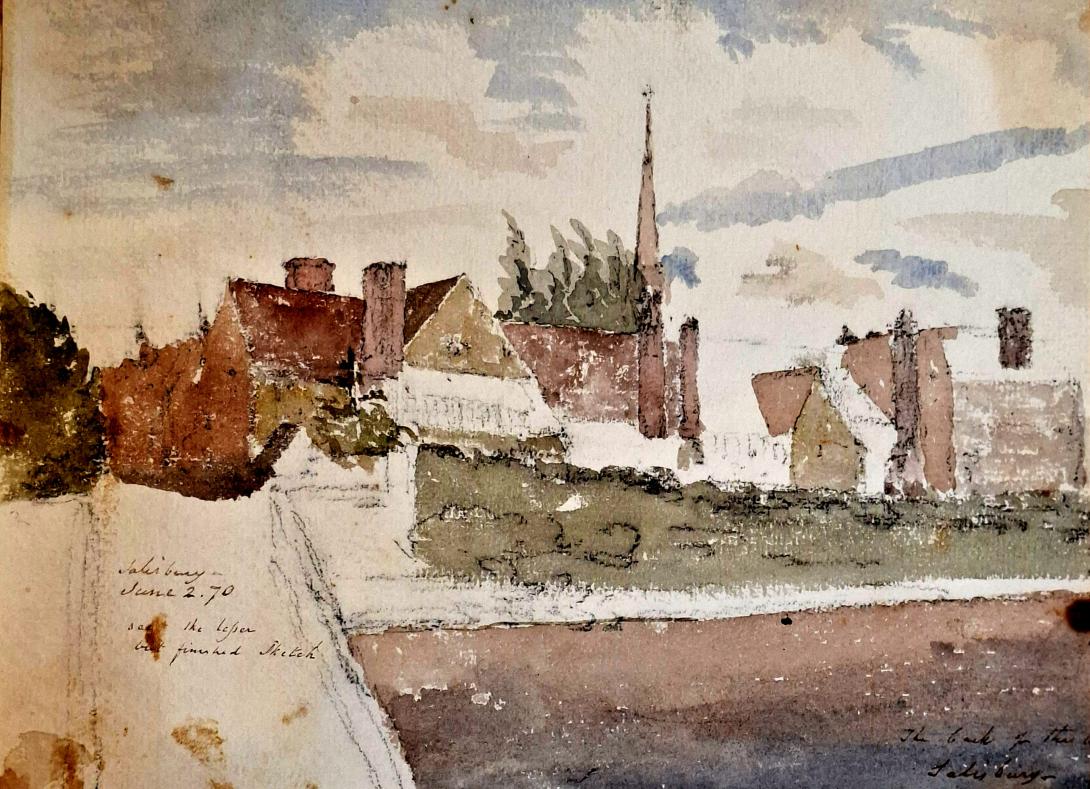
inscribed " June 22 23 70 / The Back of Union House Salisbury"
This scenic stone house was built by merchant W. Lightfoot in the 15th century. Since 1628 the house served as Salisbury’s workhouse. Later several houses on Crane Street, Nos. 95, 97 and 99, were used as the diocesan Church House. Because of their importance as the city’s Diocesan Office, these houses on Crane Street were completely renovated in 1887 by Weymouth architect George Crickmay.
Henry VIII is known to have visited Salisbury on three occasions. In 1511 and 1514, he was accompanied by the then-queen, Katherine of Aragon. Twenty-one years later, he would return for the final time, on this occasion, with Anne Boleyn by his side.
As contemporary records are silent after the couple’s visit to Portsmouth and Portchester, we do not know exactly where the royal party went or was lodged between 5 and 9 October. Given the distances involved, they likely made their way from Portchester directly toward Salisbury and probably via Southampton, heading along the main Southampton to Bristol road, arriving on Friday 8 or Saturday 9 October.
Wiltshire Community History describes how, in an assembly held on 27 September 1535, it was agreed that:
If the King’s Grace and the Queen do come to the city, then, Mr Mayor, and his brethren who shall have been mayors, were to receive them in scarlet gowns; and the forty-eight [i.e. members of the city council], and other honest men, in violet colour, after their best manner, to the honour of the city, on horseback. And that the mayor and commonalty shall give to the Queen’s Grace a purse of gold, amounting to £20.3s.4d to be levied on the goods of the chamber, and to be delivered by the mayor. Also that all the torches and torchets, of all occupations within the city, be viewed and numbered by the mayor, at his discretion; so that if the King’s grace do come late to this city, that then the said torches and torchets be in readiness to light, with convenient bearers, to give them due attendance, then to convey the King’s Grace to his lodging, to the honour of the city.’
Records show that Anne did indeed receive the purse of £20. 3s. 4d. and the then Precentor, Thomas Benett, offered the royal guests the use of his house, Leadenhall in the Close, a building which still stands today close to Salisbury Cathedral and Museum.
In the end, the King and Queen were the guests of John Tuchet, 8th Baron Audley, for the duration of their two-day stay. We know this because of a letter dated 10 October, written by Lord Audley to Cromwell in which he prays that the King and Queen ‘were satisfied with their poor lodging in his house’. That being so, it would seem that Anne and Henry stayed in the present-day Church House on the south side of Crane Street and, in the oldest part, the western range, which faces onto the River Avon. Fortunately for us, this splendid Tudor house still stands today, and forms offices for the Diocese of Salisbury, to which we shall turn in a moment.
Interestingly, though, before we do so, there is another snippet of information associated with the events of the very same day. Clearly, the business of the state and domestic concerns were never far away from the King and Anne. In a tantalising and fascinating insight into the life of the young Princess Elizabeth, we read that it was whilst at Salisbury that Henry decided that his two-year-old daughter was old enough to be weaned:
The King having considered the letter to Cromwell from Lady Brian and other of the Princess’s officers, has determined that she shall be weaned with all diligence, and that Langley shall be put in readiness. Sends letters to them, and one from the Queen to Lady Brian, Salisbury 9th Oct.
So we know that at least part of that day was taken with concerns about the welfare of Anne’s beloved daughter. Did Henry and Anne discuss such matters in the house on Crane Street? Of course, we cannot know, but it is a charming insight into the everyday conversation of the two concerned parents.
Richard Suter was born in Greenwich, Kent on 30th March 1798, to William Suter and his wife Sarah Knights. On 7th January 1825 he married Anne Ruth Burn.
English architect. As Surveyor to The Fishmongers' Company he designed the severe Presbyterian churches for Ballykelly (1825–7) and Banagher (1825) on the Company's Estate in County Londonderry, drawings of which were exhibited at the Royal Academy in 1827. He was also responsible for the Model Farm (1823–4), the Lancasterian Schools (1828–30), the Company Agent's House (1830–2—now a hotel, much altered), a range of houses on the south side of the main road (1823–4), the lodge in the Presbyterian churchyard (1828), and the Dispensary (1829), all at Ballykelly, and all Classical. As Surveyor to Trinity House Corporation, he designed houses that were erected by Thomas Cubitt in 1821–3 on a site adjoining Trinity House. For The Fishmongers' Company he designed St Peter's Almshouses, Wandsworth, London (1849–51), and The Old School-House, Gresham's School, Holt, Norfolk(1859), in an Elizabethan style.
On the 1841 Census Richard, an architect and lawyer, can be found living in London with his wife Ann (listed as Ruth) and their two children, Richard George and Andrew Burn. Living with them is Edward D Suter. 1851 finds the family living in Tottenham Court in London, by this time Andrew had left the home, but I am unable to trace him on the 1851 Census. In 1860 Andrew marries Amelia Damaris Harrison. Both Richard George and Andrew were to become ordained ministers, with Andrew later becoming a Bishop and emigrating to New Zealand. Sadly in 1854 Anne Ruth was to pass away. In 1861, widowed Richard, Justice of the Peace for Maidenhead, is living at Castle Hill, Maidenhead, Berkshire. In 1862 he married Elizabeth Anne Pocock. In 1871 and 1881 Richard and Elizabeth are still living in Castle Hill. Richard was to pass away on 1st March1883.
Richard Suter & Annesley Voysey, architects, had their office at number 35 Fenchurch Street, but they did not have it all to themselves as they shared the premises with W.C. Franks, a tea broker, who will get a separate post some other time. The earliest mention I found of Richard Suter in Fenchurch Street is in 1832 when he is listed at that address in a list of contributing members of the Society for the Propagation of the Gospel in Foreign Parts. It says that he had been a member since 1829, but that does not mean he was already at 35 Fenchurch Street in that year.(1) In fact, that seems unlikely as the Sun Fire Office records give Messrs. Short and Co., merchants, as paying the insurance premium on the premises in May 1830. The Directory of British Architects 1834-1914 give the year 1827, but I do not know on what evidence. When Suter and Voysey became partners is also uncertain, but they had known each other since at least 1825 as Suter is named as one of the executors of Voysey’s will which was dated 22 July, 1825. The address given for Suter in the will is Suffolk Street, Southwark. Voysey then lives at Conway Street, Fitzroy Square.