
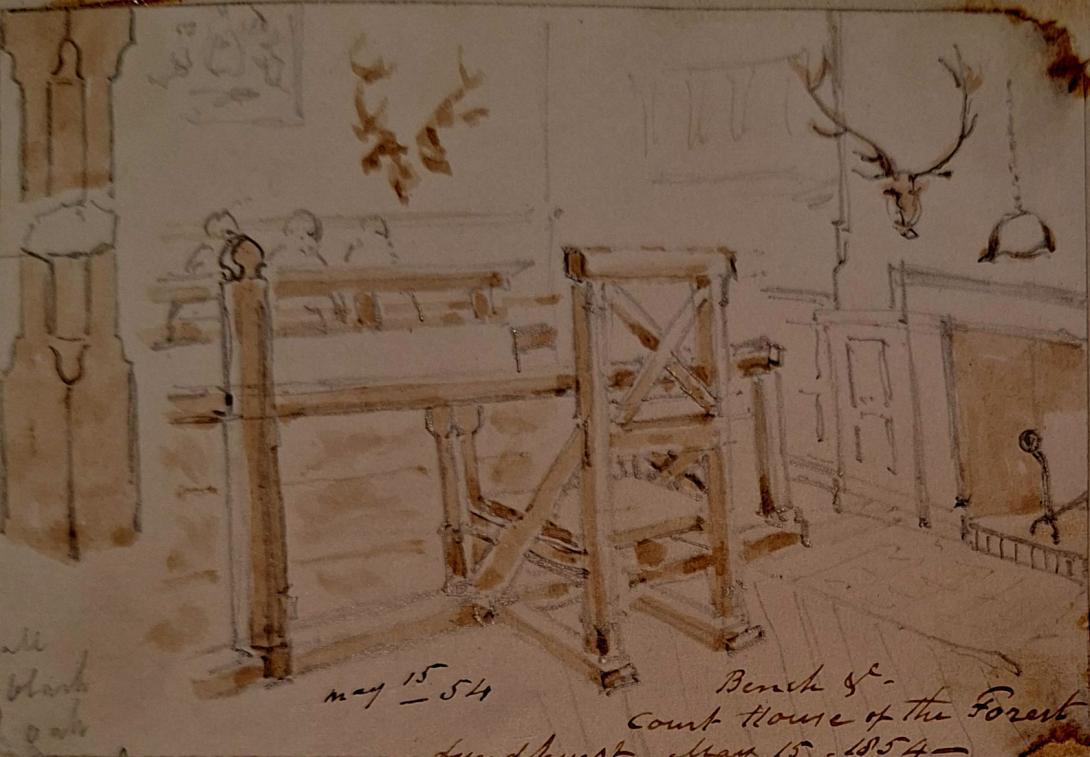
inscribed and dated " Bench 15 54 / Bench at Court House of the Forest / Lyndhurst /15 May 1854
Evidence from the 13th century indicates that the Verderers were originally a court within the Forest, authorised by the Crown and elected by the County. They sat to hear cases of offences within the Sovereign’s Forest. They could deal with minor offences directly (by fines) but more serious cases were referred to higher courts – ultimately the Forest Eyre.
The Verderers’ Hall is at the top of Lyndhurst High Street, attached to Queen’s House. It is the home of the ancient Court of Verderers, a body originally constituted to deal with those who offended against Forest Law.
Currently ten in number, the Verderers' modern role is to:
a) protect and administer New Forest commoning practices,
b) conserve the New Forest landscape, wildlife and aesthetic character; and
c) safeguard a viable future for commoning.
The Verderers also have authority to restrict encroachment or trespass on the New Forest, a power that on more than one occasion has helped safeguard the long term character of this age-old landscape.
Of the ten Verderers, the Official Verderer is appointed by the Crown, whilst four others are appointed by, respectively, the Department for Environment, Food and Rural Affairs (DEFRA), the Forestry Commission, the New Forest National Park, and Natural England. The remaining five Verderers are elected by the New Forest commoners.
Five Agisters are employed by the Verderers to deal on a day-to-day basis with the commoners’ stock. They attend all-too-frequent road traffic accidents involving the stock; organise the annual pony round-ups, or drifts as they are more properly known; and ensure that the welfare of the stock is maintained at an acceptable level.
The Verderers’ Court meets monthly, except in August when there is no meeting. Apart from in December, the first part of the proceedings is open to the public.
During each meeting, commoners and others have the opportunity to make 'presentments' during which relevant issues of the day can be raised. The Verderers’ response is given, and an animal traffic accident report provided.
The Verderers’ Hall has a long and proud history. In 1388, a building in which the New Forest courts could meet was constructed within or beside Lyndhurst’s old manor house, the building which later became Queen’s House. The current Verderers’ Hall is believed to occupy the same site as the original, although the building has been considerably affected by alterations to Queen’s House.
Inside the Hall, an ancient, rough-hewn dock is used by those making 'presentments' to the Court, a reminder of the days when breakers of Forest Law were harshly treated.
Nearby can be seen Rufus’s Stirrup, a large iron stirrup that recalls, at least in name, William II, or as he was sometimes known, William Rufus - this is the same Rufus who in August 1100 was killed by an arrow allegedly shot by Sir Walter Tyrrell.
The stirrup is probably, though, of Tudor date, and was used to determine whether dogs were to be cruelly maimed to prevent them chasing deer - dogs small enough to pass through were considered harmless; larger dogs were not, and had their paws badly mutilated.
Hanging on the walls are the mounted heads of deer, reminders of the New Forest’s original role as a royal hunting ground. The story of two displayed fallow deer heads found with antlers hopelessly entangled was recalled by Peter Evening in the 1974 book New Forest Walks. He tells that: ‘These poor beasts died as a result of a fight during the rut of 1905 when their antlers became inextricably entwined. During the contest of strength, the weaker was pushed backwards into a drainage ditch and its adversary following on broke its neck in falling and subsequently smothered the one beneath.’
He also went on to say: ‘A similar tragedy occurred in 1967 when the antlers of two rutting roebucks became entangled. Unable to break free, they both eventually died of exhaustion and starvation.' Their antlers, too, hang in the Verderers’ Hall.
Richard Suter (1797–1883).
Richard Suter was born in Greenwich, Kent on 30th March 1798, to William Suter and his wife Sarah Knights. On 7th January 1825 he married Anne Ruth Burn.
English architect. As Surveyor to The Fishmongers' Company he designed the severe Presbyterian churches for Ballykelly (1825–7) and Banagher (1825) on the Company's Estate in County Londonderry, drawings of which were exhibited at the Royal Academy in 1827. He was also responsible for the Model Farm (1823–4), the Lancasterian Schools (1828–30), the Company Agent's House (1830–2—now a hotel, much altered), a range of houses on the south side of the main road (1823–4), the lodge in the Presbyterian churchyard (1828), and the Dispensary (1829), all at Ballykelly, and all Classical. As Surveyor to Trinity House Corporation, he designed houses that were erected by Thomas Cubitt in 1821–3 on a site adjoining Trinity House. For The Fishmongers' Company he designed St Peter's Almshouses, Wandsworth, London (1849–51), and The Old School-House, Gresham's School, Holt, Norfolk(1859), in an Elizabethan style.
On the 1841 Census Richard, an architect and lawyer, can be found living in London with his wife Ann (listed as Ruth) and their two children, Richard George and Andrew Burn. Living with them is Edward D Suter. 1851 finds the family living in Tottenham Court in London, by this time Andrew had left the home, but I am unable to trace him on the 1851 Census. In 1860 Andrew marries Amelia Damaris Harrison. Both Richard George and Andrew were to become ordained ministers, with Andrew later becoming a Bishop and emigrating to New Zealand. Sadly in 1854 Anne Ruth was to pass away. In 1861, widowed Richard, Justice of the Peace for Maidenhead, is living at Castle Hill, Maidenhead, Berkshire. In 1862 he married Elizabeth Anne Pocock. In 1871 and 1881 Richard and Elizabeth are still living in Castle Hill. Richard was to pass away on 1st March1883.
Richard Suter & Annesley Voysey, architects, had their office at number 35 Fenchurch Street, but they did not have it all to themselves as they shared the premises with W.C. Franks, a tea broker, who will get a separate post some other time. The earliest mention I found of Richard Suter in Fenchurch Street is in 1832 when he is listed at that address in a list of contributing members of the Society for the Propagation of the Gospel in Foreign Parts. It says that he had been a member since 1829, but that does not mean he was already at 35 Fenchurch Street in that year.(1) In fact, that seems unlikely as the Sun Fire Office records give Messrs. Short and Co., merchants, as paying the insurance premium on the premises in May 1830. The Directory of British Architects 1834-1914 give the year 1827, but I do not know on what evidence. When Suter and Voysey became partners is also uncertain, but they had known each other since at least 1825 as Suter is named as one of the executors of Voysey’s will which was dated 22 July, 1825. The address given for Suter in the will is Suffolk Street, Southwark. Voysey then lives at Conway Street, Fitzroy Square.