
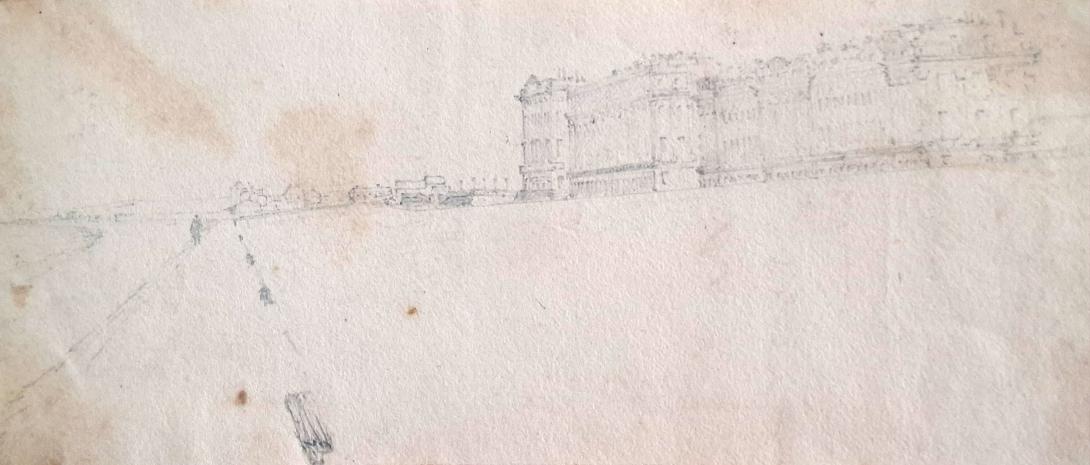
inscribed " Brunswick Terrace Brighton"
Brunswick Town is an area in Hove, in the city of Brighton and Hove, England. It is best known for the Regency architecture of the Brunswick estate.
History
Originally, the area had been part of Wick Farm. In the late 18th and early 19th centuries, nearby Brighton had become very fashionable. The Kemp Town estate there had been a success in 1824 architect Charles Busby entered into an agreement to build a similar development on land lying at the extreme east of Hove, adjacent to Brighton.The name "Brunswick" was taken from House of Brunswick, a term sometimes used for the House of Hanover, the name of the British royal family at the time.
Brunswick Town was built as a collaborative project between Busby and the landowner, the Reverend Thomas Scutt. Construction started in 1824. The first houses were completed by 1826. Busby designed Brunswick Town as a long row of terraced houses facing the sea. In the middle point of this sea-facing terrace was a central square, which stretched back. This square was named Brunswick Square. The terraced houses, in Brunswick Terrace and in Brunswick Square, were built for the upper classes, they were designed as 'first-class' housing. Beyond these houses were second-class houses in streets such as Waterloo Street.
The early 20th century saw the area enter decline. At the extreme eastern edge of Brunswick Terrace, on the border of Hove and Brighton, the modernist Embassy Court apartment block was completed in the 1930s, envisaged by local politicians such as Sir Herbert Carden as the beginning of a transformation of the entire seafront, which would have entailed the obliteration of Brunswick Terrace. By the late 1940s Brunswick Square itself had become so run-down that the Council was considering wholesale demolition and redevelopment with modern housing. These plans encountered strong local opposition, in particular through the founding of the Regency Society which fought successfully against the plans.
In the late 1990s the top of Brunswick Square, where it meets busy Western Road, was closed to motor traffic, changing the nature of the square from a through route to a residential area. The Embassy block was also redeveloped, having fallen into decay.
Notable residents
Main article: List of notable Brighton and Hove inhabitants
Brunswick Square and Brunswick Terrace have had a large number of prominent residents.
- Henry Brougham, 1st Baron Brougham and Vaux
- James Brudenell, 7th Earl of Cardigan
- Roger Quilter, composer
- John Horace Round, historian
- Robin Maugham, writer
- Robert Bevan, artist
- Philip Salomons, financier, who built a Roof-top synagogue at 26 Brunswick Terrace
- Admiral Sir George Augustus Westphal, served in over 100 actions and wounded at Trafalgar on HMS Victory lived at No 2 Brunswick Square 1836-1875
- Sir Winston Churchill was schooled in Hove in the Brunswick area between 1883 and 1885.
- Edward Carpenter, English socialist poet, socialist philosopher, anthologist, and early gay activist
- Nick Tyson, the curator of The Regency Town House, a heritage centre at No.13
Politics
Brunswick is currently part of the local council's Brunswick & Adelaide ward which is represented by Andrei Czolak of Labour and Ollie Sykes of the Green Party. Sykes previously represented the ward for eight years until he stepped down in 2019. In July 2024 he replaced Labour councillor Jilly Stevens, who stepped down due to ill health.
Culture
The Brunswick Festival takes place each year, centred on Brunswick Square. The Old Market, built in 1828 to serve Brunswick Town, was restored in 1999 and is used as a theatre.
Listing designations
Main article: Grade I listed buildings in Brighton and Hove
Many of the buildings in the area are listed by Historic England. Some are listed at the highest grade, Grade I. These include the four components of Brunswick Terrace; Nos 1-6, Nos 7-19, Nos 20-32, and Nos 33-42; the East, and West sides of Brunswick Square, and the Church of St Andrew.
Richard Suter (1797–1883).
Richard Suter was born in Greenwich, Kent on 30th March 1798, to William Suter and his wife Sarah Knights. On 7th January 1825 he married Anne Ruth Burn.
English architect. As Surveyor to The Fishmongers' Company he designed the severe Presbyterian churches for Ballykelly (1825–7) and Banagher (1825) on the Company's Estate in County Londonderry, drawings of which were exhibited at the Royal Academy in 1827. He was also responsible for the Model Farm (1823–4), the Lancasterian Schools (1828–30), the Company Agent's House (1830–2—now a hotel, much altered), a range of houses on the south side of the main road (1823–4), the lodge in the Presbyterian churchyard (1828), and the Dispensary (1829), all at Ballykelly, and all Classical. As Surveyor to Trinity House Corporation, he designed houses that were erected by Thomas Cubitt in 1821–3 on a site adjoining Trinity House. For The Fishmongers' Company he designed St Peter's Almshouses, Wandsworth, London (1849–51), and The Old School-House, Gresham's School, Holt, Norfolk(1859), in an Elizabethan style.
On the 1841 Census Richard, an architect and lawyer, can be found living in London with his wife Ann (listed as Ruth) and their two children, Richard George and Andrew Burn. Living with them is Edward D Suter. 1851 finds the family living in Tottenham Court in London, by this time Andrew had left the home, but I am unable to trace him on the 1851 Census. In 1860 Andrew marries Amelia Damaris Harrison. Both Richard George and Andrew were to become ordained ministers, with Andrew later becoming a Bishop and emigrating to New Zealand. Sadly in 1854 Anne Ruth was to pass away. In 1861, widowed Richard, Justice of the Peace for Maidenhead, is living at Castle Hill, Maidenhead, Berkshire. In 1862 he married Elizabeth Anne Pocock. In 1871 and 1881 Richard and Elizabeth are still living in Castle Hill. Richard was to pass away on 1st March1883.
Richard Suter & Annesley Voysey, architects, had their office at number 35 Fenchurch Street, but they did not have it all to themselves as they shared the premises with W.C. Franks, a tea broker, who will get a separate post some other time. The earliest mention I found of Richard Suter in Fenchurch Street is in 1832 when he is listed at that address in a list of contributing members of the Society for the Propagation of the Gospel in Foreign Parts. It says that he had been a member since 1829, but that does not mean he was already at 35 Fenchurch Street in that year.(1) In fact, that seems unlikely as the Sun Fire Office records give Messrs. Short and Co., merchants, as paying the insurance premium on the premises in May 1830. The Directory of British Architects 1834-1914 give the year 1827, but I do not know on what evidence. When Suter and Voysey became partners is also uncertain, but they had known each other since at least 1825 as Suter is named as one of the executors of Voysey’s will which was dated 22 July, 1825. The address given for Suter in the will is Suffolk Street, Southwark. Voysey then lives at Conway Street, Fitzroy Square.