
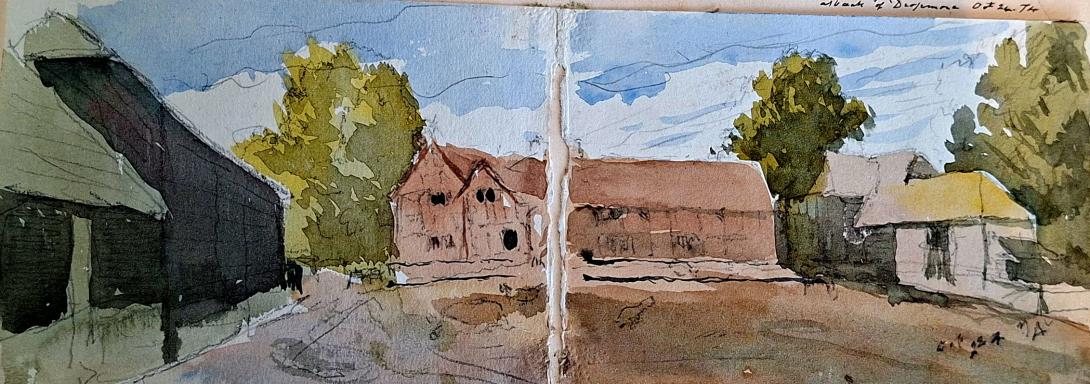
a Picturesque Homestead at back of Dropmore Oct 24 1874
"Buildings at the Back of Dropmore Park" from October 24, 1874, likely refers to the outbuildings, service wings, or estate structures associated with Dropmore House in Burnham, Buckinghamshire, as the main house and gardens (Grade II listed) were established much earlier by Lord Grenville from the 1790s, with extensive planting continuing through the 1820s, and while specific 1874 details are scarce in snippets, these ancillary buildings served the large estate, possibly including lodges, stables, or estate workers' cottages, all part of the historical fabric of the Grenville family's significant landscape design.
An indoor pool was added, but the house was rarely used. In 1990 it was badly damaged by a fire that took four days to put out. Another in 1997 left the house uninhabitable.
Dropmore was restored by the company Corporate Estates via the construction firm MP Brothers Limited into a number of private luxury dwellings around 2006–2008. The restoration included the house, Edwardian stables and a number of garden buildings including a Chinese tea house and aviary. Further plans over a 15-year period include restoration of the formal flower beds, Italian garden, woodlands, lawns, vistas, roads, bridges and gates.The developer has since gone into liquidation before the redevelopment was completed. Dropmore was then purchased in 2012 by Richard and Ian Livingstone.
The exterior of the house and the grounds were used extensively for the location filming of the Doctor Who serial Day of the Daleks.
It s third time lucky for Grade I-listed Dropmore House, near Burnham, Buckinghamshire one of the county s grandest Georgian country houses, built by Samuel Wyatt for Lord Grenville, onetime Prime Minister to George III, in 1795. Requisitioned as a headquarters for the Canadian army in 1939, Dropmore House was in a sorry state when Lord and Lady Kemsley, who bought Dropmore from Lord Grenville s great-great-nephew in 1943, undertook a major restoration of the house and grounds in the early 1950s. Its renaissance was recorded for posterity in Country Life articles by Gordon Nares (October 11 and 15, 1956). Following Lord Kemsley s death in 1968, the estate was owned for four years by the United States International University of San Diego, during which time the house fell into disrepair and much of the land was sold off. In 1972, Dropmore House and its remaining 195 acres of land were bought by the billionaire Arab businessman and art collector Mohamed Mahdi Al-Tajir, a former United Arab Emirates ambassador to the UK and France. He commissioned a major renovation of the house, redecorating and modernising the interior, and building a swimming-pool complex in the grounds. Beyond that, however, the house was rarely used and little maintained. With so little of the original 18th-century mansion left above ground, its re-creation represents a veritable architectural tour de force, which would have been impossible were it not for the visual evidence provided by the British Library s collection of 18th- century drawings of the Dropmore estate by J. C. Buckler, who worked for Lord Grenville both as an artist and as a designer of garden buildings and cottages. The other vital source of reference regarding the original design and layout of the house, and especially the proportions and decoration of its grand main rooms, was the Country Life articles of 1956, according to architect George Kalopedis. As a result, many important original elements such as fireplaces, staircases and Wyatt s soaring sash windows have been faithfully replicated using materials of the time, many of them acquired from their original source. With completion of all essential building work at Dropmore now less than a year away, April 12 is the date set for the launch onto the market, through Savills in Sunningdale (01628 526 792), of the first six of 57 properties. These include 17 sumptuous, two- and three-bedroom apartments in the main mansion, each with own unique character and outlook; a mix of 13 apartments and cottages in the delightful Grade I-listed, red-brick Victorian service wing and Edwardian dairy courtyard; 23 state-of-the-art, two-bedroom apartments in the new wing, where large roof-terraces will be a major draw ; and a solitary, one-off , two-bedroom house in the converted four-storey Victorian water-tower built by Lady Grenville s nephew and heir, George Matthew Fortescue, in 1901. Apartment sizes range from a minimum of 900sq ft in the new wing to a maximum of 4,000sq ft in the mansion houses, and prices range from £850,000 to about £4 million. Meanwhile, for Andre Meyers, the beat goes on, as he embarks on the final phase of restoration at Dropmore Park the repair and reinstatement of iconic garden structures, such as the aviary, the ornamental Chinese tea-house (where Queen Victoria is rumoured to have taken tea), the restoration of extensive gardens created by Lady Grenville during her 30 years of widowhood, and the reclamation of the estate s neglected woodland. His 21st-century vision for Dropmore Park matches that of Lord Grenville, who built his mansion for £14,000 at the end of the 18th century, and even had a hill removed to reveal his favourite view of Windsor Castle to the south a view that can now be shared in perpetuity by the new custodians of this unique estate.
Richard Suter was born in Greenwich, Kent on 30th March 1798, to William Suter and his wife Sarah Knights. On 7th January 1825 he married Anne Ruth Burn.
English architect. As Surveyor to The Fishmongers' Company he designed the severe Presbyterian churches for Ballykelly (1825–7) and Banagher (1825) on the Company's Estate in County Londonderry, drawings of which were exhibited at the Royal Academy in 1827. He was also responsible for the Model Farm (1823–4), the Lancasterian Schools (1828–30), the Company Agent's House (1830–2—now a hotel, much altered), a range of houses on the south side of the main road (1823–4), the lodge in the Presbyterian churchyard (1828), and the Dispensary (1829), all at Ballykelly, and all Classical. As Surveyor to Trinity House Corporation, he designed houses that were erected by Thomas Cubitt in 1821–3 on a site adjoining Trinity House. For The Fishmongers' Company he designed St Peter's Almshouses, Wandsworth, London (1849–51), and The Old School-House, Gresham's School, Holt, Norfolk(1859), in an Elizabethan style.
On the 1841 Census Richard, an architect and lawyer, can be found living in London with his wife Ann (listed as Ruth) and their two children, Richard George and Andrew Burn. Living with them is Edward D Suter. 1851 finds the family living in Tottenham Court in London, by this time Andrew had left the home, but I am unable to trace him on the 1851 Census. In 1860 Andrew marries Amelia Damaris Harrison. Both Richard George and Andrew were to become ordained ministers, with Andrew later becoming a Bishop and emigrating to New Zealand. Sadly in 1854 Anne Ruth was to pass away. In 1861, widowed Richard, Justice of the Peace for Maidenhead, is living at Castle Hill, Maidenhead, Berkshire. In 1862 he married Elizabeth Anne Pocock. In 1871 and 1881 Richard and Elizabeth are still living in Castle Hill. Richard was to pass away on 1st March1883.
Richard Suter & Annesley Voysey, architects, had their office at number 35 Fenchurch Street, but they did not have it all to themselves as they shared the premises with W.C. Franks, a tea broker, who will get a separate post some other time. The earliest mention I found of Richard Suter in Fenchurch Street is in 1832 when he is listed at that address in a list of contributing members of the Society for the Propagation of the Gospel in Foreign Parts. It says that he had been a member since 1829, but that does not mean he was already at 35 Fenchurch Street in that year.(1) In fact, that seems unlikely as the Sun Fire Office records give Messrs. Short and Co., merchants, as paying the insurance premium on the premises in May 1830. The Directory of British Architects 1834-1914 give the year 1827, but I do not know on what evidence. When Suter and Voysey became partners is also uncertain, but they had known each other since at least 1825 as Suter is named as one of the executors of Voysey’s will which was dated 22 July, 1825. The address given for Suter in the will is Suffolk Street, Southwark. Voysey then lives at Conway Street, Fitzroy Square.