
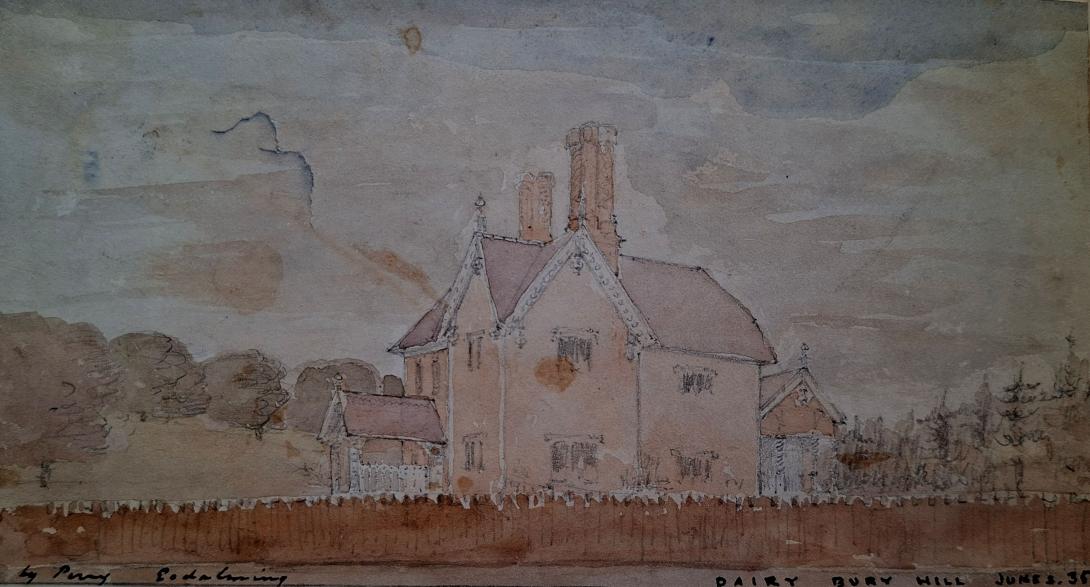
inscribed and dated " by Perry Godalming / DAIRY BURY HILL June 3 35"
Robert Barclay (1751-1830) was born in Philadelphia, where his father had been sent to help with the family export business. At the age of 12 Robert came to school in England and later went in to the family brewing business which was later to become Barclay, Perkins & Co. He married Rachel Gurney and they had 15 children. Rachel died in 1794. Ten years later Robert married Margaret Hodgson. The Barclays were a successful Quaker family and Robert was a wealthy man when he became the owner of Bury Hill. He was a philanthropist and a strong supporter of William Wilberforce in his campaign to end slavery. Closer to home, he set up the Dorking Emigrants’ Scheme and founded schools for the poor; he may have started
the idea of a school in Milton Street. Apart from these interests Robert Barclay was also a renowned botanist. Specimen plants were sent to him from all parts of the world and he built hot-houses to display his collection. He employed an artist to make drawings of his rarities and he had one
of the finest collections of natural history books in the country. The Barclaya species of water-lily was named after him. He also started the collection of trees at Bury Hill. It was these interests that brought changes in the house and grounds. After Robert’s death an obituary in Curtis’s Botanical Magazine describes the changes he made.
The range of hot-houses was extended and ‘Near the mansion, and communicating with it by an arcade, in which stood oranges, lemons etc…was another conservatory’. This is shown in a print c1830 (fig ) which shows a house very different to the earlier
structure. The obituary is at Annex K. Robert was succeeded by his eldest son, Charles (1780-1855). He was an MP and also prominent in the anti-slavery campaign. He ran the brewery from 1812 and after taking over the estate did a great deal to improve the farms. He paid for the new
village school to replace the one in Milton Street, built the vicarage and was one of the main contributors to the costs of the village church. Sadly he died after being thrown from his horse when it was startled by a stag in Milton Street.. Arthur Kett Barclay (1806-1869) was interested in geology and chemistry, but above all he was a keen astronomer and was made FRS for his astronomical work. He had the Bury Hill observatory built to the design of Decimus Burton, who had designed the Palm House at Kew. Apart from his scientific interests Arthur Kett also ran the brewery and was one of the trustees of the Great Exhibition in 1851. The Bury Hill observatory had a 5.9 inch refractor telescope in the tower and a transit instrument in the adjoining transit house. At 400 feet above sea level with clear allround views it was ideally sited. Arthur Kett was paralysed in his final years, but had
a sled made so that footmen could tow him up the steep slope to the observatory each night to make his observations.The observatory remained very much as it was until after the second world war when the instruments were removed. The building gradually fell into decay but was restored
as a house in 1990. The original dome remains a feature of the property.
Richard Suter (1797–1883).
Richard Suter was born in Greenwich, Kent on 30th March 1798, to William Suter and his wife Sarah Knights. On 7th January 1825 he married Anne Ruth Burn.
English architect. As Surveyor to The Fishmongers' Company he designed the severe Presbyterian churches for Ballykelly (1825–7) and Banagher (1825) on the Company's Estate in County Londonderry, drawings of which were exhibited at the Royal Academy in 1827. He was also responsible for the Model Farm (1823–4), the Lancasterian Schools (1828–30), the Company Agent's House (1830–2—now a hotel, much altered), a range of houses on the south side of the main road (1823–4), the lodge in the Presbyterian churchyard (1828), and the Dispensary (1829), all at Ballykelly, and all Classical. As Surveyor to Trinity House Corporation, he designed houses that were erected by Thomas Cubitt in 1821–3 on a site adjoining Trinity House. For The Fishmongers' Company he designed St Peter's Almshouses, Wandsworth, London (1849–51), and The Old School-House, Gresham's School, Holt, Norfolk(1859), in an Elizabethan style.
On the 1841 Census Richard, an architect and lawyer, can be found living in London with his wife Ann (listed as Ruth) and their two children, Richard George and Andrew Burn. Living with them is Edward D Suter. 1851 finds the family living in Tottenham Court in London, by this time Andrew had left the home, but I am unable to trace him on the 1851 Census. In 1860 Andrew marries Amelia Damaris Harrison. Both Richard George and Andrew were to become ordained ministers, with Andrew later becoming a Bishop and emigrating to New Zealand. Sadly in 1854 Anne Ruth was to pass away. In 1861, widowed Richard, Justice of the Peace for Maidenhead, is living at Castle Hill, Maidenhead, Berkshire. In 1862 he married Elizabeth Anne Pocock. In 1871 and 1881 Richard and Elizabeth are still living in Castle Hill. Richard was to pass away on 1st March1883.
Richard Suter & Annesley Voysey, architects, had their office at number 35 Fenchurch Street, but they did not have it all to themselves as they shared the premises with W.C. Franks, a tea broker, who will get a separate post some other time. The earliest mention I found of Richard Suter in Fenchurch Street is in 1832 when he is listed at that address in a list of contributing members of the Society for the Propagation of the Gospel in Foreign Parts. It says that he had been a member since 1829, but that does not mean he was already at 35 Fenchurch Street in that year.(1) In fact, that seems unlikely as the Sun Fire Office records give Messrs. Short and Co., merchants, as paying the insurance premium on the premises in May 1830. The Directory of British Architects 1834-1914 give the year 1827, but I do not know on what evidence. When Suter and Voysey became partners is also uncertain, but they had known each other since at least 1825 as Suter is named as one of the executors of Voysey’s will which was dated 22 July, 1825. The address given for Suter in the will is Suffolk Street, Southwark. Voysey then lives at Conway Street, Fitzroy Square.