
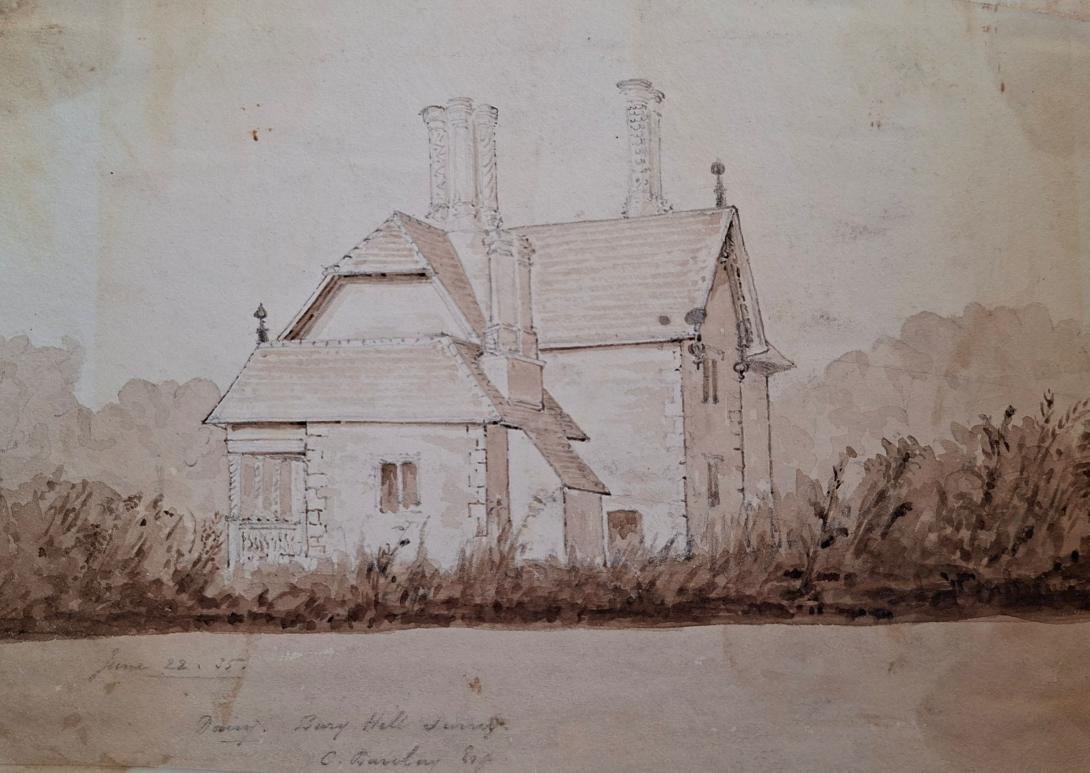
inscribed and dated " June 22 35 Dairy Burry Hill Surrey / C Barclay Esq"
inscribed and dated " June 22 35 Dairy Burry Hill Surrey / C Barclay Esq"
Bury Hill Home Farm When the Bury Hill Estate was offered for sale in 1811 it was known as Berry Hill and comprised 1,983 acres of arable, meadow, pasture and woodland. According to the sales prospectus Berry Hill Farm accounted for the following:
The sale included ‘A Farm House, and Dairy, etc., with Lofts and Chambers over the whole, and Cellars under the Building; in front of which is a Farm Yard, containing a Barn, Pigsties etc.: there is also, another Farm Yard, containing a Barn, Cow-house, and Cattle Stalls’. However, the map that accompanied the sale prospectus does not show any buildings where the Home Farm House is currently located. At that time the farm buildings were situated elsewhere, probably as part of the original Berry Hill House or as part of the estate alongside Milton Street. The farmhouse, barns and yard certainly do appear on the 1838 Tithe Map of the Parish of Dorking (left). The House was erected in 1831 or shortly before as the Bailiff’s Cottage. The design was by John Perry, architect of Godalming, and a full description, detailed specification for its construction and cost details were included in J C Loudon’s ‘Encyclopaedia of Cottage, Farm and Villa Architecture, published in 1833, from which the following details have been taken.
In the mass of detail even the initials of the principal tradesman are provided: ‘S.B.’ Bricklayer; ‘W.G.’ Mason; ‘R.S.’ Carpenter & Joiner; ‘W.B.’ Plumber, Painter & Glazier. Westcott Local History Group 2 Loudon’s Encyclopaedia also included details of the ‘farmery’ that was built in the Old English Style a few yards to the north of the bailiff’s house. The text explains that the design was also by John Perry and was primarily intended for ‘dairy husbandry’.
The accommodation provided for a cattle shed, wagon and implement house with granary over, and pigeon house over that, hay store, calf pens, cow house, slaughter house, swill-cisterns and tanks for holding liquid food, and bins for dry fob for pigs, piggeries, fowl houses.
This drawing is by Charles Duffield Harding, who was commissioned by Charles Barclay in the late 1830s to give his daughters art lessons and to illustrate scenes on the Bury Hill Estate1 After the Estate was bought by the Barclay Family some of the outlying farms were sold but the Home Farm was retained and was detailed as Lot 4 in the sales prospectus when the whole estate was offered at auction on 23 July 1914.
At that time the farm comprised 79 acres and there was a photograph of the Farm House showing remarkable similarity to the drawing made almost 80 years earlier. The Lot also included a flint and tiled roof ‘cottage or lodge’ and a pair of brick and tiled cottages known as ‘Milehouse Cottages’ (Details at Annex A). The property did not sell in 1914 (at which time it was tenanted by Mark Rowe with a lease for 12 years dated from 29 September 1910) but was offered again on 23 July 1952 when Home Farm was Lot 31 and included about 158 acres (Annex B). On this occasion the property was sold – for £4500 to the then occupant Mr K Wightman. The rate of inflation during the 1960s and 1970s is indicated by the fact that when Home Farm was sold on in 1979 the asking price, including The Home Farmhouse, Stable House and what appears to be a new dwelling - Stone House (pictured below), was £300,000.
The occupants of the Home Farm and its associated cottages can be identified from the 19th century census returns. This task has not been completed but the entries for the Home Farm Farmhouse are included in this folder. The Coldharbour lane postcode RH4 3JG now includes Home Farm, Stable House, The Stone House and The Old Cartshed (plus 1 and 2 Brambledown Park Caravan Site) Although many of the architectural features and fittings specified for the Home Farm farmhouse in 1830 have long since disappeared several remain.
Richard Suter (1797–1883).
Richard Suter was born in Greenwich, Kent on 30th March 1798, to William Suter and his wife Sarah Knights. On 7th January 1825 he married Anne Ruth Burn.
English architect. As Surveyor to The Fishmongers' Company he designed the severe Presbyterian churches for Ballykelly (1825–7) and Banagher (1825) on the Company's Estate in County Londonderry, drawings of which were exhibited at the Royal Academy in 1827. He was also responsible for the Model Farm (1823–4), the Lancasterian Schools (1828–30), the Company Agent's House (1830–2—now a hotel, much altered), a range of houses on the south side of the main road (1823–4), the lodge in the Presbyterian churchyard (1828), and the Dispensary (1829), all at Ballykelly, and all Classical. As Surveyor to Trinity House Corporation, he designed houses that were erected by Thomas Cubitt in 1821–3 on a site adjoining Trinity House. For The Fishmongers' Company he designed St Peter's Almshouses, Wandsworth, London (1849–51), and The Old School-House, Gresham's School, Holt, Norfolk(1859), in an Elizabethan style.
On the 1841 Census Richard, an architect and lawyer, can be found living in London with his wife Ann (listed as Ruth) and their two children, Richard George and Andrew Burn. Living with them is Edward D Suter. 1851 finds the family living in Tottenham Court in London, by this time Andrew had left the home, but I am unable to trace him on the 1851 Census. In 1860 Andrew marries Amelia Damaris Harrison. Both Richard George and Andrew were to become ordained ministers, with Andrew later becoming a Bishop and emigrating to New Zealand. Sadly in 1854 Anne Ruth was to pass away. In 1861, widowed Richard, Justice of the Peace for Maidenhead, is living at Castle Hill, Maidenhead, Berkshire. In 1862 he married Elizabeth Anne Pocock. In 1871 and 1881 Richard and Elizabeth are still living in Castle Hill. Richard was to pass away on 1st March1883.
Richard Suter & Annesley Voysey, architects, had their office at number 35 Fenchurch Street, but they did not have it all to themselves as they shared the premises with W.C. Franks, a tea broker, who will get a separate post some other time. The earliest mention I found of Richard Suter in Fenchurch Street is in 1832 when he is listed at that address in a list of contributing members of the Society for the Propagation of the Gospel in Foreign Parts. It says that he had been a member since 1829, but that does not mean he was already at 35 Fenchurch Street in that year.(1) In fact, that seems unlikely as the Sun Fire Office records give Messrs. Short and Co., merchants, as paying the insurance premium on the premises in May 1830. The Directory of British Architects 1834-1914 give the year 1827, but I do not know on what evidence. When Suter and Voysey became partners is also uncertain, but they had known each other since at least 1825 as Suter is named as one of the executors of Voysey’s will which was dated 22 July, 1825. The address given for Suter in the will is Suffolk Street, Southwark. Voysey then lives at Conway Street, Fitzroy Square.