
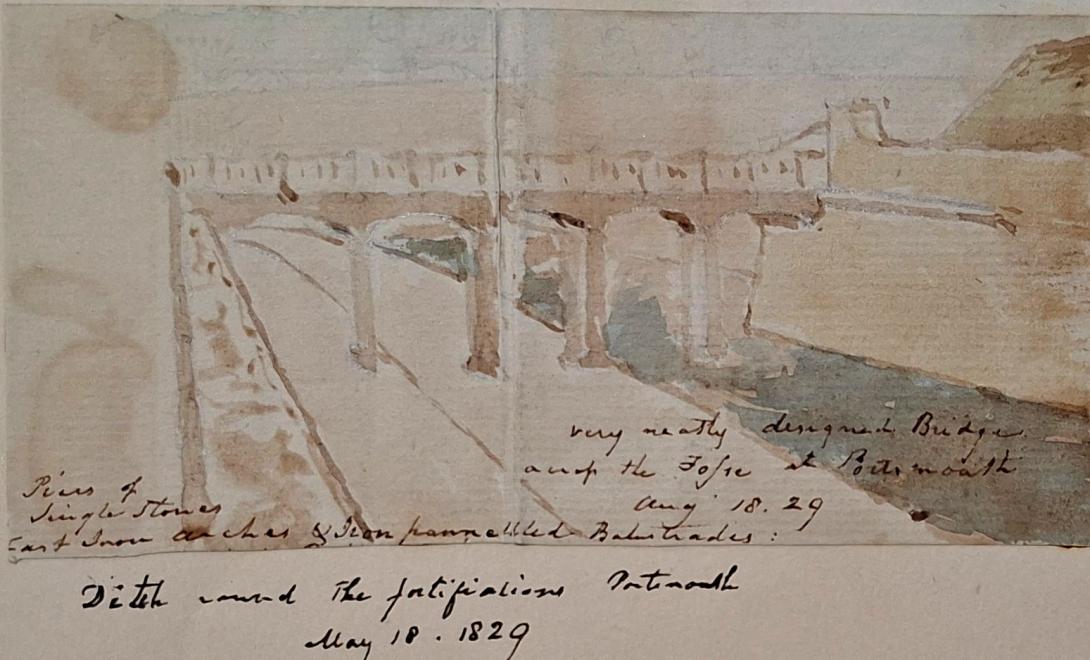
inscreibed and dated " Piers of singular storey cast iron arches and iron panelled ballustrades/ very neatly designed bridge and up the fosse Portsmouth Aug 18 1829 / Ditch around the fortifications Portsmouth May 18 1829"
Fort Nelson, in the civil parish of Boarhunt in the English county of Hampshire, is one of five defensive forts built on the summit of Portsdown Hill in the 1860s, overlooking the important naval base of Portsmouth and is a Grade I Listed Building. The current tenant is the Royal Armouries, housing the artillery of the national collection of arms and armour.
Description
Fort Nelson is a typical Polygonal or Palmerston Fort. It is six-sided with a deep ditch protected by three caponiers. Above each caponier is a well-protected emplacement for 13-inch mortars. It was originally entered by two Guthrie rolling bridges and has a barrack block for 172 officers and other ranks, protected by a V-shaped redan. A large open parade ground gives access to the magazines 40 feet underneath it. There are open emplacements on the ramparts for 64 pounder rifled muzzle-loading guns and RML 6.6-inch howitzers. There are also three Haxo casemates for 7 inch rifled breech-loaders.
The Nelson Monument, which gave the fort its name, stands adjacent.
History
Fort Nelson is one of five Portsdown Forts. Built as a result of the 1859 Royal Commission by Lord Palmerston to prevent a French land attack on the Portsmouth dockyard only 8 kilometres away, because the older Hilsea Lines at the bottom of the ridge were considered insufficient. A series of 6 forts were built along the 7 miles (10 km) of the ridge. From west to east they are forts Fareham, Wallington, Nelson, Southwick, Widley and Purbrook. The line was finished off at the eastern end with Crookhorn Redoubt and Farlington Redoubt. A garrison of around 200 volunteers accompanied by regular army officers would have staffed the fort in time of war. Construction was protracted and Fort Nelson was not fully armed until the 1890s. The fort was disarmed in 1907 and then used for accommodation. In 1938, it was converted to an area anti-aircraft ammunition store; ten large magazines were built on the parade ground. Fort Nelson was abandoned in the 1950s.

Royal Armouries


In 1979, after years of neglect and vandalism, it was sold to Hampshire County Council[5] for £50,000. The Council, with assistance of volunteers from the Palmerston Forts Society, restored it at a cost of £3–4 million, and it opened to the public in 1994, becoming part of the Royal Armouries in 1995. It houses their collection of artillery, including:
- The 'Boxted Bombard', an English wrought iron cannon from around 1450, which was powerful enough to fire a 60 kg granite ball
- The 'Dardanelles Gun', an Ottoman bronze cannon from 1464 which was powerful enough to fire stone balls with a diameter of 63 cm
- French field guns captured at the Battle of Waterloo
- Fortress guns from India and China.
- Parts of the famous Iraqi 'Project Babylon' Gulf War-era supergun.
- One of the two Mallet's Mortars.
- Several SBBL 32 pounders
The fort covers around 19 acres (77,000 m2) and is open all year round, with no charges except for some special events. Live firing demonstrations are held every day, costumed guides, video presentations, and visitors are able to explore the tunnels that run below the fort connecting the magazines with gun emplacements. There are displays demonstrating the living and working conditions of the soldiers who defended the fort, and views over Portsmouth, the Solent, Hayling Island and Gosport, with the Isle of Wight beyond.
Richard Suter (1797–1883).
Richard Suter was born in Greenwich, Kent on 30th March 1798, to William Suter and his wife Sarah Knights. On 7th January 1825 he married Anne Ruth Burn.
English architect. As Surveyor to The Fishmongers' Company he designed the severe Presbyterian churches for Ballykelly (1825–7) and Banagher (1825) on the Company's Estate in County Londonderry, drawings of which were exhibited at the Royal Academy in 1827. He was also responsible for the Model Farm (1823–4), the Lancasterian Schools (1828–30), the Company Agent's House (1830–2—now a hotel, much altered), a range of houses on the south side of the main road (1823–4), the lodge in the Presbyterian churchyard (1828), and the Dispensary (1829), all at Ballykelly, and all Classical. As Surveyor to Trinity House Corporation, he designed houses that were erected by Thomas Cubitt in 1821–3 on a site adjoining Trinity House. For The Fishmongers' Company he designed St Peter's Almshouses, Wandsworth, London (1849–51), and The Old School-House, Gresham's School, Holt, Norfolk(1859), in an Elizabethan style.
On the 1841 Census Richard, an architect and lawyer, can be found living in London with his wife Ann (listed as Ruth) and their two children, Richard George and Andrew Burn. Living with them is Edward D Suter. 1851 finds the family living in Tottenham Court in London, by this time Andrew had left the home, but I am unable to trace him on the 1851 Census. In 1860 Andrew marries Amelia Damaris Harrison. Both Richard George and Andrew were to become ordained ministers, with Andrew later becoming a Bishop and emigrating to New Zealand. Sadly in 1854 Anne Ruth was to pass away. In 1861, widowed Richard, Justice of the Peace for Maidenhead, is living at Castle Hill, Maidenhead, Berkshire. In 1862 he married Elizabeth Anne Pocock. In 1871 and 1881 Richard and Elizabeth are still living in Castle Hill. Richard was to pass away on 1st March1883.
Richard Suter & Annesley Voysey, architects, had their office at number 35 Fenchurch Street, but they did not have it all to themselves as they shared the premises with W.C. Franks, a tea broker, who will get a separate post some other time. The earliest mention I found of Richard Suter in Fenchurch Street is in 1832 when he is listed at that address in a list of contributing members of the Society for the Propagation of the Gospel in Foreign Parts. It says that he had been a member since 1829, but that does not mean he was already at 35 Fenchurch Street in that year.(1) In fact, that seems unlikely as the Sun Fire Office records give Messrs. Short and Co., merchants, as paying the insurance premium on the premises in May 1830. The Directory of British Architects 1834-1914 give the year 1827, but I do not know on what evidence. When Suter and Voysey became partners is also uncertain, but they had known each other since at least 1825 as Suter is named as one of the executors of Voysey’s will which was dated 22 July, 1825. The address given for Suter in the will is Suffolk Street, Southwark. Voysey then lives at Conway Street, Fitzroy Square.