
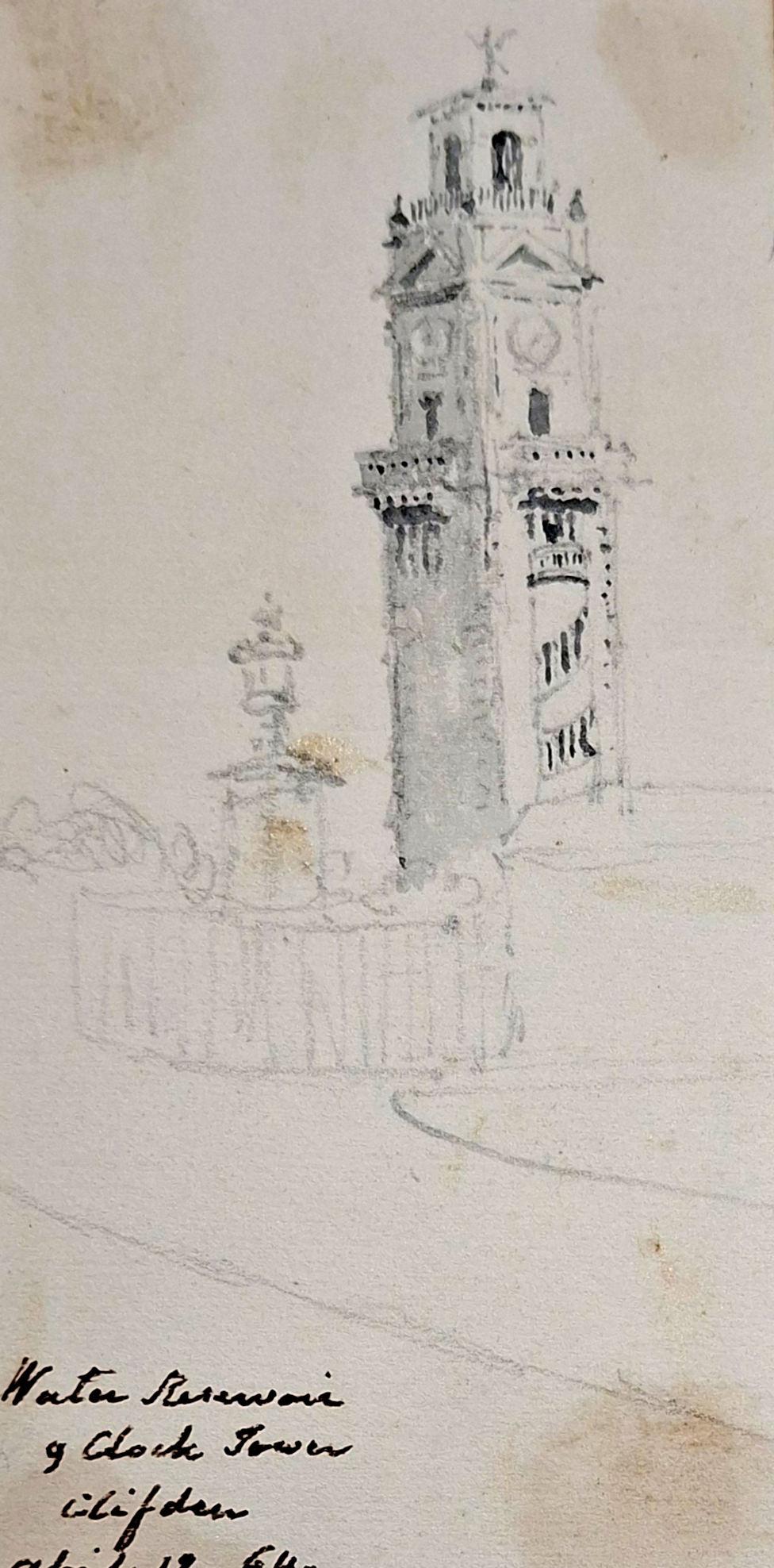
Water Reservoir Clock Tower Cliveden & April 12 1864
The Cliveden Clock Tower which is a disguised water tower originally providing for the entire Victorian three story mansion. It holds 17, 000 gallons of water. Water tower design by Henry Clutton & topped by the sculpture Spirit of Liberty mimicking that in the Place de la Bastille. Mansion architect Charles Barry & built by Lucas Brothers circa 1851.
The nearby 100-foot (30 m) clock tower was added in 1861 and is the work of the architect Henry Clutton. As a functioning water tower, it still provides water for the house today. It is rendered in Roman cement like the rest of the house, and it features four clock faces framed by gilded surrounds and a half-open staircase on its north side. It was described by the architectural critic Nikolaus Pevsner as "the epitome of Victorian flamboyance and assertiveness."
The tower is topped with a modern reproduction of Augustin Dumont's 19th-century winged male figure Le Génie de la Liberté (the Spirit of Liberty). The original is atop the July Column in the Place de la Bastille, Paris. This replaces two earlier versions, the first having fallen from the tower during a storm in the 1950s. The new statue is made of bronze and was created using Dumont's original mould from the 1860s found in a museum in Semur-en-Auxois, France. It measures 2.2 m in height, is covered in two layers of 23.5 carat gold leaf and cost a total of £68,000. It is an allegorical sculpture which holds the torch of civilization in its right hand and the broken chain of slavery in its left. It was affixed to the tower in the spring of 2012.
Cliveden is an English country house and estate in the care of the National Trust in Buckinghamshire, on the border with Berkshire. The Italianate mansion, also known as Cliveden House, crowns an outlying ridge of the Chiltern Hills close to the South Bucks villages of Taplow and Burnham. The main house sits 40 metres (130 ft) above the banks of the River Thames, and its grounds slope down to the river. There have been three houses on this site. The first was built in 1666 and burned down in 1795, while the second house was constructed around 1824 and was also destroyed by fire, in 1849. The present Grade I listed house was built in 1851 by the architect Charles Barry for the 2nd Duke of Sutherland.
Cliveden has been the home to a Prince of Wales, two dukes, an earl, and finally the Viscounts Astor. As the home of Nancy Astor, wife of the 2nd Viscount Astor, Cliveden was the meeting place during the 1920s and 1930s of the Cliveden Set, a group of political intellectuals. Later, during the early 1960s, when it was the home of the 3rd Viscount Astor, it became the setting for key events of the notorious Profumo affair. After the Astor family stopped living there, by the 1970s, it was leased to Stanford University, which used it as an overseas campus. It is now leased to a company that runs it as a luxury hotel.
The 375-acre (152 ha) gardens and woodlands are open to the public, together with parts of the house on certain days. Cliveden has been one of the National Trust's most popular pay-for-entry visitor attractions, hosting 524,807 visitors in 2019.
Cliveden means "valley among cliffs" and refers to the dene (valley) which cuts through part of the estate, east of the house. Cliveden has been spelled differently over the centuries, some of the variations being Cliffden, Clifden, Cliefden, and Clyveden.
Present house

Designed by Charles Barry in 1851 to replace a house previously destroyed by fire, the present house is a blend of the English Palladian style and the Roman Cinquecento.The Victorian three-storey mansion sits on a 400-foot (120 m) long, 20-foot (6.1 m) high brick terrace or viewing platform (visible only from the south side) which dates from the mid-17th century. The exterior of the house is rendered in Roman cement, with terracotta additions such as balusters, capitals, keystones, and finials. The roof of the mansion is meant for walking on, and there is a circular view, above the tree-line, of parts of Buckinghamshire and Berkshire including Windsor Castle to the south.:
Below the balustraded roofline is a Latin inscription which continues around the four sides of the house and recalls its history; it was composed by the then prime minister William Ewart Gladstone. On the west front, it reads: POSITA INGENIO OPERA CONSILIO CAROLI BARRY ARCHIT A MDCCCLI, which translated reads: "The work accomplished by the brilliant plan of architect Charles Barry in 1851."Continuing clockwise, text on the other fronts translates as: "Constructed upon foundations laid long before by George Villiers Duke of Buckingham in Charles the Second's reign", "Completed in the year of Our Lord 1851 when Victoria had been Queen by God's grace for fourteen years" and "Restored by George Duke of Sutherland and Harriet his wife on the site where two houses had previously been burnt down". The main contractor for the work was Lucas Brothers.
In 1984–86, the exterior of the mansion was overhauled and a new lead roof was installed by the National Trust, while interior repairs were carried out by Cliveden Hotel. In 2013, further exterior work was carried out including the restoration of 300 sash windows and 20 timber doors.
Richard Suter was born in Greenwich, Kent on 30th March 1798, to William Suter and his wife Sarah Knights. On 7th January 1825 he married Anne Ruth Burn.
English architect. As Surveyor to The Fishmongers' Company he designed the severe Presbyterian churches for Ballykelly (1825–7) and Banagher (1825) on the Company's Estate in County Londonderry, drawings of which were exhibited at the Royal Academy in 1827. He was also responsible for the Model Farm (1823–4), the Lancasterian Schools (1828–30), the Company Agent's House (1830–2—now a hotel, much altered), a range of houses on the south side of the main road (1823–4), the lodge in the Presbyterian churchyard (1828), and the Dispensary (1829), all at Ballykelly, and all Classical. As Surveyor to Trinity House Corporation, he designed houses that were erected by Thomas Cubitt in 1821–3 on a site adjoining Trinity House. For The Fishmongers' Company he designed St Peter's Almshouses, Wandsworth, London (1849–51), and The Old School-House, Gresham's School, Holt, Norfolk(1859), in an Elizabethan style.
On the 1841 Census Richard, an architect and lawyer, can be found living in London with his wife Ann (listed as Ruth) and their two children, Richard George and Andrew Burn. Living with them is Edward D Suter. 1851 finds the family living in Tottenham Court in London, by this time Andrew had left the home, but I am unable to trace him on the 1851 Census. In 1860 Andrew marries Amelia Damaris Harrison. Both Richard George and Andrew were to become ordained ministers, with Andrew later becoming a Bishop and emigrating to New Zealand. Sadly in 1854 Anne Ruth was to pass away. In 1861, widowed Richard, Justice of the Peace for Maidenhead, is living at Castle Hill, Maidenhead, Berkshire. In 1862 he married Elizabeth Anne Pocock. In 1871 and 1881 Richard and Elizabeth are still living in Castle Hill. Richard was to pass away on 1st March1883.
Richard Suter & Annesley Voysey, architects, had their office at number 35 Fenchurch Street, but they did not have it all to themselves as they shared the premises with W.C. Franks, a tea broker, who will get a separate post some other time. The earliest mention I found of Richard Suter in Fenchurch Street is in 1832 when he is listed at that address in a list of contributing members of the Society for the Propagation of the Gospel in Foreign Parts. It says that he had been a member since 1829, but that does not mean he was already at 35 Fenchurch Street in that year.(1) In fact, that seems unlikely as the Sun Fire Office records give Messrs. Short and Co., merchants, as paying the insurance premium on the premises in May 1830. The Directory of British Architects 1834-1914 give the year 1827, but I do not know on what evidence. When Suter and Voysey became partners is also uncertain, but they had known each other since at least 1825 as Suter is named as one of the executors of Voysey’s will which was dated 22 July, 1825. The address given for Suter in the will is Suffolk Street, Southwark. Voysey then lives at Conway Street, Fitzroy Square.