
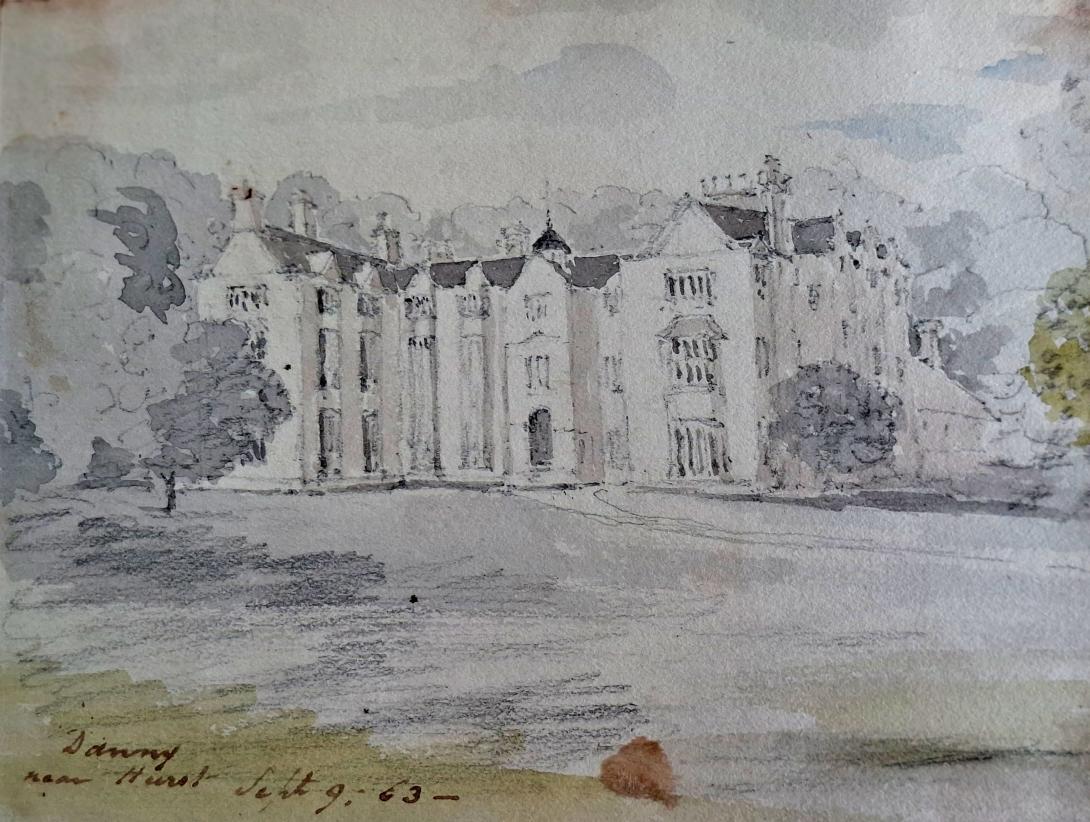
inscribed and dated " Danny/ near Hurst/ Sept 9 63"
Danny House is a Grade I listed Elizabethan red brick mansion near Hurstpierpoint in West Sussex, England. It lies at the northern foot of Wolstonbury Hill and may be regarded as one of the finest stately houses in Sussex, with 56 bedrooms and 28 apartments. The present house was built 1593–95 by George Goring, on the site of an older house. It is set in eight acres (32,000 m2) of gardens at the foot of the South Downs within an historic parkland of some 400 acres, which was granted by royal charter in 1333.
History


Pre-Roman
The outline of a Bronze Age enclosure exists above Danny House on the top of nearby Wolstonbury Hill (now owned by the National Trust and within the South Downs National Park). On the west side of Wolstonbury there is a large artificial plateau thought to be the site of an Iron Age camp.
Roman times
The Sussex Greensand Way Roman road passed through the site of Danny Park in an east–west direction, making an alignment change on the hill to the north of the house. The road survives as a terrace on the shoulder of the hill, a hollow way leading down the hill and a raised strip leading to the stream. A Roman pottery kiln has been found south of the road.
Domesday Book
The Domesday Book of 1086 recorded that “Robert holds Herst of William”. The Robert to whom the inquest referred was Robert de Pierpoint with the entry indicating that the de Pierpoint held the land of Herst, today known as Hurstpierpoint, from William de Warenne. de Warenne was a son-in-law of William the Conqueror.
13th and 14th centuries
As they had done in the 11th century, the de Pierpoint continued to hold Danny. A house has existed on the site since the 13th century, but it likely that it was little more than a hunting-lodge at this time.
It is from the 14th century that the oldest-known documentary evidence for the manor's name dates. In the first half of that century a licence was granted to Sir Simon de Pierpoint by William de Warenne to enclose “the wood at Daneghithe” Showing flexibility in the spelling of the manor's name, in 1343 another licence was granted to Sir Simon de Pierpoint, this time by John de Warenne, 4th Earl of Surrey, to enclose “the wood at Danye and the demesne lands bounding the wood”.
Danny Old One
It is in this period that the oak known as Danny Old One will have first seeded itself. It is perhaps oldest oak tree in the Sussex Weald. Her girth is 32.5 feet (9.9 metres). The oak is now so old that if you were to visit her as David Bangs puts it, "You will be visiting a being that grew up with the Saxon talk of the woodsmen and parkers who walked beneath her, and the old Norman-French of the medieval Pierpont lords, who rode by".
Late 16th century
The house in its present form dates from the early sixteenth century but was reconstructed and enlarged by George Goring in 1593, after he had purchased the estate in 1582. It was designed in the shape of the letter E to represent the Queen (Elizabeth I of England) who had been on the throne for over 30 years at the commencement of the reconstruction work. The house represents a fine example of Elizabethan architecture.
The current house has two main fronts, the east 16th century, the south early Georgian. The brick-built east frontage is monumental, the south front stately, the whole building a prominent element in views from the downs. It stands to three storeys.
Mid 17th century
After four generations of Gorings, Danny was sold to Peter Courthope in 1650. In 1652 Danny Great Park was 54 hectares (130 acres) with arable land and meadow amounting to about 170 hectares (420 acres).
In 1702, Barbara Courthope married Henry Campion, and in 1725 they made Danny their home, and soon undertook extensive alterations, including the re-fronting of the south side of the house as is confirmed by the date 1728 and their initials on the leaden water-pipes. Several generations of Campions followed.
The world’s earliest cricket ground
Cricket is recorded in the Thomas Marchant's diaries as having been played at Sand Field, Danny Park in 1717. This makes Sand Field the earliest identifiable cricket ground in the world. In July 2017, the tri-centenary of the occasion was celebrated by a match played between Danny House and Hurstpierpoint Cricket Club.
War Cabinet
During World War I, Lord Riddle rented out Danny House for four months to Prime Minister David Lloyd George, where he lived here in a ménage à trois with his wife Margaret and his secretary and mistress Frances Stevenson.[5] Regular meetings of the Imperial War Cabinet were held in the Great Hall, where on 13 October 1918 terms of the armistice to be offered to Germany at the end of the Great War were decided, and authority was given to US President Woodrow Wilson to negotiate the armistice.
There were some letters, written at Danny, from Lloyd George to Frances Stevenson, one of which read:
"My darling Pussy. You might phone from the Treasury on Friday if you can come. Don't let Hankey see you. If Saturday impossible, what about Monday? Fondest love to my own."
D. (Hankey was then Cabinet Secretary).
Recent history

Soon after the war Danny House became a school, firstly known as Montpelier College and then Wolstonbury College, which had been transferred from Brighton, but this closed down in 1956. Although the Campion family were no longer residing in the house, the estate continued in the ownership of the Campions until the 1980s when the estate was broken up and the various land holdings, houses and farms were sold to tenants or into private hands. The house was then bought by Mutual Households Association (later the Country Houses Association). After the CHA went into liquidation in 2003, the house was bought by a private purchaser in 2004. In 2007, Danny House celebrated 50 years as a retirement home.
Richard Suter (1797–1883).
Richard Suter was born in Greenwich, Kent on 30th March 1798, to William Suter and his wife Sarah Knights. On 7th January 1825 he married Anne Ruth Burn.
English architect. As Surveyor to The Fishmongers' Company he designed the severe Presbyterian churches for Ballykelly (1825–7) and Banagher (1825) on the Company's Estate in County Londonderry, drawings of which were exhibited at the Royal Academy in 1827. He was also responsible for the Model Farm (1823–4), the Lancasterian Schools (1828–30), the Company Agent's House (1830–2—now a hotel, much altered), a range of houses on the south side of the main road (1823–4), the lodge in the Presbyterian churchyard (1828), and the Dispensary (1829), all at Ballykelly, and all Classical. As Surveyor to Trinity House Corporation, he designed houses that were erected by Thomas Cubitt in 1821–3 on a site adjoining Trinity House. For The Fishmongers' Company he designed St Peter's Almshouses, Wandsworth, London (1849–51), and The Old School-House, Gresham's School, Holt, Norfolk(1859), in an Elizabethan style.
On the 1841 Census Richard, an architect and lawyer, can be found living in London with his wife Ann (listed as Ruth) and their two children, Richard George and Andrew Burn. Living with them is Edward D Suter. 1851 finds the family living in Tottenham Court in London, by this time Andrew had left the home, but I am unable to trace him on the 1851 Census. In 1860 Andrew marries Amelia Damaris Harrison. Both Richard George and Andrew were to become ordained ministers, with Andrew later becoming a Bishop and emigrating to New Zealand. Sadly in 1854 Anne Ruth was to pass away. In 1861, widowed Richard, Justice of the Peace for Maidenhead, is living at Castle Hill, Maidenhead, Berkshire. In 1862 he married Elizabeth Anne Pocock. In 1871 and 1881 Richard and Elizabeth are still living in Castle Hill. Richard was to pass away on 1st March1883.
Richard Suter & Annesley Voysey, architects, had their office at number 35 Fenchurch Street, but they did not have it all to themselves as they shared the premises with W.C. Franks, a tea broker, who will get a separate post some other time. The earliest mention I found of Richard Suter in Fenchurch Street is in 1832 when he is listed at that address in a list of contributing members of the Society for the Propagation of the Gospel in Foreign Parts. It says that he had been a member since 1829, but that does not mean he was already at 35 Fenchurch Street in that year.(1) In fact, that seems unlikely as the Sun Fire Office records give Messrs. Short and Co., merchants, as paying the insurance premium on the premises in May 1830. The Directory of British Architects 1834-1914 give the year 1827, but I do not know on what evidence. When Suter and Voysey became partners is also uncertain, but they had known each other since at least 1825 as Suter is named as one of the executors of Voysey’s will which was dated 22 July, 1825. The address given for Suter in the will is Suffolk Street, Southwark. Voysey then lives at Conway Street, Fitzroy Square.