
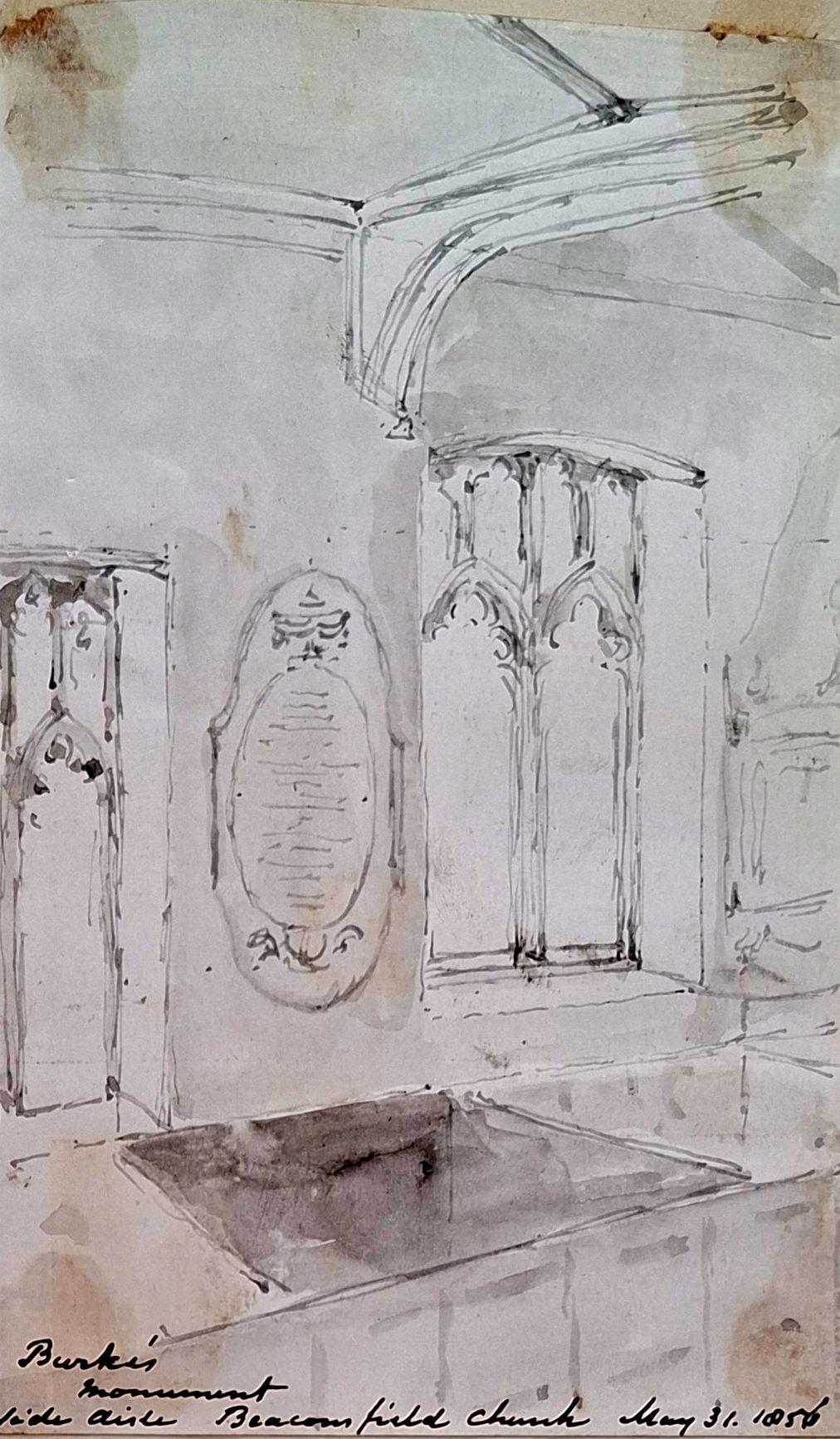
Burke's Monument Side Aisle Beaconsfield Church May 31 1856
"Edmund Burke, patriot, orator, statesman, lived at Butler's Court, formerly Gregories, in this parish, from 1769 to 1797. This memorial, placed here by public subscription, records the undying honor in which his name is held,"
Floor slab inscription:-
Within the/ vault beneath, in a wooden coffin, lie the remains of/ the Right Honourable/ EDMUND BURKE/ This brass has been placed in/ the year of our Lord & Saviour 1862/ (under the auspices of the Rev. John Gould/ B.D. Rector of Beaconsfield) by/ Edmund Haviland Burke, Esq./ Great-grand-nephew and representative of Edmund Burke/ and by/ Sir Ulysses de Burgh G.C.B., Lord Downes;/ Sir Bernard Burke, Ulster-King-at-Arms;/ Peter Burke Serjeant-at-Law/ Joseph Burke, Esq. of Elm Hall Co. Tipperary;/ Richard Bourke (sic) Esq. of Thornfields, Co. Limerick; and the/ Rev. Michael Burke of Ballydugan Co. Galway,/ their object being/ to mark the grave of the greatest of their name
Writer, Politician. He was born into a prominent family. He is regarded as one of the most prominent philosophers and political writers of the 18th century. He received an education from Trinity College in Dublin in 1748. While in college he was very active and established the Edmund Burke debate club, which eventually formed the College Historical Society. He began his literary career in 1756 and published "A Vindication of Natural Society: A View of the Miseries and Evils Arising to Mankind." The following year, he published "A Philosophical Enquiry into the Origin of Our Ideas of the Sublime and Beautiful" which was well received and widely read. Such was the popularity of his work that it caught the attention of prominent Enlightenment figures such as Denis Diderot and Immanuel Kant. In 1758, he founded the "Annual Registar" and published numerous political articles. In 1766, he was elected a member of Parliament. In 1769, he published "Observations on a Late State of the Nation." During this time, he became associated with numerous intellectual figures such as Samuel Johnson, David Garrick, Oliver Goldsmith, Joshua Reynolds, and Edward Gibbon. In 1770, he published "Thoughts on the Cause of the Present Discontents." His other works included "On American Taxation" (1774) and "Reflections on the Revolution in France" (1790). After a long and very successful career, he died in 1797.
Richard Suter was born in Greenwich, Kent on 30th March 1798, to William Suter and his wife Sarah Knights. On 7th January 1825 he married Anne Ruth Burn.
English architect. As Surveyor to The Fishmongers' Company he designed the severe Presbyterian churches for Ballykelly (1825–7) and Banagher (1825) on the Company's Estate in County Londonderry, drawings of which were exhibited at the Royal Academy in 1827. He was also responsible for the Model Farm (1823–4), the Lancasterian Schools (1828–30), the Company Agent's House (1830–2—now a hotel, much altered), a range of houses on the south side of the main road (1823–4), the lodge in the Presbyterian churchyard (1828), and the Dispensary (1829), all at Ballykelly, and all Classical. As Surveyor to Trinity House Corporation, he designed houses that were erected by Thomas Cubitt in 1821–3 on a site adjoining Trinity House. For The Fishmongers' Company he designed St Peter's Almshouses, Wandsworth, London (1849–51), and The Old School-House, Gresham's School, Holt, Norfolk(1859), in an Elizabethan style.
On the 1841 Census Richard, an architect and lawyer, can be found living in London with his wife Ann (listed as Ruth) and their two children, Richard George and Andrew Burn. Living with them is Edward D Suter. 1851 finds the family living in Tottenham Court in London, by this time Andrew had left the home, but I am unable to trace him on the 1851 Census. In 1860 Andrew marries Amelia Damaris Harrison. Both Richard George and Andrew were to become ordained ministers, with Andrew later becoming a Bishop and emigrating to New Zealand. Sadly in 1854 Anne Ruth was to pass away. In 1861, widowed Richard, Justice of the Peace for Maidenhead, is living at Castle Hill, Maidenhead, Berkshire. In 1862 he married Elizabeth Anne Pocock. In 1871 and 1881 Richard and Elizabeth are still living in Castle Hill. Richard was to pass away on 1st March1883.
Richard Suter & Annesley Voysey, architects, had their office at number 35 Fenchurch Street, but they did not have it all to themselves as they shared the premises with W.C. Franks, a tea broker, who will get a separate post some other time. The earliest mention I found of Richard Suter in Fenchurch Street is in 1832 when he is listed at that address in a list of contributing members of the Society for the Propagation of the Gospel in Foreign Parts. It says that he had been a member since 1829, but that does not mean he was already at 35 Fenchurch Street in that year.(1) In fact, that seems unlikely as the Sun Fire Office records give Messrs. Short and Co., merchants, as paying the insurance premium on the premises in May 1830. The Directory of British Architects 1834-1914 give the year 1827, but I do not know on what evidence. When Suter and Voysey became partners is also uncertain, but they had known each other since at least 1825 as Suter is named as one of the executors of Voysey’s will which was dated 22 July, 1825. The address given for Suter in the will is Suffolk Street, Southwark. Voysey then lives at Conway Street, Fitzroy Square.