
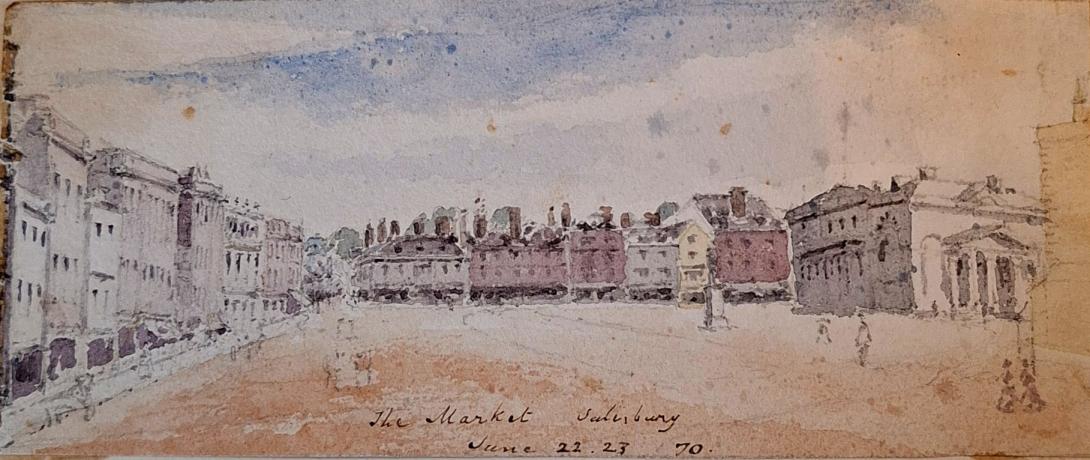
inscribed " Great Square or Market Salisbury June 23 1870
Salisbury’s Market Square and Guildhall-the historic heart of the city. For centuries, this place has buzzed with life, hosting markets every week since the Middle Ages. When you wander through here, you’re treading the same ground as medieval merchants, Victorian traders, and the modern-day locals who come to buy everything from fresh produce to unique crafts.
Back in 1361, Tuesdays and Saturdays became official market days. And just like now, you could get almost anything. Each type of good even had its own street name: Fish Row, Silver Street, Oatmeal Row, Ox Row, Butchers Row. It was a medieval shopping mall before shopping malls existed.
At the square’s northern end stands the Guildhall, a stately Georgian structure completed in 1795. With its neoclassical facade and six grand Doric columns, this building has been the backdrop for civic ceremonies, elegant banquets, and lively public meetings for over two centuries. Inside, you’ll find richly paneled rooms, intricate plaster ceilings, and portraits that tell the city’s story through the ages. Notable visitors have included King George III, Lord Nelson, Princess Diana, and Queen Elizabeth II.
These days, the Guildhall still serves as a hub for local government but also hosts exhibitions, concerts, and community events. Make sure to spot the historic coat of arms on the facade and step inside to marvel at the grand staircase and elegant interior. If you’re lucky, you might even catch a special event or artisan fair happening right in the square.
The Market Place (or Market Square) in Salisbury has been the historic commercial heart of the city since the Middle Ages, with markets held there regularly since a charter was granted in 1227. The area is known for several historic features rather than a single "Great Market Square" Wikipedia page. Key historical and architectural elements of the Market Place include: The Guildhall A stately Georgian municipal building completed in 1795, designed by Sir Robert Taylor and William Pilkington. It stands at the northern end of the square and is the current meeting place for Salisbury City Council. The Poultry Cross The only one of four medieval market crosses that remains in Salisbury. Located at the junction of Silver Street and Minster Street, it originally marked the area for the poultry, fruit, and vegetable markets. The current stone structure dates to the 14th century, with its distinctive flying buttresses added during 19th-century restorations. Former Market Crosses In the 15th century, Salisbury had four market crosses, each designating a specific market area: the Poultry Cross, the Cheese Cross, a cross for wool and yarn, and Barnard's Cross for livestock. The Corn Exchange Formerly known as the Market Hall, this 19th-century commercial building is also located in the Market Place and now accommodates a small shopping mall, public library, and art gallery
Richard Suter was born in Greenwich, Kent on 30th March 1798, to William Suter and his wife Sarah Knights. On 7th January 1825 he married Anne Ruth Burn.
English architect. As Surveyor to The Fishmongers' Company he designed the severe Presbyterian churches for Ballykelly (1825–7) and Banagher (1825) on the Company's Estate in County Londonderry, drawings of which were exhibited at the Royal Academy in 1827. He was also responsible for the Model Farm (1823–4), the Lancasterian Schools (1828–30), the Company Agent's House (1830–2—now a hotel, much altered), a range of houses on the south side of the main road (1823–4), the lodge in the Presbyterian churchyard (1828), and the Dispensary (1829), all at Ballykelly, and all Classical. As Surveyor to Trinity House Corporation, he designed houses that were erected by Thomas Cubitt in 1821–3 on a site adjoining Trinity House. For The Fishmongers' Company he designed St Peter's Almshouses, Wandsworth, London (1849–51), and The Old School-House, Gresham's School, Holt, Norfolk(1859), in an Elizabethan style.
On the 1841 Census Richard, an architect and lawyer, can be found living in London with his wife Ann (listed as Ruth) and their two children, Richard George and Andrew Burn. Living with them is Edward D Suter. 1851 finds the family living in Tottenham Court in London, by this time Andrew had left the home, but I am unable to trace him on the 1851 Census. In 1860 Andrew marries Amelia Damaris Harrison. Both Richard George and Andrew were to become ordained ministers, with Andrew later becoming a Bishop and emigrating to New Zealand. Sadly in 1854 Anne Ruth was to pass away. In 1861, widowed Richard, Justice of the Peace for Maidenhead, is living at Castle Hill, Maidenhead, Berkshire. In 1862 he married Elizabeth Anne Pocock. In 1871 and 1881 Richard and Elizabeth are still living in Castle Hill. Richard was to pass away on 1st March1883.
Richard Suter & Annesley Voysey, architects, had their office at number 35 Fenchurch Street, but they did not have it all to themselves as they shared the premises with W.C. Franks, a tea broker, who will get a separate post some other time. The earliest mention I found of Richard Suter in Fenchurch Street is in 1832 when he is listed at that address in a list of contributing members of the Society for the Propagation of the Gospel in Foreign Parts. It says that he had been a member since 1829, but that does not mean he was already at 35 Fenchurch Street in that year.(1) In fact, that seems unlikely as the Sun Fire Office records give Messrs. Short and Co., merchants, as paying the insurance premium on the premises in May 1830. The Directory of British Architects 1834-1914 give the year 1827, but I do not know on what evidence. When Suter and Voysey became partners is also uncertain, but they had known each other since at least 1825 as Suter is named as one of the executors of Voysey’s will which was dated 22 July, 1825. The address given for Suter in the will is Suffolk Street, Southwark. Voysey then lives at Conway Street, Fitzroy Square.