
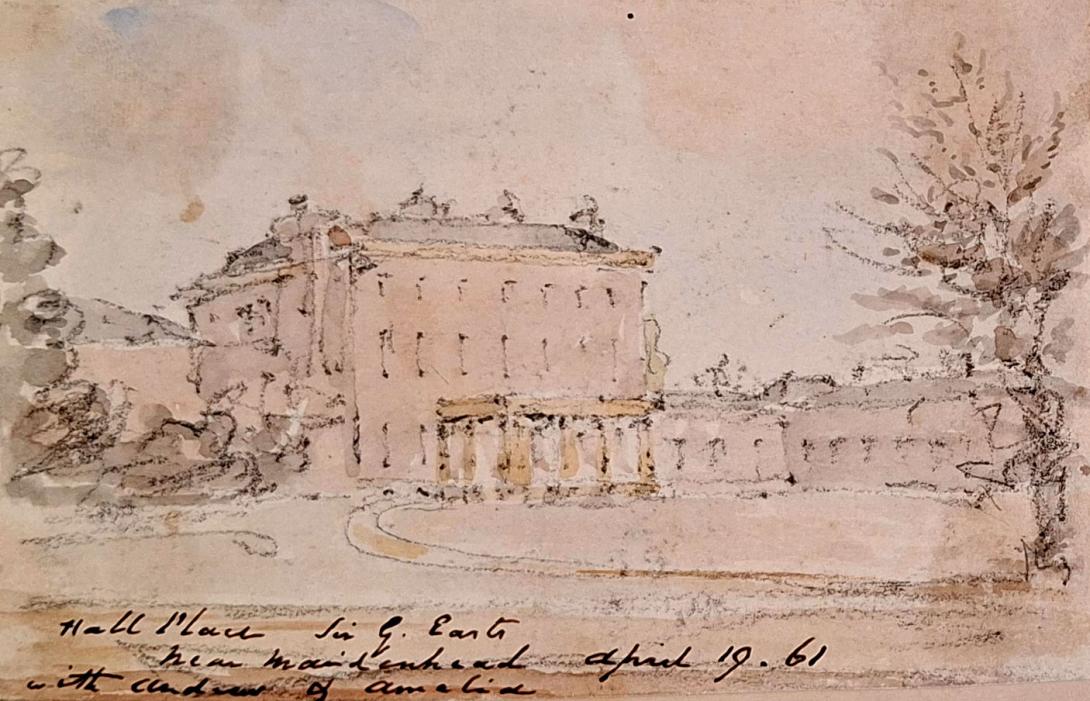
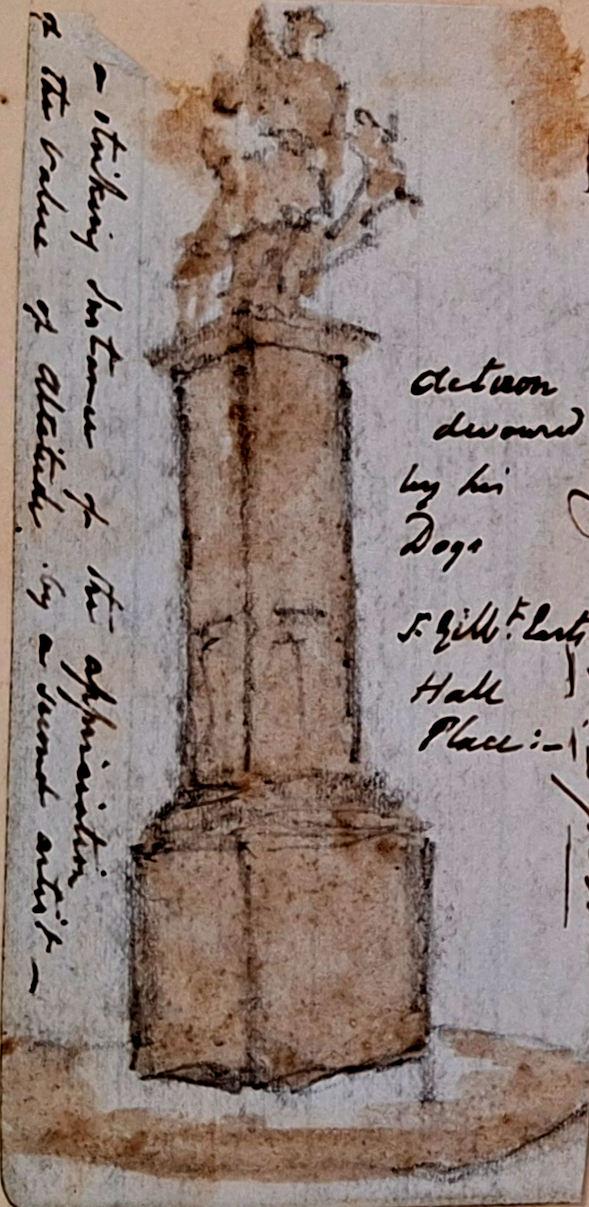
Hall Place Sir Gilbert East near Maidenhead April 19 1861 with Clendover of Amelia and Acteon devoured by his Dogs S Gilbert Easts Hall Place…..
Large country house in parkland, now the Berkshire College of Agriculture. Built 1728-1735 for William East, on the site of a late C17 house of which only a small part remains in the south wing. Altered and extended mid to late C20. Brick, stone dressings, slate hipped roofs of different heights. Symmetrical plan with nearly square centre section and balancing wings projecting forward on each side. Centre section 3 storeys and basement, one-storey blocks with basements link the 2-storey wings to the centre section. Entrance, east front: centre section: stone string at ground floor, stone blocking course, frieze and moulded cornice forming parapet on all 4 sides, breaking out over pilasters at the angles. End chimneys. 7 bays. Sash windows with glazing bars, shorter on 2nd floor, in reveals, stone cills, gauged arches with keystones. Entrance: large double-doors, now part glazed; door-case with panelled pilasters, leaf and scroll capitals, and moulded cornice and pediment; approached by a flight of 7 stone steps with stone base balustrade and coping each side. Linking blocks: stone string running through with string on centre section. Plain stone frieze below panelled brick parapet. 3 bays. Similar windows to centre section. Wings: stone string midway between ground and first floor, 6-bay return fronts to linking blocks. Similar sash windows, very tall at ground floor level.
Right-hand wing: 2 bays on west front, similar sash windows at first floor, none at ground floor. Left-hand wing: 4 bays. One sash window on right on first floor, other openings blind. South front of this wing contains parts of the older : building and is as follows: rendered ground floor, stone string over, brick and parapet above. 5 bays. Sash windows with glazing bars, gauged arches and keystones on first floor. 3 semi- circular arched openings forming loggia on ground floor with semicircular-headed sash windows either side; thick glazing bars; the one on the right partly altered to form door. At the back of the loggia is a glazed garden double-door with bars in a door-case of panelled pilasters with leaf capitals and scrolls; moulded frieze and scrolled pediment. Raised stone terrace at front, approached by flight of 7 stone steps; moulded piers at foot. Interior: richly ornate stucco-work in drawing room and ante-room on walls, ceilings and chimney pieces, and on the chimney pieces in the library and dining room. This work is thought to be by the Italians, Artari and Vassali. Entrance hall: entablature with pulvinated frieze to entrance doors, large carved stone fireplace and chequered marble floor. Principal's office (former morning room): pine panelling, fine door-cases with eared architraves, moulded cornices and 6-panelled doors. Cornice with chevron ornament. Reception (former library): boldly carved entablature with egg and dart ornament, enriched panelling, dado and window shutters. 2 door-cases with carved oak-leaf friezes. Baroque chimney piece with moulded marble fireplace, richly ornate stucco overmantel with central relief panel depicting the Sacrifice of Iphigenia.
Library (former drawing room): 3 Palladian-style Corinthian door-cases. Richly decorated stuccoed walls and ceiling; on the end walls are large panels with entwined dolphins; on the east wall, panels framing swags, cartouches and masks, with 2 larger panels with festooning ornament enclosing 2 portrait busts. Fine ceiling with cornice of shell and acanthus leaf ornament. Chimney piece with marble fireplace; overmantel with canopy of drapery and baroque scrolls; and with a medallion bust of Queen Caroline. Salter Chalker room (former ante-room): One door-case of the Doric Order. Stuccoed ceiling with Doric entablature. Palladian-style chimney piece with pedimented marble fireplace, overmantel with flat top and an eagle on each side. Students' Common Room (former dining room): painted ceiling with moulded and dentilled cornice; leaf-scroll ornament. Chimney piece with marble fireplace and overmantel with baroque scrolls surmounted by lions, flanking a phoenix on the pediment. In the centre a large relief of Campaspe's portrait by Apelles. On each side of the fireplace and let into the wall is a small panel of scagliola, depicting groups of figures. The house is approached on the east by a long avenue of lime trees. Of the 4 original avenues, 2 others remain on the north and south; all pre-date the house and are thought to have been planted by Sir Jacob Bancks, a native of Stockholm, who came to live in England in 1681 , and built an earlier house on the site.
Up and down the country there were many places like Hall Place, almost abandoned by their owners, for few could afford the upkeep of a big house. Some had been converted into flats, others had been taken for schools and institutions, but many were falling into decay, their ruin hastened by the gangs of lead stealers who were roving the country and stripping the valuable lead from the roofs, and by young hooligans who hurled a brick at the windows as they passed.
It was the 1940s, and attitudes to country houses was indifferent. Many thought that some of these houses weren’t worth saving, but many had been built with a care and skill in workmanship which couldn’t be found in post war Britain. Future generations may well have regretted the indifference of this one to the homes of England’s past.Hall Place, in the parish of Hurley, between Henley and Maidenhead, had been built in 1728 and stood in its grounds and gardens of 14 acres on a deer park of 128 acres. With its farms and woodland, the whole estate was 484 acres – a landmark 300 feet above the Thames flowing in the valley below.
There had been a house here since 1234, replaced by a 14th century house by John Lovelace and finally the mansion constructed over a seven-year period by William East, a wealthy London lawyer. His son, another William, was born shortly after his death, and during his minority years the house was rented by the Duke of Buccleuch and then Lord Folkstone. On his death in 1819 it passed to Sir William East’s eldest son, Gilbert, but he died just nine years later. Hall Place was inherited by George Clayton, a nephew. Descending the family line until the extinction of the baronetcy in 1932, Hall Place was bought by Lady Frances Clayton East who lived in the south wing until the outbreak of World War Two. Hall Place was requisitioned by the Government and in 1943, 1,025 acres of the estate were purchased under a Compulsory Order by the Ministry of Agriculture.The house had remained empty but in November 1949, through the Berkshire Education Committee, the house had come to life again. Berkshire County Council had bought Hall Place, Home (now Top) Farm and 148 acres for use as the Berkshire Institute of Agriculture (the remaining 541 acres were used for the relocation of the Grassland Research Institute). At Hall Place, farmers’ sons, sons of agricultural workers, and recruits into agriculture, all of whom had at least one year’s experience of farming, would spend a year in the practical application of scientific knowledge and modern methods of farming designed for those who intended to make the land their livelihood.
Thirty-seven students had just started the first term of their year at the new Institute, though its departments were no way complete. Governors, staff and students were combining in a planning effort in every direction, the fertility of the land had to be improved – livestock raised, trees to be lopped, scrubland reclaimed, field water supplies extended, and buildings renovated and modified to meet the modern standards of livestock husbandry.
The Berkshire undertaking was a big one, but undoubtedly constructive – an English heritage was being preserved, and a band of young men were being equipped to meet the problems of the land.In 1968 the Institute was re-named as a College by which time a substantial programme of extension and development was in progress and which is continuing to the present day.
The term "Actaeon" at Hall Place in Hurley refers to the mythological subject of a lead statue of Diana, the Roman goddess of the hunt, depicted with a stag, which is associated with the myth of Actaeon. The statue stands atop a square brick column and base, located about 500 meters north of the main house. It is an early 18th-century piece, likely erected by Sir Jacob Bancks, an earlier owner of Hall Place before the current mansion was built.
In the Greek myth, Actaeon was a hunter who accidentally stumbled upon the goddess Artemis (Diana in Roman mythology) while she was bathing. In her anger, she transformed him into a stag (deer), and he was subsequently hunted and killed by his own hounds. The statue at Hall Place depicts Diana with the stag, referencing this classical tale. The statue is a Grade II listed structure. Hall Place itself is a Grade I listed Georgian country house, built between 1728 and 1735, and is now part of the Berkshire College of Agriculture.
Richard Suter was born in Greenwich, Kent on 30th March 1798, to William Suter and his wife Sarah Knights. On 7th January 1825 he married Anne Ruth Burn.
English architect. As Surveyor to The Fishmongers' Company he designed the severe Presbyterian churches for Ballykelly (1825–7) and Banagher (1825) on the Company's Estate in County Londonderry, drawings of which were exhibited at the Royal Academy in 1827. He was also responsible for the Model Farm (1823–4), the Lancasterian Schools (1828–30), the Company Agent's House (1830–2—now a hotel, much altered), a range of houses on the south side of the main road (1823–4), the lodge in the Presbyterian churchyard (1828), and the Dispensary (1829), all at Ballykelly, and all Classical. As Surveyor to Trinity House Corporation, he designed houses that were erected by Thomas Cubitt in 1821–3 on a site adjoining Trinity House. For The Fishmongers' Company he designed St Peter's Almshouses, Wandsworth, London (1849–51), and The Old School-House, Gresham's School, Holt, Norfolk(1859), in an Elizabethan style.
On the 1841 Census Richard, an architect and lawyer, can be found living in London with his wife Ann (listed as Ruth) and their two children, Richard George and Andrew Burn. Living with them is Edward D Suter. 1851 finds the family living in Tottenham Court in London, by this time Andrew had left the home, but I am unable to trace him on the 1851 Census. In 1860 Andrew marries Amelia Damaris Harrison. Both Richard George and Andrew were to become ordained ministers, with Andrew later becoming a Bishop and emigrating to New Zealand. Sadly in 1854 Anne Ruth was to pass away. In 1861, widowed Richard, Justice of the Peace for Maidenhead, is living at Castle Hill, Maidenhead, Berkshire. In 1862 he married Elizabeth Anne Pocock. In 1871 and 1881 Richard and Elizabeth are still living in Castle Hill. Richard was to pass away on 1st March1883.
Richard Suter & Annesley Voysey, architects, had their office at number 35 Fenchurch Street, but they did not have it all to themselves as they shared the premises with W.C. Franks, a tea broker, who will get a separate post some other time. The earliest mention I found of Richard Suter in Fenchurch Street is in 1832 when he is listed at that address in a list of contributing members of the Society for the Propagation of the Gospel in Foreign Parts. It says that he had been a member since 1829, but that does not mean he was already at 35 Fenchurch Street in that year.(1) In fact, that seems unlikely as the Sun Fire Office records give Messrs. Short and Co., merchants, as paying the insurance premium on the premises in May 1830. The Directory of British Architects 1834-1914 give the year 1827, but I do not know on what evidence. When Suter and Voysey became partners is also uncertain, but they had known each other since at least 1825 as Suter is named as one of the executors of Voysey’s will which was dated 22 July, 1825. The address given for Suter in the will is Suffolk Street, Southwark. Voysey then lives at Conway Street, Fitzroy Square.