
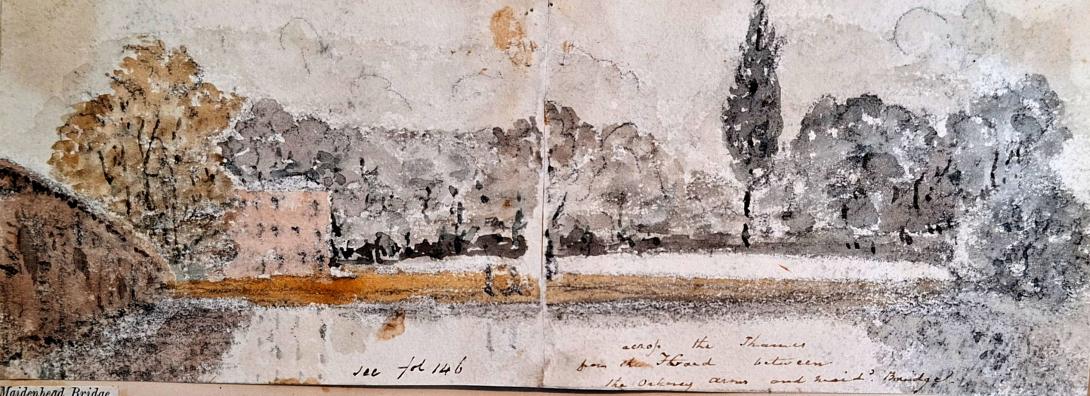
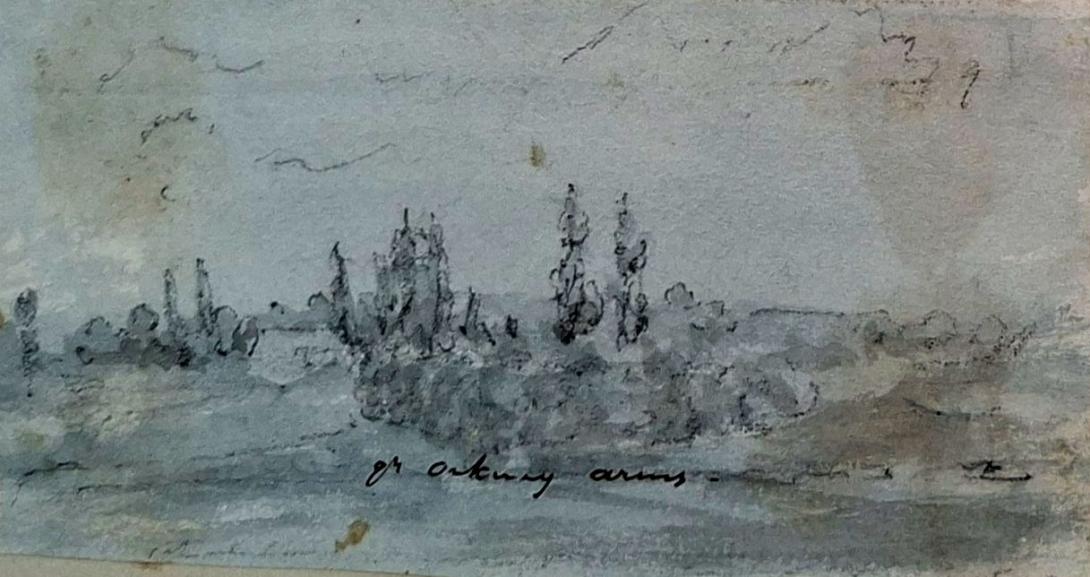
Across the Thames from the Hard between the Orkney Arms & the Maidenhead Bridge Sept 6 1856 (2)
Skindles was a hotel in Maidenhead, England, on the Buckinghamshire bank of the River Thames by Maidenhead Bridge. Formerly the Orkney Arms, built in 1743, it was turned from a coaching inn into a fashionable hotel by William Skindle in 1833. The "Orkney Arms" was an earlier name for the famous Skindles Hotel, a historic coaching inn and riverside hotel in Maidenhead, located right by the iconic Maidenhead Bridge over the River Thames; it was a fashionable spot for centuries, known for its coaching trade and later as a celebrity haunt, before closing in the 1990s and being redeveloped.
James Hatch now lives on Vancouver Island in Canada’s far west. He keeps in touch with his childhood roots in Cookham’s Widbrook Cottage by running a blog called Historical Cookham at http://widbrook2.blogspot.com. His query concerned an 1852 map which indicates that the Earl of Orkney lived at Cliveden View in the middle of Widbrook Common....
This would have been Thomas FitzMaurice, 5th Earl of Orkney, who inherited not only his grandmother’s title in 1831 but also her parlous financial plight. Consequently in 1852 he became the man who sold Taplow. The auction of 40 lots (plus three nearby) raised £102,415. The Orkneys had for many years also owned bits of Berkshire, one of which it seems was this Widbrook house from which perhaps he gazed forlornly at his erstwhile estates in Taplow.
Sylvia Topp is an American psychologist writing a biography of Eileen O’Shaughnessy who married the author George Orwell in 1935. She wanted to know about Silchester House, a girls’ boarding school in 1927 when Eileen was an assistant mistress there….mBeatrice Roberts was ‘mistress’ of Silchester Manor from before 1911 until at least 1940. I could find no record of Eileen’s brief stay in Taplow but did come across Miss Y Blonay, an assistant mistress there in 1932. She must surely be related to the Swiss nobleman Baron Godefroy de Blonay who served on the International Olympic Committee alongside Willy Grenfell, 1st Baron Desborough. Early last summer, Barbara Askew was putting together Maidenhead Riverside Walking Tours. Her query was about the origins of ‘Maidenhead’s scandalous reputation’.The credit (or the blame) is usually laid at the door of William Skindle but his is not the whole story. He was long gone before Skindle’s halcyon days in the Naughty Nineties and Noughties.
Skindle was landlord of The Orkney Arms by 1833, which was rather good timing. The railway arrived in 1838 bringing thousands to enjoy the riverside and mess about in Jonathan Bond's boats. The adjoining Hotel Tap was opened to sate the thirst of day-trippers. Business boomed. When he died 1867 it took both his sons William and Henry to step into his shoes. However it was their successor Henry Hoare who in 1876 renamed the inn Skindle’s Hotel and really made it famous. James Hodgson took over in the Edwardian era and, after The Brigade of Guards Boat Club moved its frivolities across the river in 1904, he expanded into its riverside premises. By the time the original hotel was demolished in the 1950s its former annexe had long usurped its parent to become Skindle’s, an iconic hotel in its own right, complete with a swinging night club.
The original Railway Inn building in Taplow no longer operates as a pub or hotel under that name. The original Railway Inn in Taplow, also known previously as the Orkney Arms and later Skindles Hotel, was eventually closed in 1995 and stood derelict for a long time. The site was redeveloped, and it now features the Roux at Skindles restaurant and residential homes. A pub named The Dumb Bell Hotel, located nearby, was also renamed The Bell & Crown Railway Hotel for a period in the 1840s. It eventually became a car sales showroom and then a Harvester restaurant.
The Thames Riviera Hotel was originally conceived as mansion to let but later opened as a hotel in 1888.Many of the riverside clubs were held in back rooms and cellars of private houses which had sprung up along the riverside. The wharf which had existed from the 12th to the 18th century by Maidenhead Bridge was replaced by Bridge House in the 19th century, which was converted to Murrays River Club in 1911.
Richard Suter was born in Greenwich, Kent on 30th March 1798, to William Suter and his wife Sarah Knights. On 7th January 1825 he married Anne Ruth Burn.
English architect. As Surveyor to The Fishmongers' Company he designed the severe Presbyterian churches for Ballykelly (1825–7) and Banagher (1825) on the Company's Estate in County Londonderry, drawings of which were exhibited at the Royal Academy in 1827. He was also responsible for the Model Farm (1823–4), the Lancasterian Schools (1828–30), the Company Agent's House (1830–2—now a hotel, much altered), a range of houses on the south side of the main road (1823–4), the lodge in the Presbyterian churchyard (1828), and the Dispensary (1829), all at Ballykelly, and all Classical. As Surveyor to Trinity House Corporation, he designed houses that were erected by Thomas Cubitt in 1821–3 on a site adjoining Trinity House. For The Fishmongers' Company he designed St Peter's Almshouses, Wandsworth, London (1849–51), and The Old School-House, Gresham's School, Holt, Norfolk(1859), in an Elizabethan style.
On the 1841 Census Richard, an architect and lawyer, can be found living in London with his wife Ann (listed as Ruth) and their two children, Richard George and Andrew Burn. Living with them is Edward D Suter. 1851 finds the family living in Tottenham Court in London, by this time Andrew had left the home, but I am unable to trace him on the 1851 Census. In 1860 Andrew marries Amelia Damaris Harrison. Both Richard George and Andrew were to become ordained ministers, with Andrew later becoming a Bishop and emigrating to New Zealand. Sadly in 1854 Anne Ruth was to pass away. In 1861, widowed Richard, Justice of the Peace for Maidenhead, is living at Castle Hill, Maidenhead, Berkshire. In 1862 he married Elizabeth Anne Pocock. In 1871 and 1881 Richard and Elizabeth are still living in Castle Hill. Richard was to pass away on 1st March1883.
Richard Suter & Annesley Voysey, architects, had their office at number 35 Fenchurch Street, but they did not have it all to themselves as they shared the premises with W.C. Franks, a tea broker, who will get a separate post some other time. The earliest mention I found of Richard Suter in Fenchurch Street is in 1832 when he is listed at that address in a list of contributing members of the Society for the Propagation of the Gospel in Foreign Parts. It says that he had been a member since 1829, but that does not mean he was already at 35 Fenchurch Street in that year.(1) In fact, that seems unlikely as the Sun Fire Office records give Messrs. Short and Co., merchants, as paying the insurance premium on the premises in May 1830. The Directory of British Architects 1834-1914 give the year 1827, but I do not know on what evidence. When Suter and Voysey became partners is also uncertain, but they had known each other since at least 1825 as Suter is named as one of the executors of Voysey’s will which was dated 22 July, 1825. The address given for Suter in the will is Suffolk Street, Southwark. Voysey then lives at Conway Street, Fitzroy Square.