
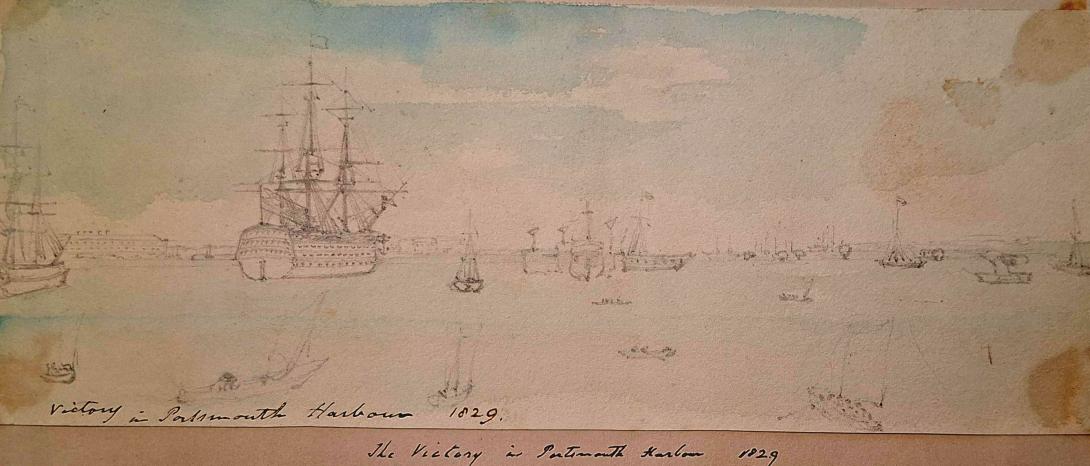
inscribed and dated " Victory in Portsmouth Harbour 1829"
by descent from the artist and architect
In 1829, the legendary HMS Victory was in Portsmouth Harbour, serving as a depot ship (harbour vessel), a secondary role after her active fighting days, especially post-Trafalgar in 1805, effectively ending frontline duty by 1812 to become a logistical base before her eventual preservation as the famous museum ship she is today.
Victory was later relocated to the mouth of Portsmouth Harbour off Gosport, for service as a floating depot and, from 1813 to 1817, as a prison ship, although she was never hulked. In March 1814, the ship was brought into dry dock for a major reconstruction and thus was not available for the hundred days conflict after Napoleon escaped from exile in Elba. The repairs included the fitting of metal braces to strengthen the frame. This was the earliest recorded use of iron for this purpose; nuts, bolts and nails had for some time been used to hold a ship's structure together but not to reinforce it. Since 1803, when her stern galleries were closed in, her outward appearance had remained unchanged but during this refit her beakhead and bulkhead were removed and the bow rounded off in line with Robert Seppings recommendations of 1811. The diagonal bracing that Seppings would introduce as standard in 1817 was not carried out however. She was repainted in black and white, the new norm for Royal Navy ships, and with only interior work left to do, the ship was taken out of dock in December 1815 and anchored in the harbour, where she was completed in January 1816. An Admiralty decision to have all three-deckers as first-rate ships, meant that when Victory was recalled to active service in February 1817, she was relisted as such and re-armed with 104 guns. However, her hull remained in poor condition and in January 1822, she was placed in dry dock at Portsmouth so further repairs could be carried out. When she was refloated in January 1824, she was considered suitable only for use as the Port admiral's flagship. She remained in that role at Portsmouth Harbour until April 1830.
In 1831 the Admiralty issued orders for the aging ship to be broken up and her timbers reused in other vessels, but a public outcry prevented her destruction. She instead became home to the Captain of Ordinary, whose responsibility was to look after all the ships that had been laid up, but in 1832 she was recommissioned as flagship to the port admiral once more. From that point, the Admiralty began inviting civilian visitors to aboard for tours. On 18 July 1833, the heir presumptive, Princess Victoria, and her mother, the Duchess of Kent, met veterans of the Trafalgar campaign on the quarterdeck. This event generated a surge of interest in the vessel, and an annual growth in civilian visitors to between 10,000 and 12,000.The port admiral moved his flag to the 120-gun HMS Britannia in August 1836 and Victory was without a role until August 1837, when she became flagship to the Admiral Superintendent of the Dockyard.
After Victoria returned for a second time on 21 October 1844, the number of visitors swelled again to more than 22,000 a year. In late April 1854, Victory sprang a leak and sank. All on board were rescued and the ship was subsequently raised. In 1847 Victory was the flagship to the Commander-in-Chief, Portsmouth but the escalation in human traffic had caused her to become increasingly decrepit and she was docked again in 1857 for further repairs and recoppering. She resumed her role on her return to service in 1858, but in 1869 the Commander-in-Chief's flag was transferred to the steam line of battle ship Duke of Wellington and Victory was designated her tender.
Sir Edward Seymour visited the vessel in 1886 as flag captain to the Commander-in-Chief and recalled in his 1911 memoirs, "a more rotten ship than she had become probably never flew the pennant. I could literally run my walking stick through her sides in many places". In 1887, the ship began leaking again and only with some difficulty was she prevented from sinking at her mooring.This prompted the Admiralty to thereafter provide a small annual subsidy for maintenance.That same year, the lower masts of the ship had become so rotten it was decided to replace them with the hollow, iron masts from HMS Shah. They were fitted to the keel as her masts would have been prior to the 1807 refit. In 1889 Victory became the home of a signal school in addition to being a tender. The school remained in Victory until 1904, when training was transferred temporarily to HMS Hercules.
Despite her reuse as a school, Victory continued to deteriorate. In 1903 she was accidentally rammed by the iron-clad ship HMS Neptune, a successor to the vessel that had towed her to Gibraltar. Neptune had broken free of tugs that were towing her and struck Victory on the port side causing considerable damage.Emergency repairs prevented her from sinking, but the Admiralty again proposed that she be scrapped, and it was only the personal intervention of Edward VII that prevented this from occurring. She was instead hastily patched up for the centenary celebration of the Battle of Trafalgar, which had caused a resurgence of interest in the ship. For part of the 1905 festivities she was illuminated with electricity generated by an adjacent submarine. Events were deliberately low key as the British Government did not wish to upset the French who were by then allies; the Entente Cordiale having been signed in 1904. The Society for Nautical Research was formed in 1910 to campaign for the ship's preservation but was unable to secure the backing of the Admiralty, which was at that time being stripped of its assets by an escalating arms race. In 1911, Frank H. Mason's The Book of British Ships remarked how the dilapidated condition of the Victory was "nothing short of an insult". Any plans for the ship were put on hold when the First World War broke out in August 1914, and she was left to deteriorate.
In dry dock and restoration
1921–1939

The ship had degraded to such an extent by 1921 that a public campaign gathered momentum with the shipping magnate, Sir James Caird, donating generously to the Save the Victory fund. On 16 December, her ballast was removed and she entered the No. 1 basin at Portsmouth Dockyard where it was discovered that she had hogged so badly that the bow and stern had dropped by 457 millimetres (18 in) and 203 millimetres (8 in) respectively, and that the scarph joints of the keelson had opened up by more than 25.5 millimetres (1 in). Concerns about her ability to remain afloat led to Victory being dry docked indefinitely. Prolonged periods out of water puts tremendous strain on a ship and it was apparent that she would require a specially manufactured, steel frame to support her. Victory was moved to No. 2 dock on 20 March 1922 where a survey revealed that 25 to 50 per cent of her internal fittings needed replacing and most of her furnishings, along with her entire steering system, had been removed or destroyed.
Richard Suter (1797–1883).
Richard Suter was born in Greenwich, Kent on 30th March 1798, to William Suter and his wife Sarah Knights. On 7th January 1825 he married Anne Ruth Burn.
English architect. As Surveyor to The Fishmongers' Company he designed the severe Presbyterian churches for Ballykelly (1825–7) and Banagher (1825) on the Company's Estate in County Londonderry, drawings of which were exhibited at the Royal Academy in 1827. He was also responsible for the Model Farm (1823–4), the Lancasterian Schools (1828–30), the Company Agent's House (1830–2—now a hotel, much altered), a range of houses on the south side of the main road (1823–4), the lodge in the Presbyterian churchyard (1828), and the Dispensary (1829), all at Ballykelly, and all Classical. As Surveyor to Trinity House Corporation, he designed houses that were erected by Thomas Cubitt in 1821–3 on a site adjoining Trinity House. For The Fishmongers' Company he designed St Peter's Almshouses, Wandsworth, London (1849–51), and The Old School-House, Gresham's School, Holt, Norfolk(1859), in an Elizabethan style.
On the 1841 Census Richard, an architect and lawyer, can be found living in London with his wife Ann (listed as Ruth) and their two children, Richard George and Andrew Burn. Living with them is Edward D Suter. 1851 finds the family living in Tottenham Court in London, by this time Andrew had left the home, but I am unable to trace him on the 1851 Census. In 1860 Andrew marries Amelia Damaris Harrison. Both Richard George and Andrew were to become ordained ministers, with Andrew later becoming a Bishop and emigrating to New Zealand. Sadly in 1854 Anne Ruth was to pass away. In 1861, widowed Richard, Justice of the Peace for Maidenhead, is living at Castle Hill, Maidenhead, Berkshire. In 1862 he married Elizabeth Anne Pocock. In 1871 and 1881 Richard and Elizabeth are still living in Castle Hill. Richard was to pass away on 1st March1883.
Richard Suter & Annesley Voysey, architects, had their office at number 35 Fenchurch Street, but they did not have it all to themselves as they shared the premises with W.C. Franks, a tea broker, who will get a separate post some other time. The earliest mention I found of Richard Suter in Fenchurch Street is in 1832 when he is listed at that address in a list of contributing members of the Society for the Propagation of the Gospel in Foreign Parts. It says that he had been a member since 1829, but that does not mean he was already at 35 Fenchurch Street in that year.(1) In fact, that seems unlikely as the Sun Fire Office records give Messrs. Short and Co., merchants, as paying the insurance premium on the premises in May 1830. The Directory of British Architects 1834-1914 give the year 1827, but I do not know on what evidence. When Suter and Voysey became partners is also uncertain, but they had known each other since at least 1825 as Suter is named as one of the executors of Voysey’s will which was dated 22 July, 1825. The address given for Suter in the will is Suffolk Street, Southwark. Voysey then lives at Conway Street, Fitzroy Square.