
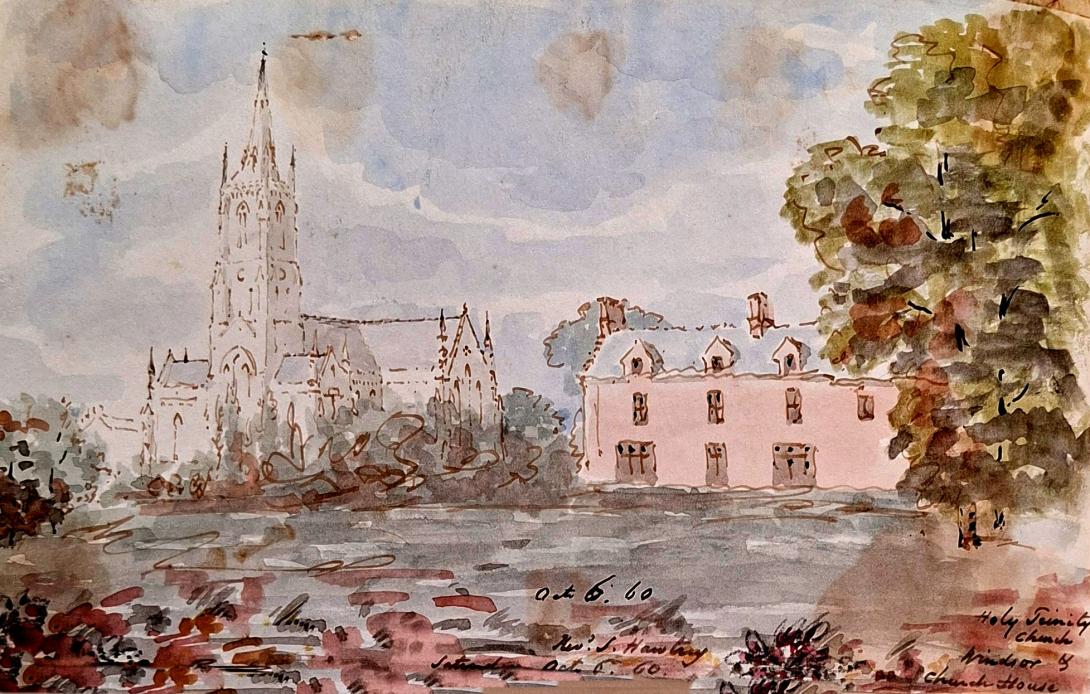
Holy Trinity Church & Church House Windsor Saturday Oct 6th 1860 Rev S Hawtrey
Holy Trinity was founded originally with a gift of 200 guineas from Queen Victoria. Other contributions made by the Duke & Duchess of Kent, Eton College, St George’s Chapel and Prince Albert allowed the construction of the Church to begin. The foundation stone was laid on 4 April 1842 by Prince Albert himself and it is rumoured that he later designed the main ceiling. Today those entering by the main door are greeted by a life-size statue of the Prince.
Queen Victoria wanted the church to be built both for the spiritual welfare of her troops (garrisoned at Combermere and Victoria Barracks) and for the growing population of Windsor (particularly the poor who lived in the slums by the river—now Alexandra Gardens). In the early years the church both educated and fed the poor. There was a chapel of ease, St Saviour’s, nearer to the river - it was demolished with the slums and only the lychgate survives, now forming an entrance into Clewer Memorial Park on the Dedworth Road.
Holy Trinity is probably the only parish and garrison church in the country and functions as a parish church being also used by the army chaplains for services. We receive no support from the MoD—its upkeep is entirely funded by the generosity of our congregation and visitors.
The church was designed by Edward Blore (most well known for his work on Buckingham Palace). It houses many memorials including the panels on the gallery which commemorate the lives of the 2,116 Officers and Men of the Grenadier, Coldstream and Scots Guards who gave their lives in the Crimean War (1854-1857). On the panels on the ground floor there are 86 panels of the names of the 742 Officers and Men of the Household Brigade who died in the Boer war in South Africa (1899-1902). Two other significant military memorials are to: John Siddall, veterinary surgeon for 53 years, who as the last surviving member of the Household Brigade of Cavalry present at Waterloo 1815; and Col Fredrick Burnaby who was an officer in the Royal Horse Guards and a famous adventurer. The largest memorial is the Guard’s Chapel, built in 1883, dedicated to the memory of those who lost their lives in the 1882 Egyptian Campaign. On poles around the gallery there are Standards and Regimental Colours (flags) of the Royal Horse Guards, Life Guards, Coldstream and Irish Guards. The Coldstream Colours were at the Battle of Waterloo in 1815.
Richard Suter was born in Greenwich, Kent on 30th March 1798, to William Suter and his wife Sarah Knights. On 7th January 1825 he married Anne Ruth Burn.
English architect. As Surveyor to The Fishmongers' Company he designed the severe Presbyterian churches for Ballykelly (1825–7) and Banagher (1825) on the Company's Estate in County Londonderry, drawings of which were exhibited at the Royal Academy in 1827. He was also responsible for the Model Farm (1823–4), the Lancasterian Schools (1828–30), the Company Agent's House (1830–2—now a hotel, much altered), a range of houses on the south side of the main road (1823–4), the lodge in the Presbyterian churchyard (1828), and the Dispensary (1829), all at Ballykelly, and all Classical. As Surveyor to Trinity House Corporation, he designed houses that were erected by Thomas Cubitt in 1821–3 on a site adjoining Trinity House. For The Fishmongers' Company he designed St Peter's Almshouses, Wandsworth, London (1849–51), and The Old School-House, Gresham's School, Holt, Norfolk(1859), in an Elizabethan style.
On the 1841 Census Richard, an architect and lawyer, can be found living in London with his wife Ann (listed as Ruth) and their two children, Richard George and Andrew Burn. Living with them is Edward D Suter. 1851 finds the family living in Tottenham Court in London, by this time Andrew had left the home, but I am unable to trace him on the 1851 Census. In 1860 Andrew marries Amelia Damaris Harrison. Both Richard George and Andrew were to become ordained ministers, with Andrew later becoming a Bishop and emigrating to New Zealand. Sadly in 1854 Anne Ruth was to pass away. In 1861, widowed Richard, Justice of the Peace for Maidenhead, is living at Castle Hill, Maidenhead, Berkshire. In 1862 he married Elizabeth Anne Pocock. In 1871 and 1881 Richard and Elizabeth are still living in Castle Hill. Richard was to pass away on 1st March1883.
Richard Suter & Annesley Voysey, architects, had their office at number 35 Fenchurch Street, but they did not have it all to themselves as they shared the premises with W.C. Franks, a tea broker, who will get a separate post some other time. The earliest mention I found of Richard Suter in Fenchurch Street is in 1832 when he is listed at that address in a list of contributing members of the Society for the Propagation of the Gospel in Foreign Parts. It says that he had been a member since 1829, but that does not mean he was already at 35 Fenchurch Street in that year.(1) In fact, that seems unlikely as the Sun Fire Office records give Messrs. Short and Co., merchants, as paying the insurance premium on the premises in May 1830. The Directory of British Architects 1834-1914 give the year 1827, but I do not know on what evidence. When Suter and Voysey became partners is also uncertain, but they had known each other since at least 1825 as Suter is named as one of the executors of Voysey’s will which was dated 22 July, 1825. The address given for Suter in the will is Suffolk Street, Southwark. Voysey then lives at Conway Street, Fitzroy Square.