
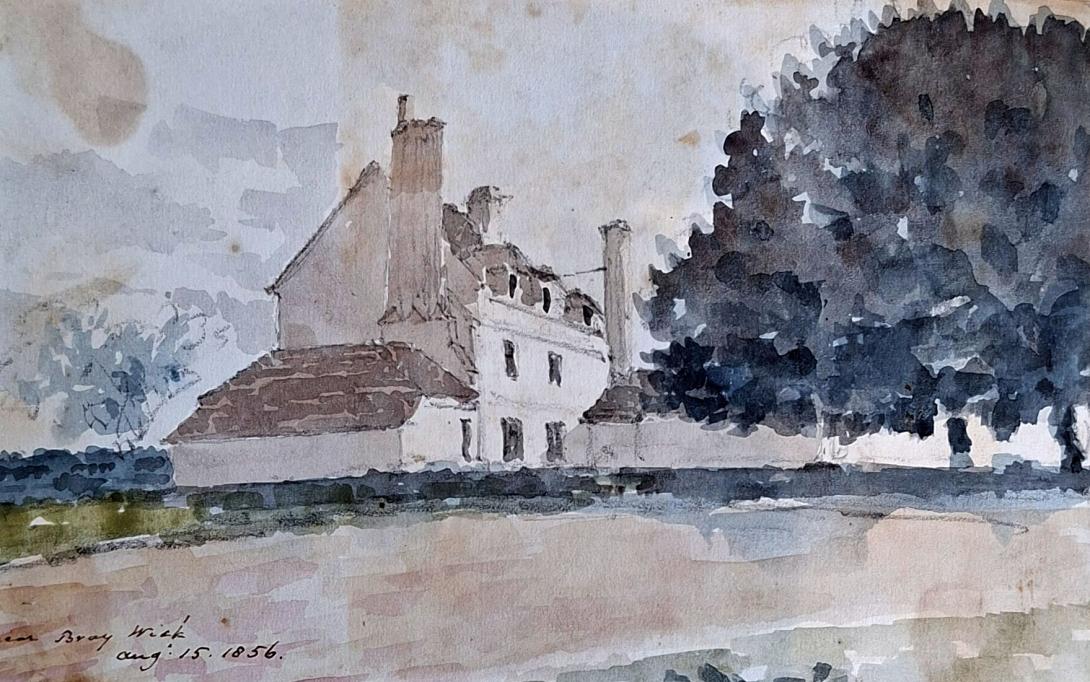
near Braywick Maidenhead Aug 15 1856
Large country house with laundry block, now offices. C17 and C18, main front dated 1675. Altered and refurbished 1984. Brick, part painted brick; mansard roof with Cumberland stone slates. Originally rectangular central staircase plan; later laundry block adjoining on north west, extension on south west. 2 storeys and attics, former laundry block one storey, part 2 storey. 3 large chimneys with clay pots in main part. South east front: probably former entrance front. Symmetrical. 7 bays. Moulded brick plinth and string to first floor. Carved wooden cornice. Sash windows with glazing bars, in moulded architraves with stone cills. Recessed centre section of 3 bays and 2 pedimented dormers, middle bay has windows with moulded, eared architraves. Outer sections each end of 2 bays and one similar dormer each. A lead rainwater pipe in each return angle with lead hopper with the inscription P 16 75 WM South west front: right hand part similar to south east front but 5 bays and with C20 distyle Doric porch approached by 3 concrete steps; 6-fielded panel moulded door in moulded architrave in second bay from left. Left hand part of 3 bays has plinth, plat band and moulded cornice at a higher level. Windows have moulded architrave frames, those on ground floor with floating moulded cornices. Former laundry block: 5 bay front. Fourth bay of 2 storeys with attic is gabled with an open pediment and with occulus in tympanum; a square sash window at first floor and a Venetian window on ground floor. Bellcote on ridge with ogee roof, ball finial and weathervane. One-bay single-storey part to right and 3 bays similar to left, all with round-headed sash windows with glazing bars. Adjoining to the left of the former stable block is a 3 bay section of the house with old sash windows with wide glazing bars; gauged brick arches scalloped on the bottom edge. Windows on the ground floor have floating moulded cornices. Interior: Conference room on left of entrance hall has plaster ceiling enriched with scrolled floral and leaf ornament; guilloche ornament in centre panel. Moulded and dentilled cornice with honeysuckle and acanthus leaf ornament, triglyph and ball flower frieze. Two 6-panelled doors, one disused, lead to entrance hall having panelling mild and enriched with bead and reel ornament which is repeated on the window shutters. Doors have moulded architraves and moulded dentilled cornices. Front office on right of entrance hall has thin Rococo plasterwork on walls and ceiling. Geometrical staircase with curved metal balusters and wreathed handrail. B.O.E. (Berkshire), p.101.
Braywick (sometimes written as Bray Wick) is a linear suburb south of the town of Maidenhead in Berkshire, England. It was formerly part of the parish of Bray. Braywick Park is a park and local nature reserve on the west side of the York Stream. Adjoining this, on the east side of the stream, is a site of Special Scientific Interest (SSSI) called Bray Meadows. Arthur Dillon (1750–1794) was an Irish Catholic aristocrat born in England who inherited the ownership of a regiment that served France under the Ancien Régime during the American Revolutionary War and then the French First Republic during the War of the First Coalition.
Richard Suter was born in Greenwich, Kent on 30th March 1798, to William Suter and his wife Sarah Knights. On 7th January 1825 he married Anne Ruth Burn.
English architect. As Surveyor to The Fishmongers' Company he designed the severe Presbyterian churches for Ballykelly (1825–7) and Banagher (1825) on the Company's Estate in County Londonderry, drawings of which were exhibited at the Royal Academy in 1827. He was also responsible for the Model Farm (1823–4), the Lancasterian Schools (1828–30), the Company Agent's House (1830–2—now a hotel, much altered), a range of houses on the south side of the main road (1823–4), the lodge in the Presbyterian churchyard (1828), and the Dispensary (1829), all at Ballykelly, and all Classical. As Surveyor to Trinity House Corporation, he designed houses that were erected by Thomas Cubitt in 1821–3 on a site adjoining Trinity House. For The Fishmongers' Company he designed St Peter's Almshouses, Wandsworth, London (1849–51), and The Old School-House, Gresham's School, Holt, Norfolk(1859), in an Elizabethan style.
On the 1841 Census Richard, an architect and lawyer, can be found living in London with his wife Ann (listed as Ruth) and their two children, Richard George and Andrew Burn. Living with them is Edward D Suter. 1851 finds the family living in Tottenham Court in London, by this time Andrew had left the home, but I am unable to trace him on the 1851 Census. In 1860 Andrew marries Amelia Damaris Harrison. Both Richard George and Andrew were to become ordained ministers, with Andrew later becoming a Bishop and emigrating to New Zealand. Sadly in 1854 Anne Ruth was to pass away. In 1861, widowed Richard, Justice of the Peace for Maidenhead, is living at Castle Hill, Maidenhead, Berkshire. In 1862 he married Elizabeth Anne Pocock. In 1871 and 1881 Richard and Elizabeth are still living in Castle Hill. Richard was to pass away on 1st March1883.
Richard Suter & Annesley Voysey, architects, had their office at number 35 Fenchurch Street, but they did not have it all to themselves as they shared the premises with W.C. Franks, a tea broker, who will get a separate post some other time. The earliest mention I found of Richard Suter in Fenchurch Street is in 1832 when he is listed at that address in a list of contributing members of the Society for the Propagation of the Gospel in Foreign Parts. It says that he had been a member since 1829, but that does not mean he was already at 35 Fenchurch Street in that year.(1) In fact, that seems unlikely as the Sun Fire Office records give Messrs. Short and Co., merchants, as paying the insurance premium on the premises in May 1830. The Directory of British Architects 1834-1914 give the year 1827, but I do not know on what evidence. When Suter and Voysey became partners is also uncertain, but they had known each other since at least 1825 as Suter is named as one of the executors of Voysey’s will which was dated 22 July, 1825. The address given for Suter in the will is Suffolk Street, Southwark. Voysey then lives at Conway Street, Fitzroy Square.