
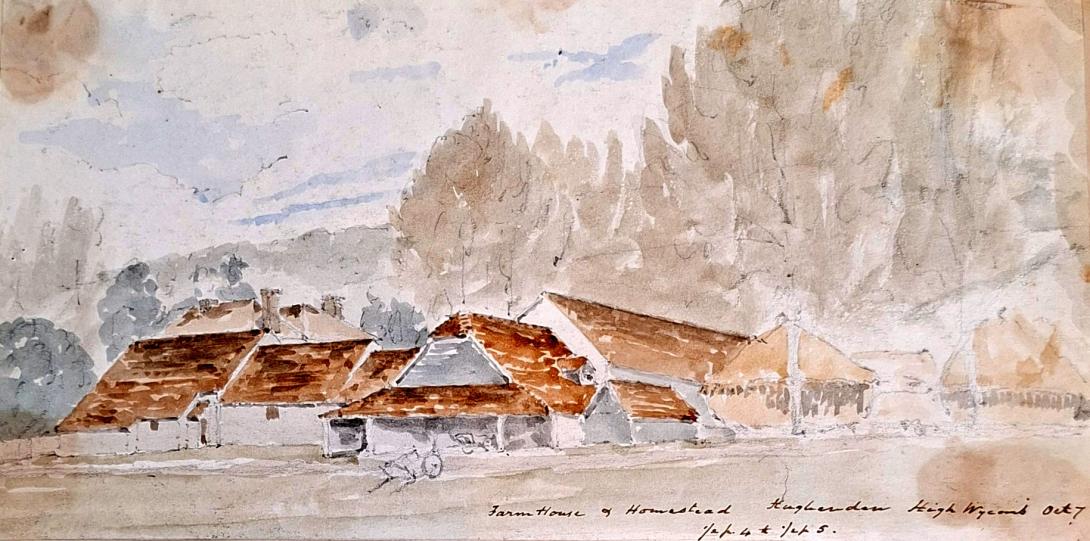
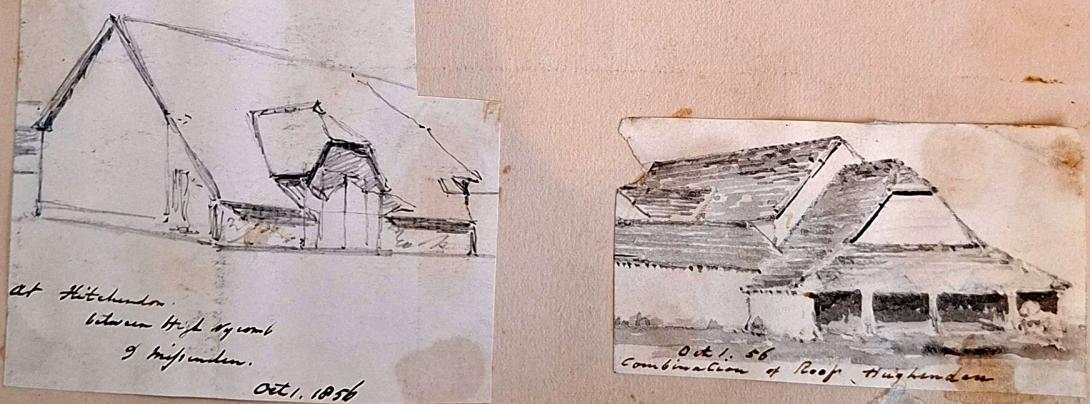
Farmhouse & Homestead Hughenden High Wycombe Oct 7 1856
Manor Farm, Hughenden, is lacated 2km Nwof the centre of High Wycombe, Buckinghamshire. The farm is part of the Hughenden Estate and lies 500m SW of the principal house. The property lies within the chalk hill of the Chilterns, the farmstead being sited on a SE facing slope at between 115 - 125m OD, overlooking the Hughenden Valley and a smaller dry valley between the farmstead and Hughenden Manor and its park. Although associated with Hughenden, Manor Farm actually lies within the civil parish of High Wycombe, occupying narrow strip od land extending northwards. The parish boundary between High Wycombe and Hughenden follows the edge of the HughendenPark, some 300m to the E. The origin of the farmstead is uncertain. A map of Hughenden estate dated 1818 (part of a Commissioners return in Chancery) excludes the area of Manor Farm. By the mid-ninteenth century, Manor Farm was a predominantly arable holding of just over 235 acres. Of this c.28 acres was pasture and there was a 31/2 acre orchard adjacent to the farmstead.
Hughenden Manor, Hughenden, Buckinghamshire, England, is a Victorian mansion, with earlier origins, that served as the country house of the Prime Minister, Benjamin Disraeli, 1st Earl of Beaconsfield. It is now owned by the National Trust and open to the public. It sits on the brow of the hill to the west of the main A4128 road that links Hughenden to High Wycombe.
The manor of Hughenden is first recorded in 1086, as part of Queen Edith's lands, and held by William, son of Odo the Bishop of Bayeux, and was assessed for tax at 10 hides. After his forfeiture, the lands were held by the Crown, until Henry I of England gave the lands to his chamberlain and treasurer, Geoffrey de Clinton. Clinton, whose main home was in Kenilworth, Warwickshire, had the lands tenanted by Geoffrey de Sancto Roerio, who resultantly changed his surname to the Anglicised Hughenden. After passing through that family, with successive kings having to confirm the gift of the lands, the manor returned to the Crown in the 14th century. In 1539, the Crown granted the manor and lands to Sir Robert Dormer, and it passed through his family until 1737 when it was sold by Philip Stanhope, 4th Earl of Chesterfield to Charles Savage.
After passing through his extended family following a series of deaths and resultant devises by will, by 1816 the manor and lands were owned by John Norris, a distinguished antiquary and scholar. Isaac D'Israeli, the father of Benjamin Disraeli, Prime Minister of the United Kingdom (1868 and 1874–1880, and Earl of Beaconsfield 1876), had for some time rented the nearby Bradenham Manor and, following Norris's death in 1845, bought the manor and lands from his executors in 1847. The purchase was supported with the help of a loan of £25,000 (equivalent to almost £1,500,000 today) from Lord Henry Bentinck and Lord Titchfield. This was because at the time, as Disraeli was the leader of the Conservative Party, "it was essential to represent a county," and county members had to be landowners. Taking ownership of the manor on the death of his father in 1848, Disraeli and his wife Mary Anne, alternated between Hughenden and several homes in London.

Lady Beaconsfield died in 1872, and Disraeli in 1881; both were buried in a vault adjacent in the churchyard of St Michael and All Angels Church which is situated downhill from the main house to the east. The church contains a memorial to the Earl erected by Queen Victoria: the only instance of a reigning British monarch ever erecting a memorial to a subject.
Disraeli had no children; he left Hughenden to his nephew, Coningsby Disraeli. However, as Coningsby was only 14 at the time, his trustees rented out the property until he came into his inheritance in 1888. When Coningsby died in 1936, his widow left Hughenden, and the following year Disraeli's niece sold the house to W H Abbey, who vested it, with the remaining contents and 189 acres (76 ha), in the Disraelian Society.
During the Second World War, the basement at Hughenden Manor was used as a secret intelligence base code named "Hillside". The UK Air Ministry staff at the manor analysed aerial photography of Germany and created maps for bombing missions, including the "Dambusters" raid.
In 1947, the Abbey family and the Disraelian Society made Hughenden over to the National Trust. In 1955, it was designated a Grade I listed building.The gardens are also listed as Grade II on the Register of Historic Parks and Gardens. It is decorated as it might have been at the time it was occupied by Disraeli. It contains a collection of memorabilia including family portraits, Disraeli's own furnishings, a library including a collection of Disraeli's novels and one written and signed by Queen Victoria along with many of the books he inherited from his father, Isaac D'Israeli.
The park and woodlands total almost 1,500 acres (610 ha). The formal garden which was designed by Lady Beaconsfield (Queen Victoria created Mary Anne a Viscountess in her own right in 1868), has been restored to a similar condition to when occupied by the Disraelis. The long terrace at the rear of the house is decorated with Florentine vases. A monument on a nearby hill, visible from the house, was erected by Mary Anne in 1862 in memory of her father-in-law.
Richard Suter was born in Greenwich, Kent on 30th March 1798, to William Suter and his wife Sarah Knights. On 7th January 1825 he married Anne Ruth Burn.
English architect. As Surveyor to The Fishmongers' Company he designed the severe Presbyterian churches for Ballykelly (1825–7) and Banagher (1825) on the Company's Estate in County Londonderry, drawings of which were exhibited at the Royal Academy in 1827. He was also responsible for the Model Farm (1823–4), the Lancasterian Schools (1828–30), the Company Agent's House (1830–2—now a hotel, much altered), a range of houses on the south side of the main road (1823–4), the lodge in the Presbyterian churchyard (1828), and the Dispensary (1829), all at Ballykelly, and all Classical. As Surveyor to Trinity House Corporation, he designed houses that were erected by Thomas Cubitt in 1821–3 on a site adjoining Trinity House. For The Fishmongers' Company he designed St Peter's Almshouses, Wandsworth, London (1849–51), and The Old School-House, Gresham's School, Holt, Norfolk(1859), in an Elizabethan style.
On the 1841 Census Richard, an architect and lawyer, can be found living in London with his wife Ann (listed as Ruth) and their two children, Richard George and Andrew Burn. Living with them is Edward D Suter. 1851 finds the family living in Tottenham Court in London, by this time Andrew had left the home, but I am unable to trace him on the 1851 Census. In 1860 Andrew marries Amelia Damaris Harrison. Both Richard George and Andrew were to become ordained ministers, with Andrew later becoming a Bishop and emigrating to New Zealand. Sadly in 1854 Anne Ruth was to pass away. In 1861, widowed Richard, Justice of the Peace for Maidenhead, is living at Castle Hill, Maidenhead, Berkshire. In 1862 he married Elizabeth Anne Pocock. In 1871 and 1881 Richard and Elizabeth are still living in Castle Hill. Richard was to pass away on 1st March1883.
Richard Suter & Annesley Voysey, architects, had their office at number 35 Fenchurch Street, but they did not have it all to themselves as they shared the premises with W.C. Franks, a tea broker, who will get a separate post some other time. The earliest mention I found of Richard Suter in Fenchurch Street is in 1832 when he is listed at that address in a list of contributing members of the Society for the Propagation of the Gospel in Foreign Parts. It says that he had been a member since 1829, but that does not mean he was already at 35 Fenchurch Street in that year.(1) In fact, that seems unlikely as the Sun Fire Office records give Messrs. Short and Co., merchants, as paying the insurance premium on the premises in May 1830. The Directory of British Architects 1834-1914 give the year 1827, but I do not know on what evidence. When Suter and Voysey became partners is also uncertain, but they had known each other since at least 1825 as Suter is named as one of the executors of Voysey’s will which was dated 22 July, 1825. The address given for Suter in the will is Suffolk Street, Southwark. Voysey then lives at Conway Street, Fitzroy Square.