
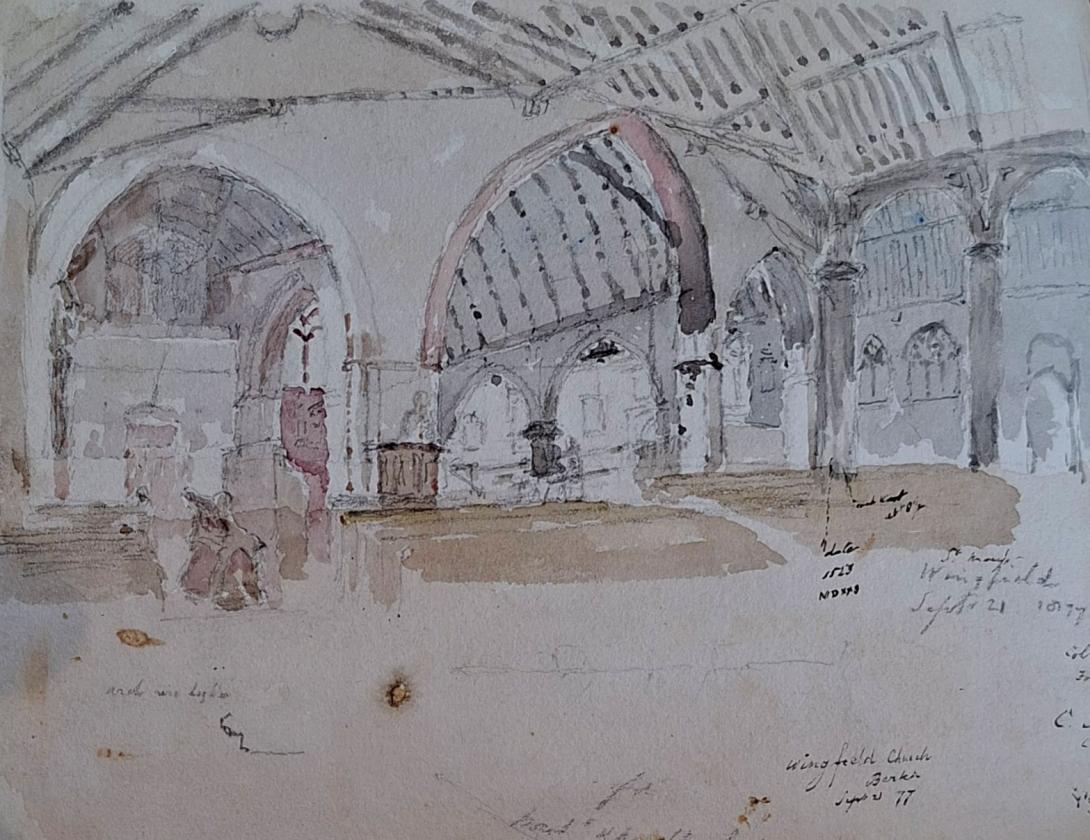
St Marys Wingfield (sic) Sept 21 1877 C J Elliot Clergyman
Winkfield is an extraordinary church. From the outside, it is a handsome building of standard format, with a fine Berkshire brick tower. However, you will never see anything quite like the interior anywhere else. For the nave consists of two wide bays redesigned in 1592 with the huge wooden supporting columns running right down the middle of the central aisle. Thus thwarting the intentions of bride and groom to walk down it. Despite other legends, carvings indicate the oaks were given by Queen Elizabeth I and a charming poem on display records this. The chancel walls were beautifully decorated by Woodyer in 1858. There is a charitable brass to one of the Montagues from Killbees Farm who was a 17th century beefeater; a good monument to Thomas Wise, the builder of the dome of St. Paul's; and some lovely modern glass. In the 1310s/20s, the Vicar of Winkfield was a certain William Pagula who became well-known as the author of a number of books to aid parish priests. Particularly popular was his 'Oculus Sacerdotis', a manual of pastoral theology. Late in his life, he became a champion of the local people of Windsor Forest and wrote complaints concerning their exploitation by the King's men.
Winkfield, together with nearby Winkfield Row was created from the clearance of the woodland during the Saxon period, c 600-700AD (VCH Berks, 3, p85). The name of Winkfield derived from Wineca’s Field and was noted in a survey of the parish boundaries dating from 942AD (ibid). Winkfield Village, Winkfield Parish, is part of the Ripplesmere Hundred (ibid). The manor of Winkfield was originally granted to Saethryth, a holy woman, by King Edmund in 942AD. The land was then given to the Abbey of Abingdon in 1015AD and remained in its possession until the Dissolution of the Monasteries. It was run on behalf of the Abbey of Abingdon by the Nuns of Broomhill Priory (Ford, 2001). St Mary’s Church, Winkfield, was appointed a vicar by the Abbot of Abingdon in 1248 (Winkfield Chronicles, 2000, 4). The C13th build of the church may have been constructed at this time. During the Dissolution Winkfield manor was sold to St John’s College, Cambridge and managed by Thomas Warde, Keeper of Cranbourne Chase, Windsor. It passed to his son, Richard Warde of Hurst House and remained in the Hurst family until 1652.
The church was extended and a timber roof was inserted, supported by four octagonal oak columns and marked with the date of 1592 and the royal initials of Elizabeth I. The Caroline brick bell tower that replaced the wooden tower, was added to the south-west corner of the church and inscribed with a date in 1629 At the beginning of the C18th the manor was split up, but by 1782 the majority of the land was owned by the Meeke family, whom in turn sold it to King George III. He built a hunting lodge in the grounds in 1786 and retained the land until 1819 (VCH Berks, 3, p87). In 1858, St Mary’s Church, Winkfield, was extended to the east, providing a chancel, vestry and an organ room (Winkfield Chronicles 2000, p21). 1.5 Historical Development of Winkfield The church of St Mary is the focal point of the village and dates from at least 1297, when the first vicar is recorded in the register (plate 5). The church was built on land originally belonging to the Abbey of Abingdon and retains elements of the original C13th build, including the south wall and arched doorway. The church is governed by the Diocese of Oxfordshire and is Grade II* listed.
St Mary’s Church itself was extended to the east and a replacement wooden pillar for the south aisle was granted by Queen Victoria during the roof repairs of 1887. Other repairs and additions were made during the late C19th, most notably by G E Street. To the east side of St Mary’s Church is the Old School House (plate 41), dating to the C17th or C18th, and Popel’s Cottages (plates 39-40), which date from the late C19th to 7 Winkfield Conservation Area Appraisal early C20th. Popel’s Cottages now form the village school. To the east of this school is Church Cottage (plate 37), dating from the late C19th, and opposite this is Ryemead (plate 34), which post-dates the 1881 OS map. These two properties mark the eastern extent of the Conservation Area.
The initial construction of St Mary’s Church was wholly of conglomerate stone, still present in the south aisle wall. Limestone was used for the detailing of the moulded arch surround of the south door. The use of limestone and conglomerate stones is confined to those buildings that pre-date the use of the local brick clay in the area, namely St Mary’s Church, or to provide architectural details to contrast with the brick.
The church grounds are lined by a low, orange brick wall that runs along the curve of the road and to the north of the parking area. It is interrupted by the heavy-set Victorian lych gate, which partially obscures the view of the church itself. The wall continues to join the Rectory Cottage north-south boundary wall, which is much greater in height and contains an arched and pedimented gateway (plate 13). Over the top of the low churchyard wall, the grounds of the church are fully visible, indicating the wall is to mark the churchyard boundary rather than for security prevention. Towards the west end of the village, the view of the road becomes closed again as it curves north, with the boundary walls and hedges of New Barn on the south side and the Rectory on the north side rising up in height.
Richard Suter was born in Greenwich, Kent on 30th March 1798, to William Suter and his wife Sarah Knights. On 7th January 1825 he married Anne Ruth Burn.
English architect. As Surveyor to The Fishmongers' Company he designed the severe Presbyterian churches for Ballykelly (1825–7) and Banagher (1825) on the Company's Estate in County Londonderry, drawings of which were exhibited at the Royal Academy in 1827. He was also responsible for the Model Farm (1823–4), the Lancasterian Schools (1828–30), the Company Agent's House (1830–2—now a hotel, much altered), a range of houses on the south side of the main road (1823–4), the lodge in the Presbyterian churchyard (1828), and the Dispensary (1829), all at Ballykelly, and all Classical. As Surveyor to Trinity House Corporation, he designed houses that were erected by Thomas Cubitt in 1821–3 on a site adjoining Trinity House. For The Fishmongers' Company he designed St Peter's Almshouses, Wandsworth, London (1849–51), and The Old School-House, Gresham's School, Holt, Norfolk(1859), in an Elizabethan style.
On the 1841 Census Richard, an architect and lawyer, can be found living in London with his wife Ann (listed as Ruth) and their two children, Richard George and Andrew Burn. Living with them is Edward D Suter. 1851 finds the family living in Tottenham Court in London, by this time Andrew had left the home, but I am unable to trace him on the 1851 Census. In 1860 Andrew marries Amelia Damaris Harrison. Both Richard George and Andrew were to become ordained ministers, with Andrew later becoming a Bishop and emigrating to New Zealand. Sadly in 1854 Anne Ruth was to pass away. In 1861, widowed Richard, Justice of the Peace for Maidenhead, is living at Castle Hill, Maidenhead, Berkshire. In 1862 he married Elizabeth Anne Pocock. In 1871 and 1881 Richard and Elizabeth are still living in Castle Hill. Richard was to pass away on 1st March1883.
Richard Suter & Annesley Voysey, architects, had their office at number 35 Fenchurch Street, but they did not have it all to themselves as they shared the premises with W.C. Franks, a tea broker, who will get a separate post some other time. The earliest mention I found of Richard Suter in Fenchurch Street is in 1832 when he is listed at that address in a list of contributing members of the Society for the Propagation of the Gospel in Foreign Parts. It says that he had been a member since 1829, but that does not mean he was already at 35 Fenchurch Street in that year.(1) In fact, that seems unlikely as the Sun Fire Office records give Messrs. Short and Co., merchants, as paying the insurance premium on the premises in May 1830. The Directory of British Architects 1834-1914 give the year 1827, but I do not know on what evidence. When Suter and Voysey became partners is also uncertain, but they had known each other since at least 1825 as Suter is named as one of the executors of Voysey’s will which was dated 22 July, 1825. The address given for Suter in the will is Suffolk Street, Southwark. Voysey then lives at Conway Street, Fitzroy Square.