
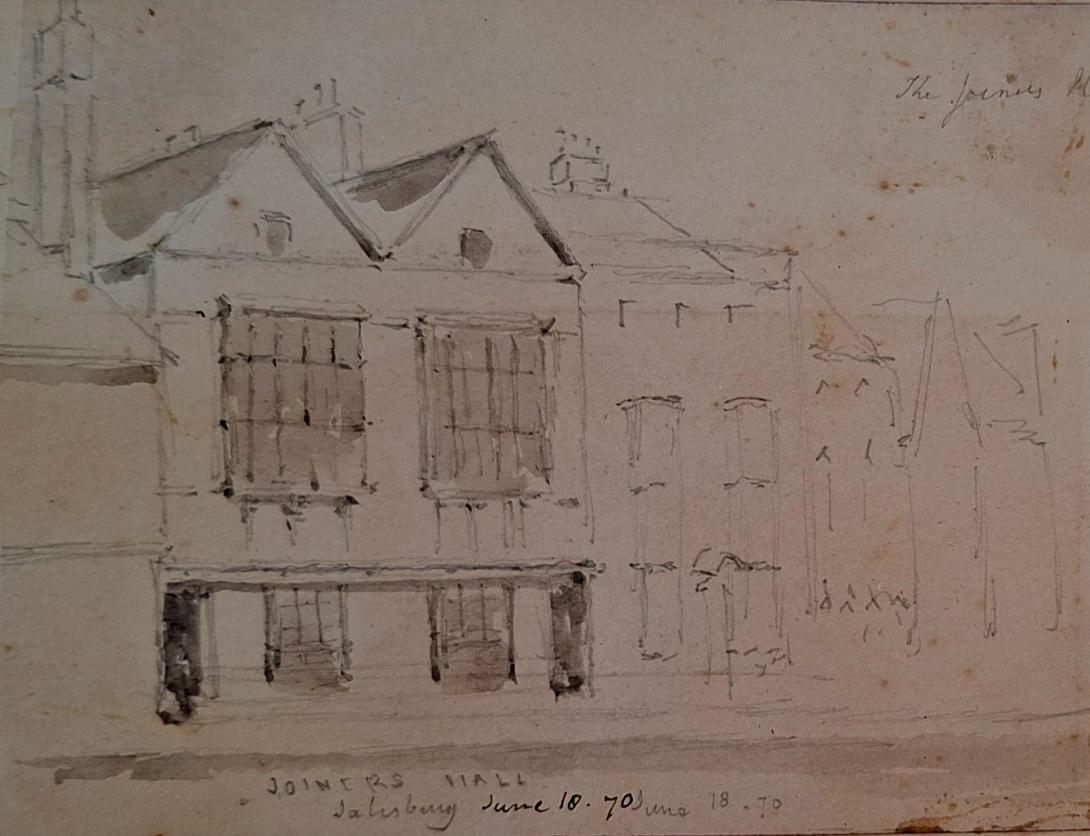
Joiners Hall Salisbury June 28th 1870
The city’s Joiners' Guild was established at the beginning of the 17th century. The organization built Joiners' Hall for their meetings. The building is an amazing blend of Elizabethan, Georgian and Victorian architectural styles, and it display the craftsmen’s skills to great advantage. The Joiners' Guild owned the hall until the beginning of the 19th century. Joiners' Hall has been protected by the National Trust since 1898.
Joiners' Hall in Salisbury, located on St Ann's Street, is a historic, Grade I listed building from the early 17th century, famous for its intricate and bizarre carvings by local joiner Humphrey Beckham, showcasing Salisbury's woodworking heritage, and is a significant architectural landmark in the city. Key Details: Location: St Ann's Street, Salisbury. History: Built in the early 17th century. Significance: A testament to Salisbury's strong tradition in woodworking and furniture making. Architectural Feature: Known for unique carvings by Humphrey Beckham (1588-1671). Listing: A Grade I listed building (National Heritage List for England number 1258872). What to Know: The Hall features distinctive carvings by Beckham, a renowned local joiner whose work can be seen in other Salisbury buildings, like the Red Lion Hotel. It's a well-preserved example of early 17th-century architecture, highlighting the skilled craftsmanship of the era.
The Hall still stands, it illustrates the bizarre carvings by one Humphrey Beckham 1588 ~ 1671, a joiner of the city.
This Grade 1 listed building was built in the early 17th century and is impressive even today.
At that time the City had a high reputation for woodworking and furniture making.
Beckham’s carvings can be found in a many buildings in the city. The fire surround in the lounge of the Red Lion Hotel for instance.
The Property
Built circa 1612 as a meeting house for the Joiners Guild, Joiners Hall is a singular Grade I Listed property built of a mix of timber frame, tile hung, brick and rendered elevations beneath a clay tiled roof. Of particular note is the exceptional façade with double transomed windows on grotesque brackets and carved fascia. The carvings and corbels of the exterior are thought to have been done by Humphry Beckham. Converted into two houses in the 19th Century and then into a single dwelling in 1965, it was acquired by the National Trust in 1898 and it is being sold on a long leasehold basis (approximately 90 years left unexpired).
The property has over recent years been the subject of a comprehensive and careful programme of improvement and now provides well balanced, immaculately presented, accommodation with a wealth of period features including excellent ceiling heights, timbers and elaborate cornicing etc.
The front door leads to the long dining room by way of an entrance porch, with elm flooring and doors to both the study (with extensive built in shelving), the sitting room and also to the kitchen/breakfast room. The kitchen has been fitted with high specification, hand built units, stone worktops and flagstone flooring (which continues into the garden room and scullery); this also opens into the Amdega garden room with double doors to the rear and glorious views of the garden. A good sized scullery and ground floor cloakroom completes the ground floor accommodation.
On the first floor is a large drawing room at the front of the property which runs the full width of the house and the principal bedroom, which is a large double room, with extensive built in wardrobes and a large, very well appointed, en suite bathroom (fitted with high quality sanitary ware and with a single slipper bath and walk in shower).
On the second floor are a further 3 double bedrooms, and again a very well appointed shower room.
Outside
To the rear of the property is a delightful south facing garden which in total measures approximately 200 feet in length. This has been exceptionally well designed and planted to provide colour and interest all year round, with an area of paved terraced immediately to the rear of house and lawn beyond. A paved path leads from the rear of the house the driveway by way of an arbour with a prolific white Wisteria, with well deep flower beds on both sides with a mixture of mature shrubs and flowering plants including roses, clematis, jasmine, hydrangea and an ornamental pond. Adjoining the garage is a fruit and vegetable plot with raised beds. The substantial garage has electric power, light, car charger and both an electric garage door and a separate pedestrian access. Beyond is a large area of gravelled off street parking for several cars, secured by double electric gates that open onto Eyres Way.
Location
St Ann Street is known as one of the most architecturally interesting streets within Salisbury’s city centre. It forms part of the medieval chequer system of Salisbury and as such is a level walking distance from all of the city’s excellent range of facilities- shopping, educational, cultural and leisure as well as the mainline station which has trains to London Waterloo (journey time- 90 minutes). Salisbury supports a well thought of playhouse and a twice weekly market. At the end of St Ann Street is St Ann’s Gate which leads through to the world famous Cathedral and its beautiful surrounding Close.
Richard Suter was born in Greenwich, Kent on 30th March 1798, to William Suter and his wife Sarah Knights. On 7th January 1825 he married Anne Ruth Burn.
English architect. As Surveyor to The Fishmongers' Company he designed the severe Presbyterian churches for Ballykelly (1825–7) and Banagher (1825) on the Company's Estate in County Londonderry, drawings of which were exhibited at the Royal Academy in 1827. He was also responsible for the Model Farm (1823–4), the Lancasterian Schools (1828–30), the Company Agent's House (1830–2—now a hotel, much altered), a range of houses on the south side of the main road (1823–4), the lodge in the Presbyterian churchyard (1828), and the Dispensary (1829), all at Ballykelly, and all Classical. As Surveyor to Trinity House Corporation, he designed houses that were erected by Thomas Cubitt in 1821–3 on a site adjoining Trinity House. For The Fishmongers' Company he designed St Peter's Almshouses, Wandsworth, London (1849–51), and The Old School-House, Gresham's School, Holt, Norfolk(1859), in an Elizabethan style.
On the 1841 Census Richard, an architect and lawyer, can be found living in London with his wife Ann (listed as Ruth) and their two children, Richard George and Andrew Burn. Living with them is Edward D Suter. 1851 finds the family living in Tottenham Court in London, by this time Andrew had left the home, but I am unable to trace him on the 1851 Census. In 1860 Andrew marries Amelia Damaris Harrison. Both Richard George and Andrew were to become ordained ministers, with Andrew later becoming a Bishop and emigrating to New Zealand. Sadly in 1854 Anne Ruth was to pass away. In 1861, widowed Richard, Justice of the Peace for Maidenhead, is living at Castle Hill, Maidenhead, Berkshire. In 1862 he married Elizabeth Anne Pocock. In 1871 and 1881 Richard and Elizabeth are still living in Castle Hill. Richard was to pass away on 1st March1883.
Richard Suter & Annesley Voysey, architects, had their office at number 35 Fenchurch Street, but they did not have it all to themselves as they shared the premises with W.C. Franks, a tea broker, who will get a separate post some other time. The earliest mention I found of Richard Suter in Fenchurch Street is in 1832 when he is listed at that address in a list of contributing members of the Society for the Propagation of the Gospel in Foreign Parts. It says that he had been a member since 1829, but that does not mean he was already at 35 Fenchurch Street in that year.(1) In fact, that seems unlikely as the Sun Fire Office records give Messrs. Short and Co., merchants, as paying the insurance premium on the premises in May 1830. The Directory of British Architects 1834-1914 give the year 1827, but I do not know on what evidence. When Suter and Voysey became partners is also uncertain, but they had known each other since at least 1825 as Suter is named as one of the executors of Voysey’s will which was dated 22 July, 1825. The address given for Suter in the will is Suffolk Street, Southwark. Voysey then lives at Conway Street, Fitzroy Square.