
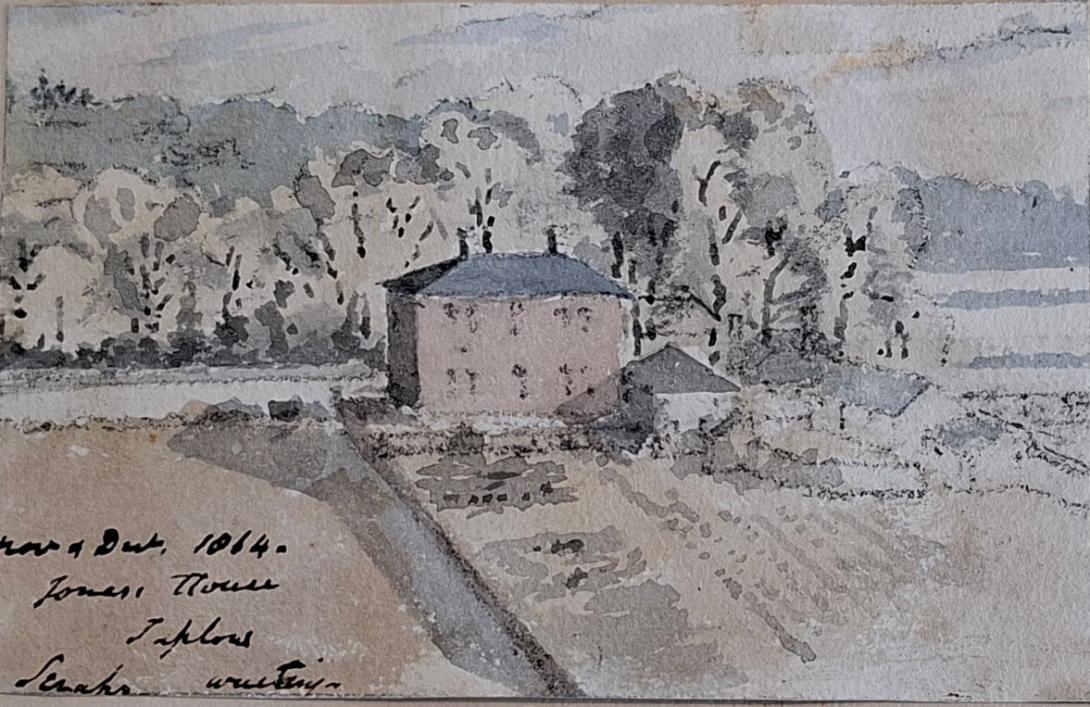
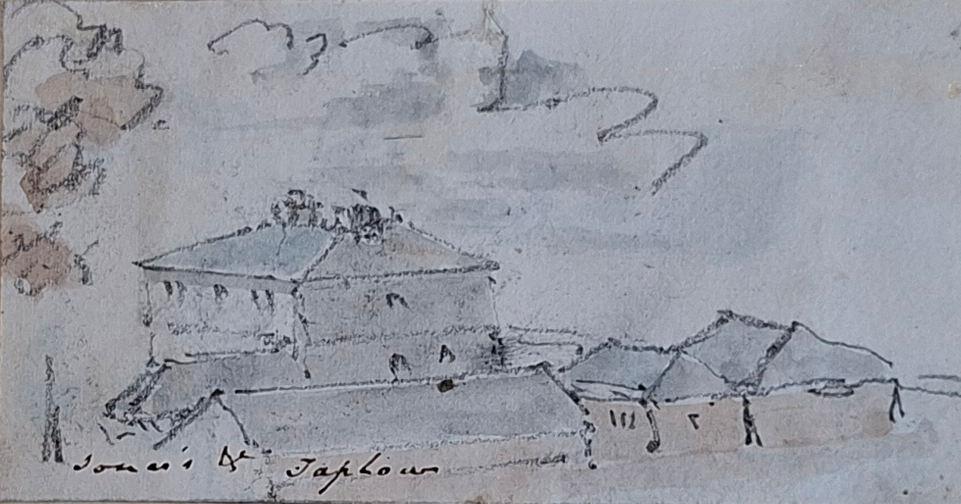
Nov & Dec 1864 Jones's House Taplow Senaho writing
Plans for the Great Western Railway's main line between London and Bristol began as far back as 1833. However the Act of Parliament
incorporating the GWR did not receive the Royal Assent until August 1835. Originally it was not intended to provide the village of Taplow with a station, but the difficulties encountered by the need to bridge the River Thames between Taplow and Maidenhead forced the GWR to build their first westward terminus within Taplow's boundaries. The station was known at first as 'Maidenhead', that town already being an important entrepôt for traffic between the West Country and London. The station was opened to public traffic on the 4th June 1838 when limited service of four trains each way was provided, reduced to three trains each way on Sundays. The station was situated on the embankment just west of the railway bridge over the main A4 Bath
Road. This bridge was originally designed by Brunel and later extended on the north side during 'widening', i.e. quadrupling the tracks, in the 1890's. The south west abutment of the bridge contained one of the entrances up to the station at track level.The former archway to this entrance can still be seen today and is surviving remainder of the old station. The steps from the entrance were removed not long after closure and now form part of the
stairway which itself has since been closed, between Paddington's suburban line platforms and Bishop's Bridge Road. There were two other entrances to the station at track level; the first led up from the main concourse of buildings at ground level to the north of the railway and the second on the south or 'Down' side led up from a lane at the west end of the station, being on the same side but at the end opposite to the entrance in the bridge abutment.
The main group of buildings for the station were provided at ground level but each platform at track level had a substantial range of buildings complete with clock tower, provided so that passengers were reminded that trains ran to Greenwich Mean Time and not to local time, which was about three minutes behind GMT. The site of the former Down side platform can be seen to the side of the current Down main line, a few yards to the west of the bridge over the A4 Bath Road. A small servicing depot was provided for the station and this is believed to have been situated near the site of the current Taplow station, where access to the railway from the road would have been much easier than at the station. Coaches, horses and other road
traffic to or from the West Coutnry was often carried by the GWR between Paddington and Maidenhead, thus easy transfer between road and rail was essential. The depot also included a large engine shed, turntable and other ancillary facilities which were staffed just six men. The usefulness of the road/rail access was shown in January 1838 when one of the GWR's first locomotives, the 'North Star' was delivered to Maidenhead by barge and transferred to the railway at Taplow. The 'North Star' later hauled the GWR's first passenger carrying train between Paddington and Maidenhead.
The original station had many different names ascribed to it during its short life. At first it was called Maidenhead whilst also being known as Maidenhead Riverside or Maidenhead Dumb Bell Bridge, the latter after a nearby public house, the Dumb Bell, which remains to this day. It is interesting to note that this pub is opposite another built later on the site of the original station's buildings and called, appropriately, Old Station Inn. The different names by which the station was known can probably be attributed to the fact that, although the station was meant to serve Maidenhead, it was nowhere near the centre of the town. The station was later shown timetables as 'Maidenhead and Taplow' and to distinguish it from the Wycombe Railway's station in Maidenhead (on the A4 too at Castle Hill), temporary eventually as 'Taplow'. Taplow station was only expected to and was designed as such by Brunel. Unlike the more wooden permanent stations at Slough and West Drayton, Brunel designed a station for Maidenhead and even though it had its clock towers and consideration was given to providing it with an overall roof, resolved it was always doomed. Indeed in August 1839 the GWR board to move the station further west but did not for a number of the reasons local even though they were constantly being urged to do so by users of the station. It was finally closed on the 1st September 1872 when the present Taplow Station was opened.be The reason why Taplow was home to the first Maidenhead station was of course the problem of crossing the River Thames which proved to be one of the GWR's most severe engineering problems. The difficulties came about mainly as a result of the stipulations laid down by the River Thames Commissioners. They said that the bridge must not obstruct the river or its towpaths and that it must be brick built. No brick bridge of a comparable size had ever: been attempted before. Fortunately the GWR had as its architect IK Brunel and his revolutionary design won approval from the Commissioners. Inevitably his design had its critics who claimed that the proposals to construct a bridge 778 feet long with two arches spanning 128 feet with a rise of just 24 feet 3 inches each was far too optimistic.
The GWR however kept their faith in Brunel an the centerings construction began in 1837. The critics appeared justified when to the eastern arch were first removed. The arch showed signs of distortion but the foreman in charge of construction admitted that he had ordered the centerings to be removed too soon. The arch was soon repaired. In the meantime the western arch was be found to be perfectly satisfactory. Brunel's design had proved to more than up to the task demanded of it. After some initial tests the bridge was opened to public traffic on July 1st 1839 when the line was extended through to Twyford. At this time the timetable was considerably altered. Now there were to be seven trains each way between Maidenhead and Paddington, with an additional Down train early on Monday mornings only. On Sundays there were six trains each way. In about 1844 Turner completed his famous painting 'Rain Steam and Speed', which featured the bridge at Maidenhead. This painting now hangs in the National Portrait Gallery in London. The Wycombe Railway Company opened the first ten miles of its line to Oxford on 1st August 1854. This section was between Maidenhead Junction (on the site of the present Maidenhead Station) and High Wycombe. via Princes It Risborough was extended through to Aylesbury in 1862 and to Oxford in Taplow in 1864. Trains started from the GWR station November 1871. until the new Maidenhead Station was opened on 1st In 1882 the GWR announced that the number of running tracks between Slough and Taplow was to be doubled from two to four. The plan was carried out at Taplow during 1883/84 when the opportunity was also taken to rebuild and enlarge the station on the Northern side. It is known that the plans for an enlarged Taplow station were prepared as early as 1871. This suggests that when the new Taplow station was built in 1872 a quarter mile east of the old Maidenhead Riverside, thought was already being given to 'widening'. The even newer and enlarged Taplow Station came into public sevice early in 1884. Shortly after, with both freight and passenger traffic increasing all the time, the GWR decided to continue 'widening' between Taplow and Reading. Brunel's masterpiece however caught the GWR in a dilemma. Should they demolish Brunel's bridge and replace it withan iron girder structure or could they widen the old bridge? Fortunately consideration was given to the aesthetic value of Brunel's work and it was decided to widen the bridge on each side by fifteen feet and to keep the original design. Widening proved far more difficult than building the original bridge. Part of the reason why consideration was given to demolishing the bridge was that it had shown signs of distortion and had to undergo aconsiderable amount of repair before it could be widened. Delays were also encountered on land west of the bridge. Thus although work began in the early 1880's the new part of the bridge was not opened to public service until January 1893.
By the end of the nineteenth century the pattern of the railway through Taplow had been established and remained virtually unchanged until the beginning of the modern era which began with the famous Beeching report of 1963, entitiled 'The Reshaping of British Railways'. So far as Beeching was concerned Taplow came through unscathed. No recommendations for closure were made not even for the goods depot which, according to the report, handled less than 5,000 tons of freight per week (this was the lowest category for freight in the report- putting Taplow on a par with Furze Platt
Halt!). Maybe no recommendation was made because a decision to withdraw these facilities had already been made for the Goods shed was closed shortly after the report was published. Almost immediately however it gained a new lease of life when the then recently formed Great Western Society leased it from British Rail 1965 to store some of their early acquisitions. Amongst the stock kept at Taplow was the 2-6-2T tank engine No. 6106 which came back to the area in 1973 when it helped to operate trains between Maidenhead and Bourne End during the Bourne End to Marlow branch
centenary celebrations on the 15th of July of that year. Other stock kept at Taplow at this time included an Ocean Liner Saloon, other special saloons and a Dynometer Car which is now on the Dart Valley Railway in the West Country. The GWS did not remain at Taplow for very long. By the mid 1960's the substantial engine sheds and sidings at Didcot had become available and in November 1967 the GWS stock at Taplow was transferred to its new home.
Richard Suter was born in Greenwich, Kent on 30th March 1798, to William Suter and his wife Sarah Knights. On 7th January 1825 he married Anne Ruth Burn.
English architect. As Surveyor to The Fishmongers' Company he designed the severe Presbyterian churches for Ballykelly (1825–7) and Banagher (1825) on the Company's Estate in County Londonderry, drawings of which were exhibited at the Royal Academy in 1827. He was also responsible for the Model Farm (1823–4), the Lancasterian Schools (1828–30), the Company Agent's House (1830–2—now a hotel, much altered), a range of houses on the south side of the main road (1823–4), the lodge in the Presbyterian churchyard (1828), and the Dispensary (1829), all at Ballykelly, and all Classical. As Surveyor to Trinity House Corporation, he designed houses that were erected by Thomas Cubitt in 1821–3 on a site adjoining Trinity House. For The Fishmongers' Company he designed St Peter's Almshouses, Wandsworth, London (1849–51), and The Old School-House, Gresham's School, Holt, Norfolk(1859), in an Elizabethan style.
On the 1841 Census Richard, an architect and lawyer, can be found living in London with his wife Ann (listed as Ruth) and their two children, Richard George and Andrew Burn. Living with them is Edward D Suter. 1851 finds the family living in Tottenham Court in London, by this time Andrew had left the home, but I am unable to trace him on the 1851 Census. In 1860 Andrew marries Amelia Damaris Harrison. Both Richard George and Andrew were to become ordained ministers, with Andrew later becoming a Bishop and emigrating to New Zealand. Sadly in 1854 Anne Ruth was to pass away. In 1861, widowed Richard, Justice of the Peace for Maidenhead, is living at Castle Hill, Maidenhead, Berkshire. In 1862 he married Elizabeth Anne Pocock. In 1871 and 1881 Richard and Elizabeth are still living in Castle Hill. Richard was to pass away on 1st March1883.
Richard Suter & Annesley Voysey, architects, had their office at number 35 Fenchurch Street, but they did not have it all to themselves as they shared the premises with W.C. Franks, a tea broker, who will get a separate post some other time. The earliest mention I found of Richard Suter in Fenchurch Street is in 1832 when he is listed at that address in a list of contributing members of the Society for the Propagation of the Gospel in Foreign Parts. It says that he had been a member since 1829, but that does not mean he was already at 35 Fenchurch Street in that year.(1) In fact, that seems unlikely as the Sun Fire Office records give Messrs. Short and Co., merchants, as paying the insurance premium on the premises in May 1830. The Directory of British Architects 1834-1914 give the year 1827, but I do not know on what evidence. When Suter and Voysey became partners is also uncertain, but they had known each other since at least 1825 as Suter is named as one of the executors of Voysey’s will which was dated 22 July, 1825. The address given for Suter in the will is Suffolk Street, Southwark. Voysey then lives at Conway Street, Fitzroy Square.