
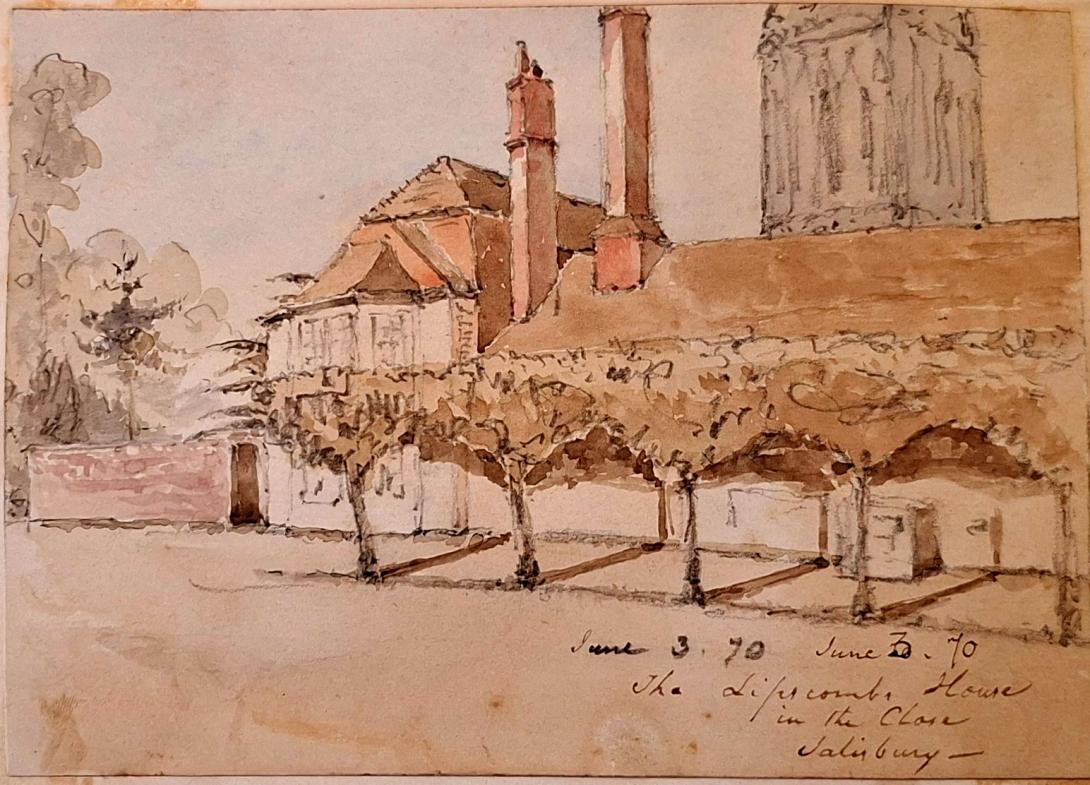
Lipscomb's House Salisbury Close June 3rd 1870
Salisbury Cathedral Close, Britain's largest at 80 acres, began as an open green space for the new cathedral (moved from Old Sarum in the 1220s), later walled after 1327, evolving into an elegant precinct with historic residences, offices, and gardens, encompassing buildings for clergy, bishops, and canons, alongside notable features like Mompesson House and the Old Deanery, reflecting continuous use and architectural changes from the 13th century onwards. Origins & Development The Move: The cathedral moved from Old Sarum in the 1220s due to poor relations with the garrison and site issues, with the new Close established on virgin land. Early Layout: Initially open, the Close was walled for security and to define the ecclesiastical precinct around the new cathedral, completed by 1258. Growth: It housed the cathedral, the Bishop's residence, and homes for other clergy (deans, canons).
800 years of history is on show in Salisbury’s Cathedral Close. At 80 acres it is Britain’s largest Cathedral Close and reflects architectural styles from the 13th through to the 20th Century.
From the majestic cathedral to award-winning museums, there is plenty to see and do inside the ancient walls:
Salisbury Cathedral: Britain’s tallest spire, the world’s best preserved original Magna Carta 1215 and Europe’s oldest working clock are all on display in the cathedral. Built between 1220 and 1258 Salisbury is thought to be Britain’s finest 13th century Gothic Cathedral. Free tours are available.
Arundells: The Grade II Listed home of the late Sir Edward Heath, former Prime Minister of the UK, is now open to visitors. The house is still furnished much as Sir Edward Heath had it. Among the items on display are gifts to him from other world leaders, including Fidel Castro, Sir Winston Churchill, Chairman Mao and Richard Nixon.
Mompesson House: The largest house on Choristers’ Green in the Cathedral Close. An elegant Queen Anne townhouse that has featured in the award-winning film, Sense and Sensibility. The interior features beautiful mid-18th-century plasterwork fine period furniture and graceful oak staircase while the walled garden is an area of tranquility.
Sarum College: Sarum College is a centre for study and research in historic Grade I listed buildings opposite Salisbury Cathedral. B&B, conference facilities, events and learning programmes are open to the public.
The Rifles Museum: The Grade II listed building is known as The Wardrobe. The museum itself details the fascinating history of the Berkshire and Wiltshire Regiments with thousands of artefacts from photographs, medals, uniforms and weapons. A garden to the rear flows down to the banks of the River Avon.
The Salisbury Museum: The Museum houses one of the best collections relating to Stonehenge and local archaeology, with about 100,000 items in the archaeological collection alone. Other collections also include fine art and costume. There are five watercolours by J. M. W. Turner, a pencil drawing by John Constable and an oil painting by Augustus John as well as the Rex Whistler archive.
Richard Suter was born in Greenwich, Kent on 30th March 1798, to William Suter and his wife Sarah Knights. On 7th January 1825 he married Anne Ruth Burn.
English architect. As Surveyor to The Fishmongers' Company he designed the severe Presbyterian churches for Ballykelly (1825–7) and Banagher (1825) on the Company's Estate in County Londonderry, drawings of which were exhibited at the Royal Academy in 1827. He was also responsible for the Model Farm (1823–4), the Lancasterian Schools (1828–30), the Company Agent's House (1830–2—now a hotel, much altered), a range of houses on the south side of the main road (1823–4), the lodge in the Presbyterian churchyard (1828), and the Dispensary (1829), all at Ballykelly, and all Classical. As Surveyor to Trinity House Corporation, he designed houses that were erected by Thomas Cubitt in 1821–3 on a site adjoining Trinity House. For The Fishmongers' Company he designed St Peter's Almshouses, Wandsworth, London (1849–51), and The Old School-House, Gresham's School, Holt, Norfolk(1859), in an Elizabethan style.
On the 1841 Census Richard, an architect and lawyer, can be found living in London with his wife Ann (listed as Ruth) and their two children, Richard George and Andrew Burn. Living with them is Edward D Suter. 1851 finds the family living in Tottenham Court in London, by this time Andrew had left the home, but I am unable to trace him on the 1851 Census. In 1860 Andrew marries Amelia Damaris Harrison. Both Richard George and Andrew were to become ordained ministers, with Andrew later becoming a Bishop and emigrating to New Zealand. Sadly in 1854 Anne Ruth was to pass away. In 1861, widowed Richard, Justice of the Peace for Maidenhead, is living at Castle Hill, Maidenhead, Berkshire. In 1862 he married Elizabeth Anne Pocock. In 1871 and 1881 Richard and Elizabeth are still living in Castle Hill. Richard was to pass away on 1st March1883.
Richard Suter & Annesley Voysey, architects, had their office at number 35 Fenchurch Street, but they did not have it all to themselves as they shared the premises with W.C. Franks, a tea broker, who will get a separate post some other time. The earliest mention I found of Richard Suter in Fenchurch Street is in 1832 when he is listed at that address in a list of contributing members of the Society for the Propagation of the Gospel in Foreign Parts. It says that he had been a member since 1829, but that does not mean he was already at 35 Fenchurch Street in that year.(1) In fact, that seems unlikely as the Sun Fire Office records give Messrs. Short and Co., merchants, as paying the insurance premium on the premises in May 1830. The Directory of British Architects 1834-1914 give the year 1827, but I do not know on what evidence. When Suter and Voysey became partners is also uncertain, but they had known each other since at least 1825 as Suter is named as one of the executors of Voysey’s will which was dated 22 July, 1825. The address given for Suter in the will is Suffolk Street, Southwark. Voysey then lives at Conway Street, Fitzroy Square.