
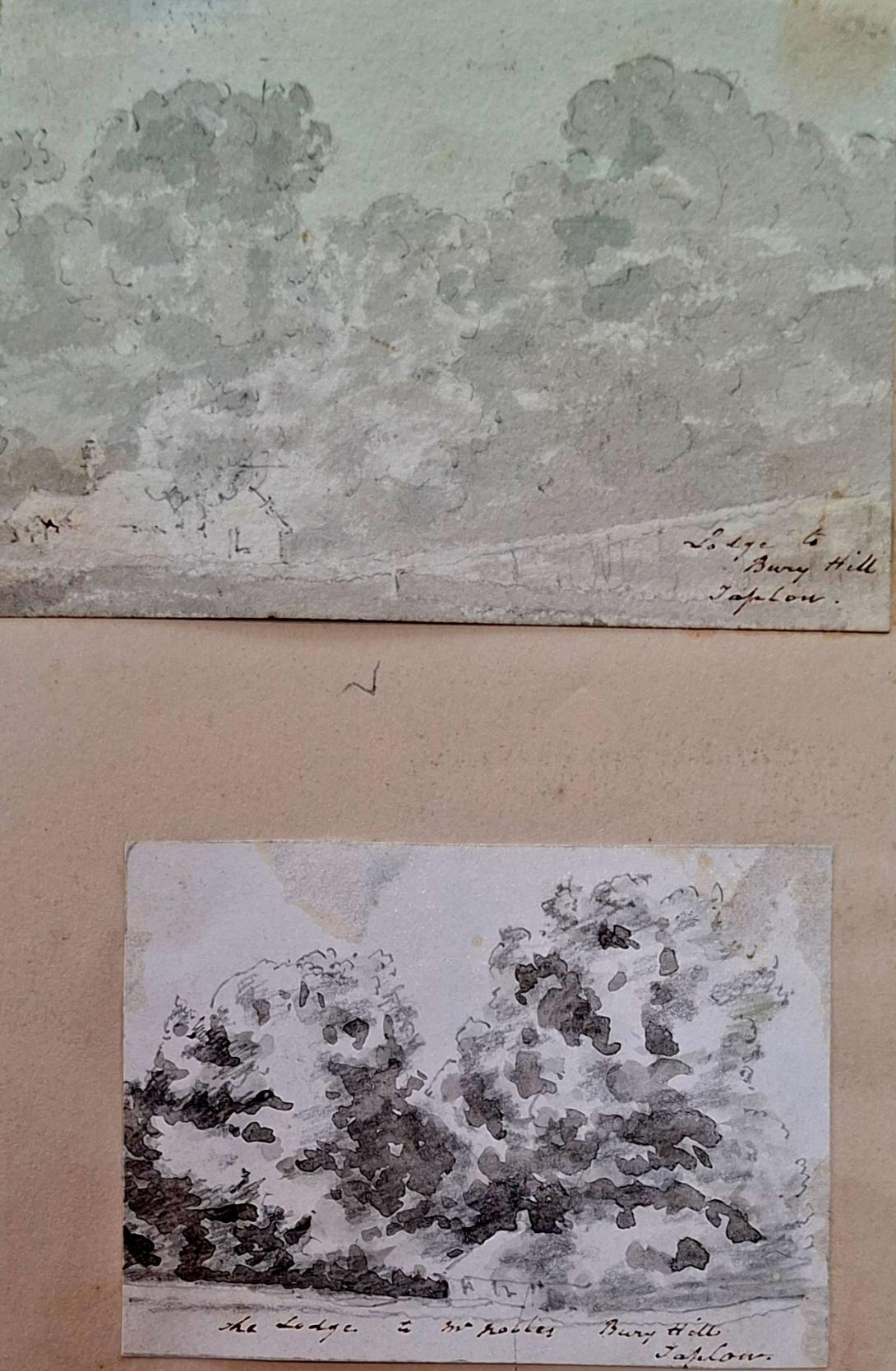
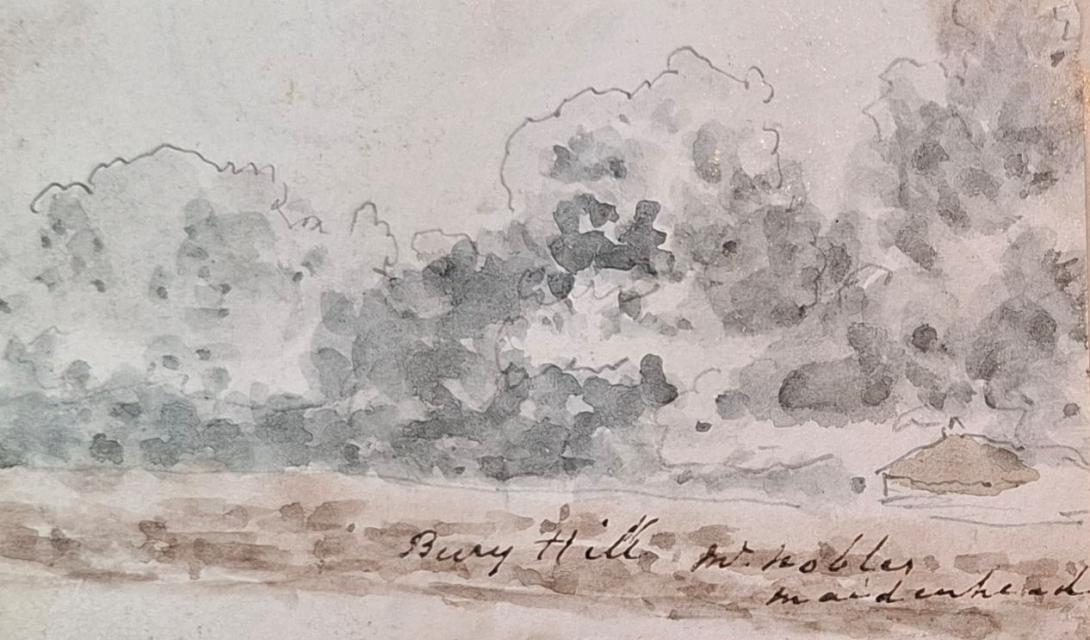
Lodge to Mr Nobles Bury Hill Taplow Maidenhead July 1874
Ownership and Residents: John Noble, a prominent varnish manufacturer, had purchased the estate in 1855, but records indicate he moved out by 1871. The house passed through a number of hands between the 1870s and the late 1940s, when it was converted into a hotel and country club.
The extensive gardens and pleasure grounds, originally laid out by landscape gardener Robert Marnock in the late 1850s, were a notable feature of the estate. Alexander Roger was the head gardener during this period, and his children were born at Berry Hill House.The village of Taplow, where Bury Hill is located, is near Maidenhead and has a history dating back to an Anglo-Saxon burial mound (Taplow Mound) from the 7th century AD, the artifacts from which are now in the British Museum.
Mr John Noble, a leading varnish manufacturer, commissioned Robert Marnock, the famous Scottish garden designer, to ‘beautify’ his garden at Berry Hill, Taplow, near Maidenhead, towards the end of the 1850s, and Marnock invited James 2 to help with their construction. According to James 2’s notes, most of this work at Berry Hill took place between 1859 and 1862, and involved the creation of:
‘Waterfalls; ford across lake; cliffs and cave to hide gasworks; boathouse.’
Some unspecified additions were also made in 1868. John Noble apparently asked Robert Marnock to create his gardens ‘in the shortest possible time’, and it seems that these objectives must have been achieved, because an article in the Gardeners’ Chronicle in 1860 [ii] reports that:
‘This affords a good example of successful transplanting, and furnished a place in a short time. Four years ago, the gardens had little pretensions to distinction, their extent being little more than three acres. . . The grounds now consist, however, of upwards of fifteen acres, beautifully laid out, and contain as fine specimens of Pines as can be found in places that have been established for centuries. . . ‘
‘The general appearance of the new grounds, viewed from the south side of the house, is very pleasing, advantage having been taken of fine meadow in front on the south-west side, to continue the pleasure grounds all round, beginning with a lake of four acres. The soil removed in the formation of the latter was used to undulate the opposite part: and to raise the ground where necessary to block out any unsightly objects from view . .
‘The walks are led along the banks so as to catch here and there views of the house and water (see Fig 1). On the undulations beyond are planted fine specimens of Conifers, Ailanthus, Holly, and evergreens, mostly of large size. These have been transplanted at all times of year, and without the slightest trace of having been shifted. Masses of Yucca gloriosa, with fine columns of bloom, form conspicuous objects near the water. The grounds are generally neatly managed, as far as effect is concerned, and the excellent state in which they are kept does credit to Mr Rogers, the gardener . . .’
Mr Rogers later moved on to take over the job of Park Superintendent at Battersea Park, where James 2 also constructed some rockwork between 1866-70 – see Chapter 6 of Rock Landscapes: The Pulham Legacy – and there are some very interesting comparisons between the two installations. Staying at Berry Hill, however, the Gardeners’ Chronicle article of 1860 goes on to record that there were bedding plant borders next to the house, containing Gazania Splendens and Centaurea Argentia. Beyond these, two rockery features are described:
‘. . a neat rockery planted with English Ferns, to be covered in with glass, after the fashion of that of Mr Veitch (a famous nurseryman, and one of the main promoters of the Chelsea Flower Show) at Chelsea. Lower down, near the lake is another rockery of larger dimensions, made of artificial stone some 12 or 13 feet in height. On this are ferns, Potentillas, Roses, Spergula pilifera, Variegated Vines, Cotoneaster, Magnolia, Tropaeoliums, Cupressus, and with other Conifers, with here and there water flowing over the rocks in quite a rush. From among the rocks a column of water rises some 20 feet in height, giving life and beauty to this department.’
Six years later, the Gardeners’ Chronicle [iii] published another article on the gardens at Berry Hill, describing them as an embodiment of all the virtues of the:
‘English or natural style of garden design’, and contrasting this with the “over-elaborate public garden design; with clumsy attempts at the natural style, and with formal geometric landscaping in the French style” . . .
‘It is of great importance to English horticulture that the most tasteful examples of what foreigners call the “English Garden”, and the most correct principles of designing them, should be made known . . . does not the future beauty of half the pleasantest tracts in the country depend largely upon the way they may be laid out? . . It is much to be desired, for such a garden is almost sure to lead its owner imperceptibly to a love of all that is beautiful in the art, and he can hardly err in taste while every walk and group, and gently and undulating slope, impressively teach that which is true.’
The lakeside rockwork at Berry Hill is singled out in this article for its effectiveness, and for its planting style. Around the lake was:
‘. . here and there a glint of well-constructed rockwork, fringed and speckled as it should be with native and other pretty rock plants, and not by the shrubs which frequently cover such. It is an intriguing delightful lakeside environment; an expanse of water surrounded by splashes of colour, gaining interest from flowerbeds and specimen plants. There is also a remarkable rustic fernery, with none whatever of the glasshouse about it, either inside or out.’
Berry Hill House passed through a number of hands between the 1870s and the late 1940s, when it was converted into a hotel and country club, and it was during this period that the picture in Fig .1 was taken. The house was sadly burned down as a result of a serious fire during the 1970s, and a block of flats was erected in its place. These still exist today, and the gardens immediately associated with them are in extremely good condition, and are registered as a Grade II Registered Park or Garden.
One hundred and thirty years after the above extracts from Gardeners’ Chronicle were written, Sir Nikolaus Pevsner also had something to say about Berry Hill: [iv]
‘. . . off the west side of Berry Hill, Berry Hill House has been demolished; a block of flats stands in its place. What is important are the grounds, laid out for John Noble between 1856 and 1860 by Robert Marnock. The focus is a long lake, with, to the northwest, a huge construction of artificial rockwork, begun in 1859 by the specialist James Pulham. Its waterfalls, 20ft high jet d’eau and small shrubs and rock plants have, alas, gone, but the artificial cliff – built to screen the view of the gasworks – and cave are still there.’
At first sight, this reference was encouraging, and made Berry Hill sound like an ideal potential candidate for a visit. My initial enquiries did nothing to sustain that enthusiasm, however. I soon discovered that Berry Hill was one of those estates that has now been broken up into parcels, and the section that includes the part of the lake on which James 2 built his ‘waterfall, cliffs, cave and boathouse’ had been let out by its owner to a local fishing club, who made it quite clear that ‘coach loads of visitors swarming all over our rocks’ would not be encouraged. Moreover, a whole series of recently dug channels that form part of the new Thames Flood Relief scheme has now decimated the land around this part of the lake, so it began to look as if this might be another ‘lost site’.
However, despite all these drawbacks, the owner of this piece of land was happy to show me round what remained of the lake, and one of the first things to catch my eye was the foundations for the boathouse on the far side of the lake from the old house. There is no boathouse now, although Lincoln Lee – who lived at Lower Lodge in the grounds of Berry Hill, and took the photograph in Fig 1 – recalls that it was still there in 1950. He said:
‘It was rather handsome, with a decorative stone slab roof, and, at that time, there was even a rather ramshackle bridge across to an island in the lake.’
A few yards further along the bank, there is some rockwork. As can be seen from Fig 2, this no longer forms part of the bank to the lake, and is now so overgrown as to be almost obscured. Its original purpose of concealing the view of the gasworks appears to have long since been forgotten.
This was consequently a rather disappointing start to my visit, but my luck was soon to change. As I was about to bid farewell to my host, he suggested that, while we were in the district, it might be an idea to call on someone else ‘just up the road’. This happened to be one of the residents from the new block of flats on the site of the old Berry Hill House, and he invited me back to look at something in the middle of a clump of trees on the lawns down by the lake.
He thought it was called a ‘fernery’, although he – and presumably none of his fellow flat-owners – had any real idea of what a fernery actually looked like. I followed him, and we (almost literally) stumbled across the ‘remarkable rustic fernery’ described in the Gardeners’ Chronicle article of 1866. It really is ‘truly remarkable’ – completely round, with three ‘rustic’ entrances, and is about 20ft across. It is sunk about eight feet into the ground, and the boundary wall extends about 18 inches above ground level. The internal ‘wall’ is made of very rough, projecting bricks that may once have been partly covered by tufa, and there is a proliferation of typical Pulham ‘planting pockets’ all around. There is also a sort of alcove at the bottom of the wall at one point that may at one time have been used for burning charcoal. Looking carefully along part of the smooth top of the projecting wall, one can see square holes into which such a roof structure could have been inserted, and the Gardeners’ Chronicle articles tend to confirm this. It is also very similar in concept to the sunken fernery at Merrow Grange, near Guildford, described in Chapter 25 of the book, and pictured in Fig 25.10.
There can be no doubt that this is the fernery described in the Gardeners’ Chronicle, and it became quite obvious from my subsequent enquiries that the local Historical Societies and Garden Trusts had not heard about it until I drew it to their attention, so one now has to wonder if it may be worthy of restoration. That would at least be far preferable to its present use, which is that of a convenient tip for the flat-owners’ garden rubbish.
It has to be appreciated, however, that this, too, is on private property, and the present owners may well have the same attitude towards ‘coach loads of visitors’ as do the members of the local fishing club. One can therefore only hope that – some day, somehow – a way may be found to preserve this unique example of Pulham’s craftsmanship for genuinely interested future generations to inspect and admire.
Richard Suter was born in Greenwich, Kent on 30th March 1798, to William Suter and his wife Sarah Knights. On 7th January 1825 he married Anne Ruth Burn.
English architect. As Surveyor to The Fishmongers' Company he designed the severe Presbyterian churches for Ballykelly (1825–7) and Banagher (1825) on the Company's Estate in County Londonderry, drawings of which were exhibited at the Royal Academy in 1827. He was also responsible for the Model Farm (1823–4), the Lancasterian Schools (1828–30), the Company Agent's House (1830–2—now a hotel, much altered), a range of houses on the south side of the main road (1823–4), the lodge in the Presbyterian churchyard (1828), and the Dispensary (1829), all at Ballykelly, and all Classical. As Surveyor to Trinity House Corporation, he designed houses that were erected by Thomas Cubitt in 1821–3 on a site adjoining Trinity House. For The Fishmongers' Company he designed St Peter's Almshouses, Wandsworth, London (1849–51), and The Old School-House, Gresham's School, Holt, Norfolk(1859), in an Elizabethan style.
On the 1841 Census Richard, an architect and lawyer, can be found living in London with his wife Ann (listed as Ruth) and their two children, Richard George and Andrew Burn. Living with them is Edward D Suter. 1851 finds the family living in Tottenham Court in London, by this time Andrew had left the home, but I am unable to trace him on the 1851 Census. In 1860 Andrew marries Amelia Damaris Harrison. Both Richard George and Andrew were to become ordained ministers, with Andrew later becoming a Bishop and emigrating to New Zealand. Sadly in 1854 Anne Ruth was to pass away. In 1861, widowed Richard, Justice of the Peace for Maidenhead, is living at Castle Hill, Maidenhead, Berkshire. In 1862 he married Elizabeth Anne Pocock. In 1871 and 1881 Richard and Elizabeth are still living in Castle Hill. Richard was to pass away on 1st March1883.
Richard Suter & Annesley Voysey, architects, had their office at number 35 Fenchurch Street, but they did not have it all to themselves as they shared the premises with W.C. Franks, a tea broker, who will get a separate post some other time. The earliest mention I found of Richard Suter in Fenchurch Street is in 1832 when he is listed at that address in a list of contributing members of the Society for the Propagation of the Gospel in Foreign Parts. It says that he had been a member since 1829, but that does not mean he was already at 35 Fenchurch Street in that year.(1) In fact, that seems unlikely as the Sun Fire Office records give Messrs. Short and Co., merchants, as paying the insurance premium on the premises in May 1830. The Directory of British Architects 1834-1914 give the year 1827, but I do not know on what evidence. When Suter and Voysey became partners is also uncertain, but they had known each other since at least 1825 as Suter is named as one of the executors of Voysey’s will which was dated 22 July, 1825. The address given for Suter in the will is Suffolk Street, Southwark. Voysey then lives at Conway Street, Fitzroy Square.