
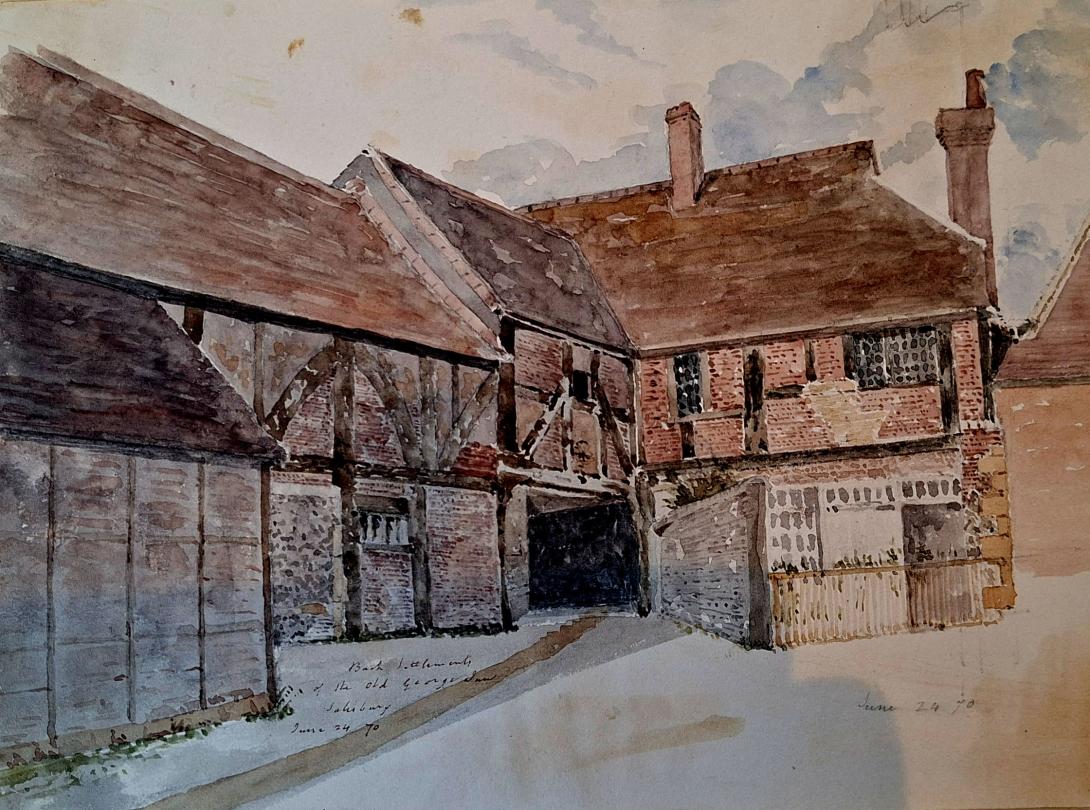
"Back settlements of the old George Inn Salisbury June 24 70"
This three-story building on Salisbury’s High Street now serves as the main entrance to Old George Mall-practically swallowing the ground floor in the process. But before it became a gateway to retail therapy, this place played host to some very notable characters.
Originally built in the 14th century as a coaching inn, it took its name from the Guild of Saint George, founded by Salisbury’s mayor and corporation. In 1645, Protestant leader Oliver Cromwell bunked down here on his way to join his troops. Samuel Pepys, ever the food critic, praised the fare as “very good diet” but also “very dear.” In true Pepys fashion, he got into a spat with the landlady and promptly moved somewhere cheaper.
Step inside the Old George, and you’ll find a labyrinth of crooked hallways, slanted floors, and steep, uneven stairs. A fire door from the mall reveals the Inn’s old banqueting hall, complete with wooden beams, a minstrel’s gallery, and a Jacobean mantelpiece. Overhead, the carved heads of King Edward II and Queen Isabella make for an interesting touch-though the queen allegedly murdered the king, they seem to be making amends up there.
Charles Dickens name-dropped the inn in “Martin Chuzzlewit”, and it’s said Shakespeare’s troupe once rehearsed “As You Like It” here. The 14th-century charm of the Old George stands in stark contrast to the sleek shops and cafes of the mall, but together, they make for a fascinating blend of history and modern convenience.
The George Inn (now part of the Boston Tea Party) was the property of William Teynterer, Mayor in 1330. His son, William, who served the same office in 1361 and 1375, bequeathed certain property to the Mayor and his brethren, as the Guild of St. George “for the good of his soul and the souls of his wives,” etc. After the death of his widow the George Inn became the property of the Corporation.
The inn was said to have contained no fewer than thirteen guest chambers in addition to the tavern and wine cellar, the buttery, the kitchen, the hostler’s chamber, and the parlour above the warehouse. One of the chambers was known as the “Lombards’ Chamber,” no doubt because of its association with the Lombard banker or exchanger, who was present at all fairs and large centres of trade, to assist in the payment for merchandise, as there would be present merchants from Venice, and Genoa with their silks, velvets, leather goods etc., and other foreign countries. Money-changers from Florence also visited the city, and at this period the corner of the High Street was known as Florentine Corner.
The innkeeper at the George provided board and lodgings. He was not allowed to make beer or bread, but he could buy from the brewer or baker, and supply his guests from his store or warehouse in the same way that he dealt with his wine, cheese, salt fish, butter, etc. In the ordinary way butter was sold by the gallon, pressed into jars, and salted. Cheese was sold in three sizes, 2lb. 4lb. and 6lb. Inland towns had to depend on salt fish and no meat was eaten on Friday’s or during Lent.
The Old George Inn has several claims to fame with famous visitors over the years. Shakespeare and his team of players are said to have stayed at the pub and performed ‘As You Like It,’ in the courtyard.
In 1645 Oliver Cromwell stayed at the inn on his way to join his army.
Samuel Pepys came to the inn on Wednesday 10th June in 1668 for a good meal and a place to rest his head. Of the inn, he said.
“Come to the George Inne, where lay in a silk bed; and very good diet. To supper; then to bed.”
Lastly, the inn appears in Charles Dickens’s novel ‘Martin Chuzzlewit.’
HIGH STREET 1. 1594 (East Side) Nos 15 & 17 (The Old George Inn) SU 1429 NW 3/81 28.2.52. 1 GV 2. C14 and later. 3 storeys, paired gables to front. Elaborately braced-timber framed elevation with plaster infilling. Old tile roof. 2 5 light mullioned and transomed casement windows on 2nd floor. 1st floor has 2 irregular canted oriel windows each of 10 mullioned and transomed lights, hipped tiled pent roofs, timber framed aprons. The wall between bays has elaborate interlaced bracing. The ground floor has recently been opened up to provide access to the "Old George Mall", one original post with bracket projecting forward to carry overhang. On lst floor the south room has early C17 plaster work friezes on beams and carved wood overmantel. Projecting to east on north side open hall through 2 storeys. C15 hammerbeam roof, arched braces to collars. Heavy scissor bracing visible on 2nd floor lath decorated wall plates and spandrels. 2 rooms with tie beams and kingposts with 4-way struts.
Richard Suter was born in Greenwich, Kent on 30th March 1798, to William Suter and his wife Sarah Knights. On 7th January 1825 he married Anne Ruth Burn.
English architect. As Surveyor to The Fishmongers' Company he designed the severe Presbyterian churches for Ballykelly (1825–7) and Banagher (1825) on the Company's Estate in County Londonderry, drawings of which were exhibited at the Royal Academy in 1827. He was also responsible for the Model Farm (1823–4), the Lancasterian Schools (1828–30), the Company Agent's House (1830–2—now a hotel, much altered), a range of houses on the south side of the main road (1823–4), the lodge in the Presbyterian churchyard (1828), and the Dispensary (1829), all at Ballykelly, and all Classical. As Surveyor to Trinity House Corporation, he designed houses that were erected by Thomas Cubitt in 1821–3 on a site adjoining Trinity House. For The Fishmongers' Company he designed St Peter's Almshouses, Wandsworth, London (1849–51), and The Old School-House, Gresham's School, Holt, Norfolk(1859), in an Elizabethan style.
On the 1841 Census Richard, an architect and lawyer, can be found living in London with his wife Ann (listed as Ruth) and their two children, Richard George and Andrew Burn. Living with them is Edward D Suter. 1851 finds the family living in Tottenham Court in London, by this time Andrew had left the home, but I am unable to trace him on the 1851 Census. In 1860 Andrew marries Amelia Damaris Harrison. Both Richard George and Andrew were to become ordained ministers, with Andrew later becoming a Bishop and emigrating to New Zealand. Sadly in 1854 Anne Ruth was to pass away. In 1861, widowed Richard, Justice of the Peace for Maidenhead, is living at Castle Hill, Maidenhead, Berkshire. In 1862 he married Elizabeth Anne Pocock. In 1871 and 1881 Richard and Elizabeth are still living in Castle Hill. Richard was to pass away on 1st March1883.
Richard Suter & Annesley Voysey, architects, had their office at number 35 Fenchurch Street, but they did not have it all to themselves as they shared the premises with W.C. Franks, a tea broker, who will get a separate post some other time. The earliest mention I found of Richard Suter in Fenchurch Street is in 1832 when he is listed at that address in a list of contributing members of the Society for the Propagation of the Gospel in Foreign Parts. It says that he had been a member since 1829, but that does not mean he was already at 35 Fenchurch Street in that year.(1) In fact, that seems unlikely as the Sun Fire Office records give Messrs. Short and Co., merchants, as paying the insurance premium on the premises in May 1830. The Directory of British Architects 1834-1914 give the year 1827, but I do not know on what evidence. When Suter and Voysey became partners is also uncertain, but they had known each other since at least 1825 as Suter is named as one of the executors of Voysey’s will which was dated 22 July, 1825. The address given for Suter in the will is Suffolk Street, Southwark. Voysey then lives at Conway Street, Fitzroy Square.