
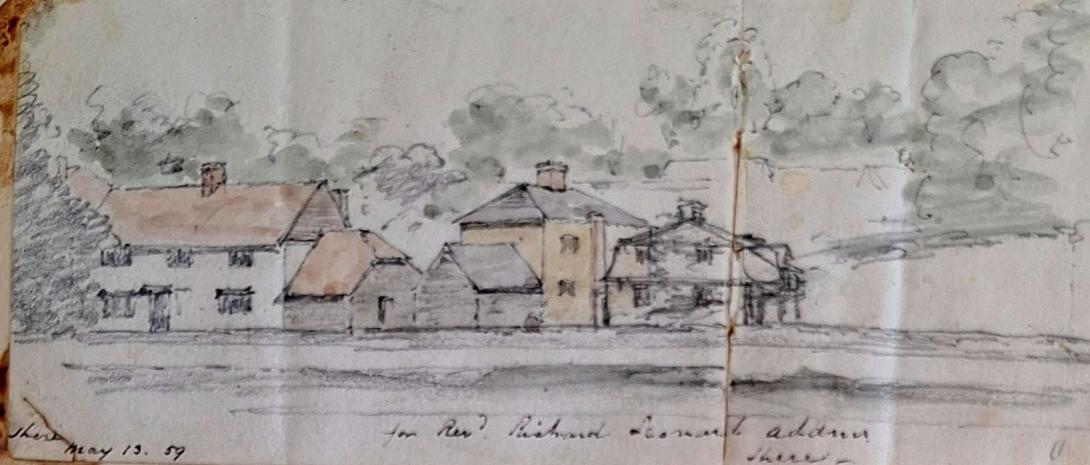
for revd Richard Sconnal Adams Shere May 13 1859
Shere's Old Rectory, a Grade II listed building, boasts origins potentially back to the 1500s, featuring notable elements like a "plague door" and a significant Cedar tree, once associated with Jarvis Kenrick, who scored football's first FA Cup goal, though the main rectory for St Mary's is now on Whyteleafe Road, with the historic building serving as a local landmark and testament to village history. While its exact origins are debated, evidence suggests parts of the building date back to the 16th century (1500s). It's a substantial house, traditionally built for an important figure in the community, often with grand reception rooms and bedrooms. A heavily studded door on the building is believed to mark a plague victim, a common feature in older buildings. A large cedar tree, possibly planted around 1770, stands as a prominent feature in the village. A plaque on the Old Rectory commemorates Jarvis Kenrick, who scored the first goal in the FA Cup's history.The original rectory for St Mary's, the building is now a notable part of Shere's landscape, distinct from the modern rectory on Whyteleafe Road.
Shere is a village in the Guildford district of Surrey, England 4.8 miles (7.7 km) east south-east of Guildford and 5.4 miles (8.7 km) west of Dorking, centrally bypassed by the A25. Located on the River Tillingbourne it is a small still partly agricultural village chiefly set in the wooded Vale of Holmesdale between the North Downs and Greensand Ridge. As of 2011 the village had a population of 1,032.
The village gives its name to the larger civil parish of Shere, extending to the east and south into hamlets founded in the early Middle Ages which officially, in the 19th century, were consolidated into three villages; Gomshall, Holmbury St. Mary and Peaslake. This larger entity has a total population of 3,359 and area of 24.5 square kilometres (9.5 sq mi) (as at the 2011 census).[
Shere appears in Domesday Book as Essira and Essire in the ancient hundred of Blackheath.[3] It was held by William the Conqueror. Its Domesday assets were: 1 church, 2 mills worth 10s per year, 14 ploughs, 3 acres (1.2 ha) of meadow, woodland worth 50 hogs. It rendered £15 per year to its overlords.[3][4][5]
In 1086, when Gomshall was royal demesne, the villeins (villagers) there were exempt from the sheriff's jurisdiction; Gomshall Netley and Gomshall Towerhill manors had court baron. Eleanor, Countess of Ormond owning the Vachery manor, had view of frankpledge in Gomshall Towerhill. In 1281 William Braose was granted free warren there
In the 13th century Roger de Clare settled for a life-rent on the church and sold the manor of Shere to a grandson of Geoffrey Fitz Peter, 1st Earl of Essex. In turn his grandson divided the manor, according with the law of moiety title to his daughter Joan Butler who thus received the new manor of Shiere Vachery; while Richard Óg de Burgh, 2nd Earl of Ulster ('the red Earl') received Shiere Ebor(acum). Two other manors evolved.
The Victoria County History (Surrey: 1911) cites numerous mentions in the Assize Rolls, Patent Rolls, Feet of Fines and the ecclesiastical records of Westminster and Lambeth Palaces. Traditionally the parish included the areas of the current civil parish and measured about 4+1⁄2 miles from north to south, and from 2 to 2+1⁄2 miles from east to west and contained 6,400 acres of land and 12 of water.
The neighbourhood was for a time one of the wildest in Surrey: sheep-stealers, smugglers, and poachers found a refuge in these remote hills. Some of the cottages have, still existing, very large cellars (excavated easily in the sandy hill), stated by H.E. Malden to have been "far too large for any honest purpose, and were no doubt made for storing smuggled goods till they could be conveniently taken on to London".
In 1671, a Shere man called Edward Bound was charged by church authorities with "playing cricket on the Sabbath" and was exonerated, one of the sport's earliest references.
Iron was worked from the stone and into implements in centuries before the 18th century in Shere. In 1911 great quantities of watercress were grown which is no longer the case; the principal area in southern England for this being near New Alresford in Hampshire.
Holmbury St. Mary up in the Greensand Ridge was a modern village term devised in 1878 for the two hamlets of Felday in Shere and Pitland Street in Shere and Abinger, when the place became a civil parish and ecclesiastical parish. The Church of England schools were built in 1860 and enlarged in 1900.
Shere Infant and Nursery School has been serving the local community since 1852, celebrating its 175th birthday in 2017. The school received a 'Good' status from the Ofsted inspection in December 2015.
The church of St James is in the Early English style, most being 12th, 13th and 14th century. It replaced an earlier Anglo-Saxon church mentioned in the Domesday Book. Constructed of ironstone rubble with sandstone buttresses, it was restored in 1895 by S. Weatherley. By the north chancel wall there is a 14th-century quatrefoil window and squint – belonging to an Anchorite cell used by Christina Carpenter in the 14th-century. There is 14th-century glass in the east window and the chancel fittings were renewed in 1956 by Louis Osman. It is a Grade I listed building.
Richard Suter was born in Greenwich, Kent on 30th March 1798, to William Suter and his wife Sarah Knights. On 7th January 1825 he married Anne Ruth Burn.
English architect. As Surveyor to The Fishmongers' Company he designed the severe Presbyterian churches for Ballykelly (1825–7) and Banagher (1825) on the Company's Estate in County Londonderry, drawings of which were exhibited at the Royal Academy in 1827. He was also responsible for the Model Farm (1823–4), the Lancasterian Schools (1828–30), the Company Agent's House (1830–2—now a hotel, much altered), a range of houses on the south side of the main road (1823–4), the lodge in the Presbyterian churchyard (1828), and the Dispensary (1829), all at Ballykelly, and all Classical. As Surveyor to Trinity House Corporation, he designed houses that were erected by Thomas Cubitt in 1821–3 on a site adjoining Trinity House. For The Fishmongers' Company he designed St Peter's Almshouses, Wandsworth, London (1849–51), and The Old School-House, Gresham's School, Holt, Norfolk(1859), in an Elizabethan style.
On the 1841 Census Richard, an architect and lawyer, can be found living in London with his wife Ann (listed as Ruth) and their two children, Richard George and Andrew Burn. Living with them is Edward D Suter. 1851 finds the family living in Tottenham Court in London, by this time Andrew had left the home, but I am unable to trace him on the 1851 Census. In 1860 Andrew marries Amelia Damaris Harrison. Both Richard George and Andrew were to become ordained ministers, with Andrew later becoming a Bishop and emigrating to New Zealand. Sadly in 1854 Anne Ruth was to pass away. In 1861, widowed Richard, Justice of the Peace for Maidenhead, is living at Castle Hill, Maidenhead, Berkshire. In 1862 he married Elizabeth Anne Pocock. In 1871 and 1881 Richard and Elizabeth are still living in Castle Hill. Richard was to pass away on 1st March1883.
Richard Suter & Annesley Voysey, architects, had their office at number 35 Fenchurch Street, but they did not have it all to themselves as they shared the premises with W.C. Franks, a tea broker, who will get a separate post some other time. The earliest mention I found of Richard Suter in Fenchurch Street is in 1832 when he is listed at that address in a list of contributing members of the Society for the Propagation of the Gospel in Foreign Parts. It says that he had been a member since 1829, but that does not mean he was already at 35 Fenchurch Street in that year.(1) In fact, that seems unlikely as the Sun Fire Office records give Messrs. Short and Co., merchants, as paying the insurance premium on the premises in May 1830. The Directory of British Architects 1834-1914 give the year 1827, but I do not know on what evidence. When Suter and Voysey became partners is also uncertain, but they had known each other since at least 1825 as Suter is named as one of the executors of Voysey’s will which was dated 22 July, 1825. The address given for Suter in the will is Suffolk Street, Southwark. Voysey then lives at Conway Street, Fitzroy Square.