
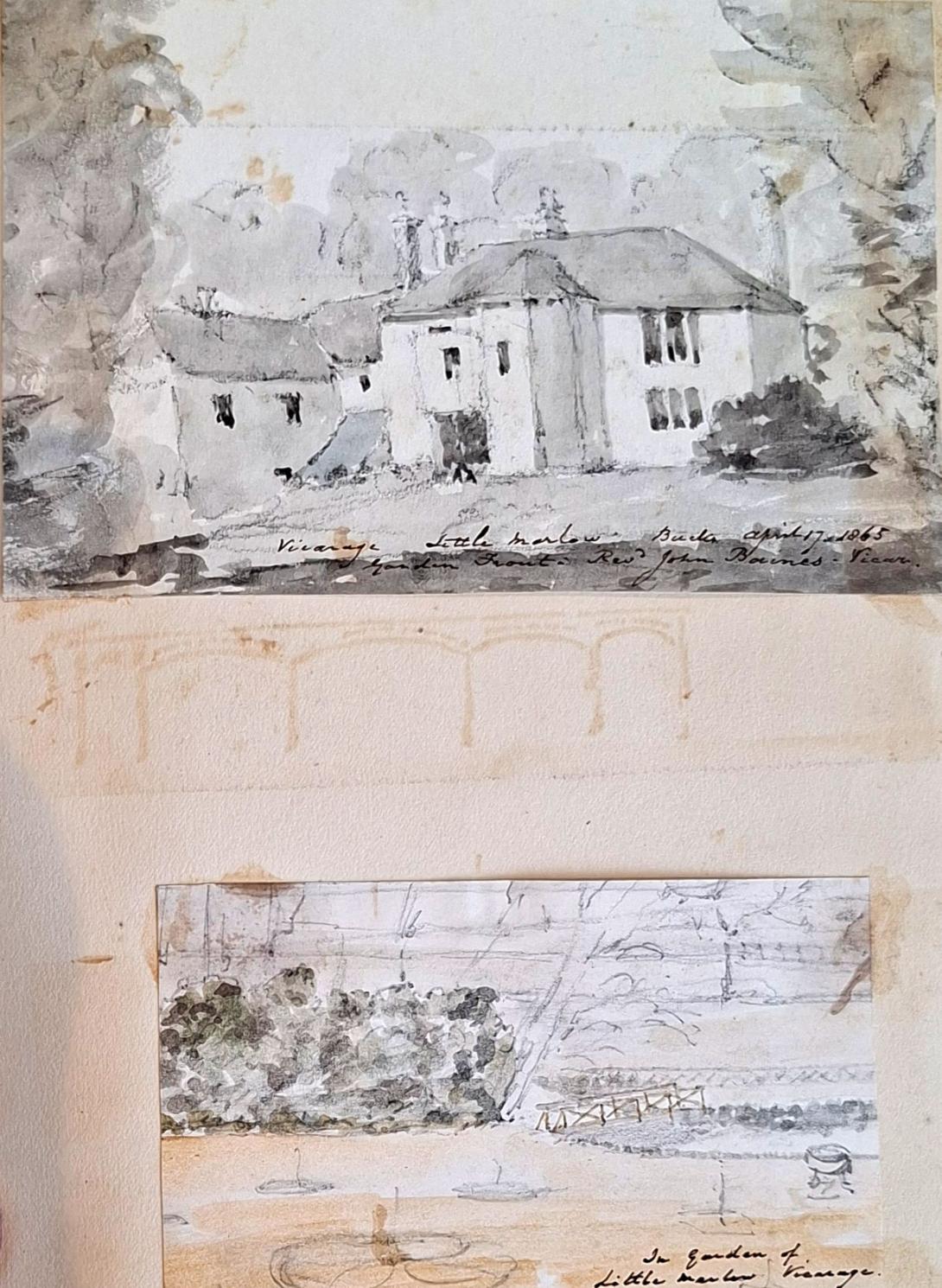
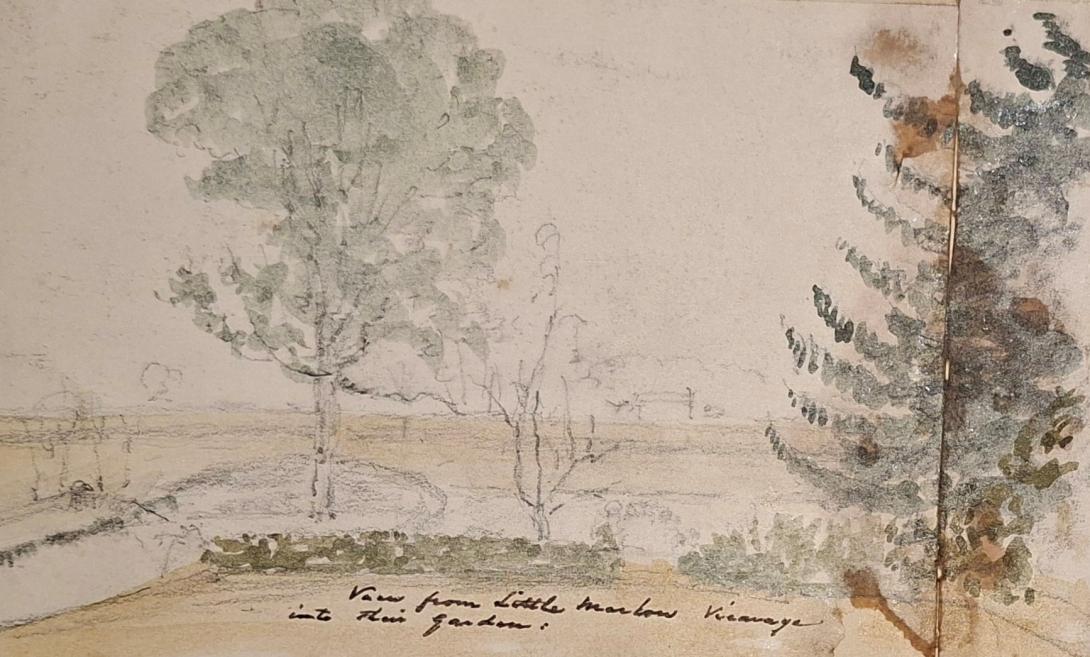
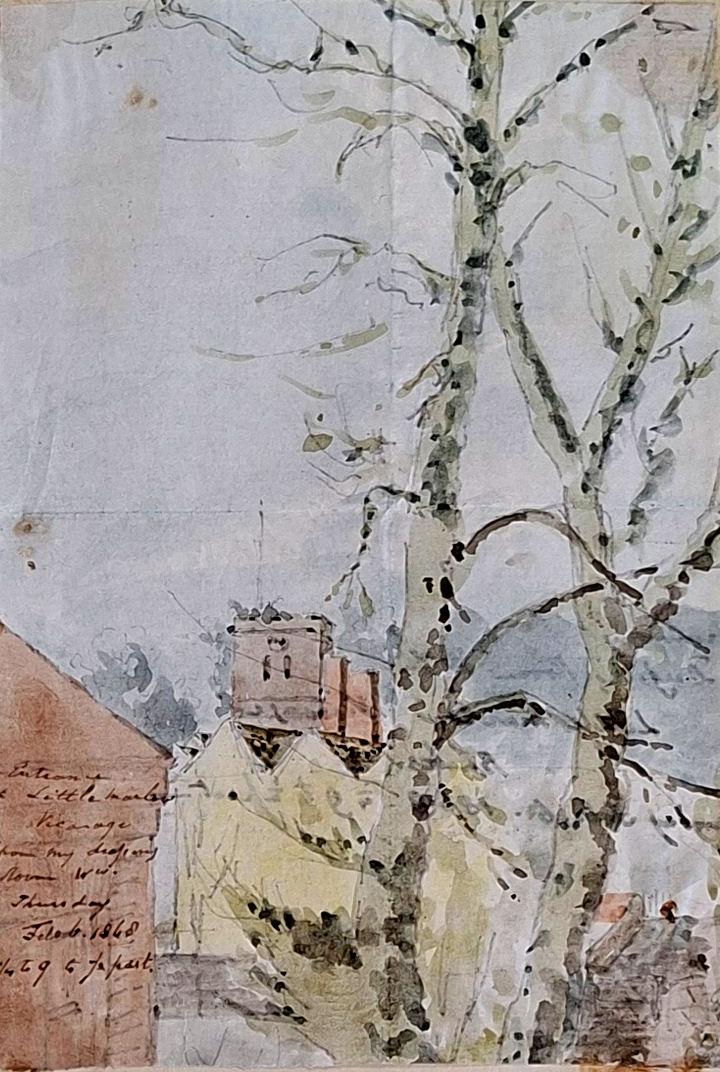
Vicarage Little Marlow Bucks April 17 1865 Garden Front Revd John Baines Vicar and Entrance at Little Marlow Vicarage from my dressing room Thursday Feb 6th 1868" (4)
LITTLE MARLOW CHURCH ROAD SU 88 NE The Old Vicarage 5/77 (formerly listed as Vicarage) 21.6.55 - II House, formerly vicarage. Circa 1770 with late C19 extensions to rear. For Rev. Price, incumbent 1763-1776 (T. Langley, Hundred of Desborough, 1797). Red brick with incised line pointing, narrow dentil eaves, hipped old tile roof, brick chimneys with offset heads. C19 brick chimney to right with pilasters and strings. 2 storeys and cellars, 3 bays. Tripartite sashes with glazing bars and gauged heads. 2 blocked cellar openings with segmental heads. Central door with 6 octagonal moulded panels, moulded wooden architrave surround, and wooden cornice on shaped scroll brackets with guttae. Right end, to the road, has C20 paired metal casement to the ground floor left, 2 C19 sashes to first floor, and a small C20 flat-roofed single-storey extension. C19 rear extension is of brick with 2 storeys and 2 bays of paired sashes to the garden. Semi-octagonal staircase projection to centre rear of original wing in angle with C19 block.
The Vicarage in Little Marlow, Buckinghamshire, is tied to the historic parish church (St. John the Baptist), with its history intertwined with local landowners, church benefactors (like the Knights Hospitallers who held land nearby), and the rural development from Saxon times, evolving from "land left after draining" into distinct Great and Little Marlow, reflecting centuries of English ecclesiastical and land history. Key Historical Context: Origins (Saxon/Norman): The area was once a lake, later drained, giving Marlow its name ("land left after a pond"). Little Marlow developed separately from Great Marlow, with different manorial histories. Land Ownership: Land in the area was held by figures like Godric, then Walter de Vernon, and later the Knights Hospitallers, who acquired land in the 13th century, establishing significant influence.
The Old Vicarage of circa 1770 Old Vicarage of circa 1770 and the early 19th century south range of the
Manor House were the most important Georgian Manor house, were me most important Georgian additions to the conservation area, with other work consisting of small cottages, such as Wayside and Westover and Greengates, the last completed in 1796. Victorian architecture added the school and the estate cottages in Church Road while this catts century saw little expansion of the village.
Richard Suter was born in Greenwich, Kent on 30th March 1798, to William Suter and his wife Sarah Knights. On 7th January 1825 he married Anne Ruth Burn.
English architect. As Surveyor to The Fishmongers' Company he designed the severe Presbyterian churches for Ballykelly (1825–7) and Banagher (1825) on the Company's Estate in County Londonderry, drawings of which were exhibited at the Royal Academy in 1827. He was also responsible for the Model Farm (1823–4), the Lancasterian Schools (1828–30), the Company Agent's House (1830–2—now a hotel, much altered), a range of houses on the south side of the main road (1823–4), the lodge in the Presbyterian churchyard (1828), and the Dispensary (1829), all at Ballykelly, and all Classical. As Surveyor to Trinity House Corporation, he designed houses that were erected by Thomas Cubitt in 1821–3 on a site adjoining Trinity House. For The Fishmongers' Company he designed St Peter's Almshouses, Wandsworth, London (1849–51), and The Old School-House, Gresham's School, Holt, Norfolk(1859), in an Elizabethan style.
On the 1841 Census Richard, an architect and lawyer, can be found living in London with his wife Ann (listed as Ruth) and their two children, Richard George and Andrew Burn. Living with them is Edward D Suter. 1851 finds the family living in Tottenham Court in London, by this time Andrew had left the home, but I am unable to trace him on the 1851 Census. In 1860 Andrew marries Amelia Damaris Harrison. Both Richard George and Andrew were to become ordained ministers, with Andrew later becoming a Bishop and emigrating to New Zealand. Sadly in 1854 Anne Ruth was to pass away. In 1861, widowed Richard, Justice of the Peace for Maidenhead, is living at Castle Hill, Maidenhead, Berkshire. In 1862 he married Elizabeth Anne Pocock. In 1871 and 1881 Richard and Elizabeth are still living in Castle Hill. Richard was to pass away on 1st March1883.
Richard Suter & Annesley Voysey, architects, had their office at number 35 Fenchurch Street, but they did not have it all to themselves as they shared the premises with W.C. Franks, a tea broker, who will get a separate post some other time. The earliest mention I found of Richard Suter in Fenchurch Street is in 1832 when he is listed at that address in a list of contributing members of the Society for the Propagation of the Gospel in Foreign Parts. It says that he had been a member since 1829, but that does not mean he was already at 35 Fenchurch Street in that year.(1) In fact, that seems unlikely as the Sun Fire Office records give Messrs. Short and Co., merchants, as paying the insurance premium on the premises in May 1830. The Directory of British Architects 1834-1914 give the year 1827, but I do not know on what evidence. When Suter and Voysey became partners is also uncertain, but they had known each other since at least 1825 as Suter is named as one of the executors of Voysey’s will which was dated 22 July, 1825. The address given for Suter in the will is Suffolk Street, Southwark. Voysey then lives at Conway Street, Fitzroy Square.