
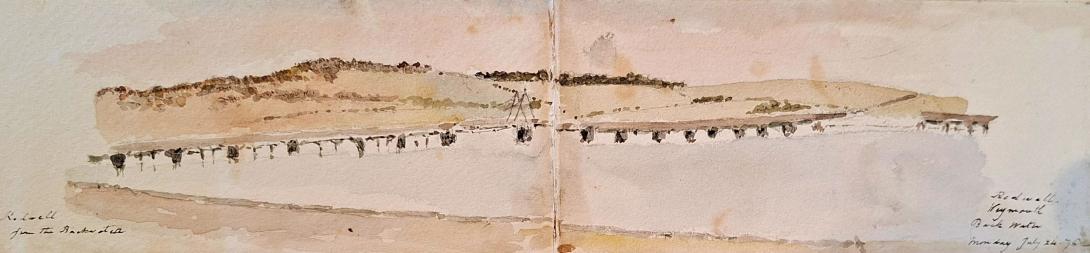
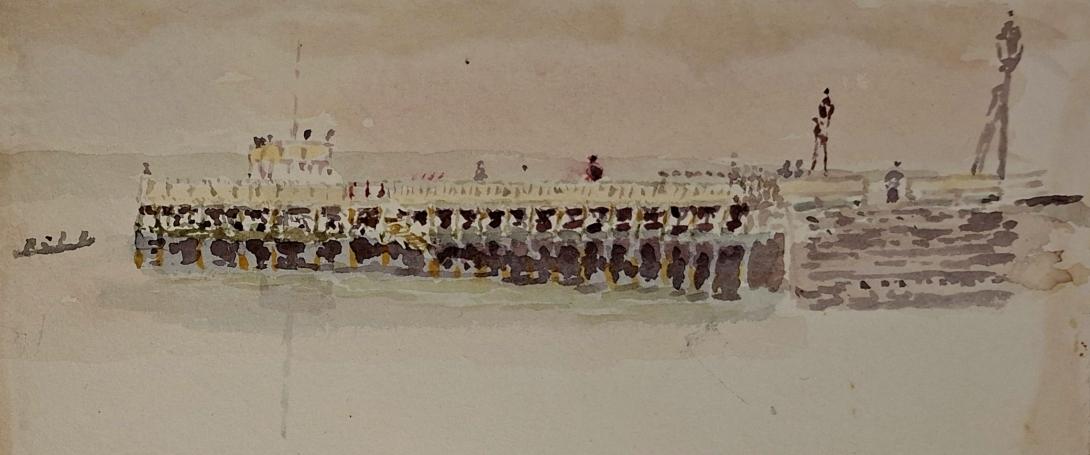
& the Weymouth Pier morning July 24th 1876 (3)
The Victorian also enjoyed the delights of this vast stretch of water, though not quite the same way that we do today.
The Backwater was so named because it literally was the back water to the sea front…before the dam was built in the harbour, it was tidal right up as far as Radipole. Boat excursions were popular in those days, bringing tourists up river for afternoon teas at Radipole. In 1847 a rare specimen of a fish was caught here, a King Fish of Shaw, otherwise known as Lampus Imperatus. It was a massive three feet in length, weighing in at a humongous 90 pounds.
So impressive was this fine (dead!) specimen that it was put on public display in Weymouth.The same year, a rare bird was spotted feeding in the lake, a Spoon-Bill, or Plateba Sencorodia of Pennant. It was claimed by the Victorian writer to be a most beautiful bird, measuring almost 2 foot in length from the tip of its beak to the end of its tail. The Victorians loved their natural sciences and revelled in new discoveries…only problem was they liked to keep hold of their unusual specimens, so first they shot them… then stuffed them!
Rodwell Backwater in Weymouth, Dorset, is a historic tidal inlet transformed by Victorian railway engineering (the Portland Branch Line) and land reclamation, evolving from a natural estuary used for industry and recreation into the Rodwell Trail, a popular walking/cycling path featuring the Backwater Viaduct, alongside wildlife habitats like Radipole Lake, preserving glimpses of its industrial past (like torpedo factories) and natural beauty. Key Historical Aspects: Victorian Railway Era (1860s-1960s): The Backwater was dramatically altered by the construction of the Weymouth & Portland Railway. The Marsh Embankment and the impressive Backwater Viaduct (later replaced by a steel structure in 1909) were built across it, connecting Weymouth to Portland. Engineering Feats: The railway required significant engineering, including the viaduct and a tunnel under Wyke Road, changing the landscape permanently. Industrial & Military Use: The area saw industrial development, including facilities for the torpedo factory, and military installations like Bofors gun emplacements, remnants of which can still be seen. Land Reclamation: Over time, parts of the Backwater were reclaimed for development (Commercial Road, Radipole Gardens), reducing its size but creating new land. Transformation into the Rodwell Trail: Closure of the Railway: Passenger services on the Portland line ended in 1952, with the line fully closing in 1965. Creation of the Trail: The former railway line was converted into the Rodwell Trail, a scenic path connecting Weymouth's harbour to Portland, with key features like the viaduct and old halts (like Westham Halt) preserved.
This one ‘dead-as-a-dodo Spoon Bill’ was down to a certain Mr Crocker Esquire no less.
Mind you, their habit of approaching the wildlife with guns rather than looking glasses sometimes literally backfired on them.
Such was the case in 1856.
Thirty two year old John Gillingham, a whitesmith from Melcombe Regis was on the Backwater in a boat with his wife, Eliza and young daughter, 12-year-old Sarah.John was out for a spot of sport, he had his fowling piece with him. He had just pulled into the side of the lake to let his wife and daughter off the boat, when somehow, the fully loaded gun that was resting in the boat suddenly discharged its contents, and young Sarah who was stood on the bank received the full blast of the shot at close range. Her arm was shattered with the force of the gun, and had to be amputated, the local paper stated that her life was in imminent danger. But Sarah was made of sterner stuff than that because by the next census, the family have moved to St Nicholas Street, where they ran the Welcome Home public house, and Sarah, now aged 18, is still listed as a student at that point.
*************************************************************************************************************
In July of 1864, a spot of tourism promotion was the name of the day when a local man, Mr John Brett wrote to the Southern Times extolling the virtues of a boat trip on the Radipole lake, advising visitors to the area (in such flowery terms as the Victorians seemed to revel in,) not to miss such a delightful experience.
Maybe todays tourist board should find such a fine fellow as he.
CORRESPONDANCE
A BACKWATER EXCURSION
To the Editor of the “Southern Times.”
SIR- It is much to be regretted that some of the most interesting scene and sources of pleasure are lost to our visitors from want of knowledge of the circumstances under which they may be enjoyed. Such is the case relative to the delightful trip to the charming little village of Radipole at spring tides or even a morning 10 or 11 o’clock tide. No lake in Cumberland can be more lovely than our estuary at high water in the summer season.
Fringed even to its margin with fields of grain or over-hanging honeysuckles, resounding with the song of the cuckoo, the lark, and the blackbird, often has my heart been ravished while gliding smoothly over its glassy waters at their contemplation, and while my thoughts have ascended from nature up to nature’s God, they have found language in the words of the poet-
“These are thy glorious works
Parent of Good.-Almighty.
Thine this universal frame
Thus wondrous fair,
Thyself how wondrous then.”
After a morning spent upon the briny deep in viewing the boundless ocean and its margin of magnificent cliffs of chalk, or its cavers that the ceaseless waters have worn on the coast, how sweet to vary the scene by an evening trip on the placid waters that isolate our town from the main. A farm, ancient and substantial, adjoining the church, will kindly furnish refreshments of the class used at the marriage at Cann, in Galilee, as well as those of a less stimulating property. Our worthy old townsmen, Caddy, will furnish a boat like an old family coach, in which the children may dance Scotch reels, or possibly old Davy himself may amuse his fare with a hornpipe man-‘o-war fashion. As I know that, like myself, you are desirous of giving our visitors all possible enjoyment during their excursions, I lay aside the deep and important matters that are my usual study to refresh myself with this light ebullition, and request your kind insertion thereof.
Yours truly,
Weymouth
JOHN BRETT
***********************************************************************************************************
Even though some of the more enlightened Victorian people saw the beauty around them for what it was, a pleasure to enjoy, many still wanted to capture those fleeting moments for all time, but were destructive to the nth degree in doing so!
‘1870 5 NOV
OSPREY AND LITTLE AUK AT WEYMOUTH. -Mr. William Thompson, writing to the Field, says :- An adult male osprey (Pandion Halicetus Gould ) was killed in the Backwater of Weymouth on September 22 last, and is now in my possession, having been brought to me in the flesh the same day. It was observed on the feed the previous day, when it caught a fish, either a mullet or bass. The osprey soared with its prey to some height, when it fell; but the hawk, making a swoop, recovered the fish before it touched the water, and flew with it inland. On the following day the osprey was again seen flying towards the Weymouth Back Harbour, and mobbed by some rooks and a kestrel. The birds crossed the Backwater, and on nearing the railway station the rooks beat a retreat; but not so the kestrel, who attacked the osprey, and gave the gunner the opportunity of bringing down the osprey with the right hand barrel, and the kestrel with the left. The kestrel was a female. Gillingham tells me that the osprey screamed when attacked by the kestrel. Little auk (Mergulus melanoleucos) was shot on the same day in the Weymouth Backwater.’
‘1884 6 DEC
HAMPSHIRE ADVERTISER
AN OTTER SHOT IN THE BACKWATER.
On Thursday a man, name Brewer, shot a fine dog otter in the Backwater. From tip to tail it measured over 3 feet, and it was in splendid condition. A short time since the female was trapped. There are now two young otters in the neighbourhood of the Backwater.’
(Mr Brewer was actually the keeper of the swans, he fed them three times a day, took care of their every need, and was to frequently be seen on picture postcards of the era in his rowing boat attending the regal birds.)
During the 1870’s serious discussions had begun on reclaiming parts of the Backwater, but the major fears that once the tidal flows of the estuary were interfered with problems would arise in the harbour, the natural ebb and flow of the tides scoured the sands from the harbour, some were convinced that altering the lie of the land and nature would ultimately result in Weymouth harbour silting up altogether.
As we now know, this large open expanse of waterway has slowly been eroded over the years with various plots of land reclaimed from the brine, being created here and there for building purposes, Commercial Road, Radipole gardens, Melcombe Regis gardens….until the Radipole Lake is a mere shadow of its former self.
But its history has so many more stories to tell, murder, tragedy, joy….that’s for another time.
Weymouth Pier is a peninsula between Weymouth Harbour and Weymouth Beach, in Dorset, England. It was intended to extend Weymouth's esplanade, and consists of a theatre, Weymouth Pavilion, pleasure pier, car parking and a cross-channel ferry terminal. The entire site underwent redevelopment to include new facilities for the 2012 Olympic Games, including the Weymouth Sea Life Tower.

There is little documented history of the origins of Weymouth Pier, though it is believed that a structure existed as early as 1812.
Costing £120,000 in 1933, the pier was constructed in reinforced concrete, reaching a length of 400 metres (1,300 ft) and varying between 30 metres (100 ft) in width at the shoreward end and 12 metres (40 ft) at the seaward end.
When built, the pier was divided into two halves. The southern side of the deck was reserved for commercial use, and was fitted out to load and unload cargo from harbour ships, including electric cranes, electrically operated capstans and two railway tracks. The pier was capable of handling one passenger vessel, three cargo vessels and two pleasure steamers simultaneously.
The northern side, fenced off from the industrial section, was a promenade area. This included shelters, a diving stage, changing rooms, and at night the whole promenade area would be illuminated, with views across Weymouth Bay and Nothe Fort.
- 1840: Considerable change was made to the port area when a pile-pier, filled with a mixture of Portland stone and shingle concrete, was built on the northern edge of the harbour;
- 1860 Weymouth Pier was largely rebuilt in timber and at the same time, extended to a length of 273 metres (900 ft);
- 1877: A cargo stage was added;
- 1889: A landing stage and baggage handling hall were built;
- 1908: The Weymouth Pavilion opened;
- 1930s: The pier was rebuilt;
- 13 July 1933: The new Weymouth Pier officially opened; the ceremony was carried out by the Prince of Wales, soon to become King Edward VIII;[2]
- 1954: The Ritz Theatre Renamed after the war) was destroyed in a fire;
- 1961: A New Pavilion opened;
- 1971–1972 The pier was widened to create a new terminal and a large car park to serve the ferry port and Weymouth Pavilion
- 1993: The Alexandra Gardens Theatre damaged by fire;
- 2007–2011: Redevelopment of the entire peninsula was planned for the 2012 Olympic Games but apart from an observation tower (known as Jurassic Skyline) this did not take place.
Richard Suter was born in Greenwich, Kent on 30th March 1798, to William Suter and his wife Sarah Knights. On 7th January 1825 he married Anne Ruth Burn.
English architect. As Surveyor to The Fishmongers' Company he designed the severe Presbyterian churches for Ballykelly (1825–7) and Banagher (1825) on the Company's Estate in County Londonderry, drawings of which were exhibited at the Royal Academy in 1827. He was also responsible for the Model Farm (1823–4), the Lancasterian Schools (1828–30), the Company Agent's House (1830–2—now a hotel, much altered), a range of houses on the south side of the main road (1823–4), the lodge in the Presbyterian churchyard (1828), and the Dispensary (1829), all at Ballykelly, and all Classical. As Surveyor to Trinity House Corporation, he designed houses that were erected by Thomas Cubitt in 1821–3 on a site adjoining Trinity House. For The Fishmongers' Company he designed St Peter's Almshouses, Wandsworth, London (1849–51), and The Old School-House, Gresham's School, Holt, Norfolk(1859), in an Elizabethan style.
On the 1841 Census Richard, an architect and lawyer, can be found living in London with his wife Ann (listed as Ruth) and their two children, Richard George and Andrew Burn. Living with them is Edward D Suter. 1851 finds the family living in Tottenham Court in London, by this time Andrew had left the home, but I am unable to trace him on the 1851 Census. In 1860 Andrew marries Amelia Damaris Harrison. Both Richard George and Andrew were to become ordained ministers, with Andrew later becoming a Bishop and emigrating to New Zealand. Sadly in 1854 Anne Ruth was to pass away. In 1861, widowed Richard, Justice of the Peace for Maidenhead, is living at Castle Hill, Maidenhead, Berkshire. In 1862 he married Elizabeth Anne Pocock. In 1871 and 1881 Richard and Elizabeth are still living in Castle Hill. Richard was to pass away on 1st March1883.
Richard Suter & Annesley Voysey, architects, had their office at number 35 Fenchurch Street, but they did not have it all to themselves as they shared the premises with W.C. Franks, a tea broker, who will get a separate post some other time. The earliest mention I found of Richard Suter in Fenchurch Street is in 1832 when he is listed at that address in a list of contributing members of the Society for the Propagation of the Gospel in Foreign Parts. It says that he had been a member since 1829, but that does not mean he was already at 35 Fenchurch Street in that year.(1) In fact, that seems unlikely as the Sun Fire Office records give Messrs. Short and Co., merchants, as paying the insurance premium on the premises in May 1830. The Directory of British Architects 1834-1914 give the year 1827, but I do not know on what evidence. When Suter and Voysey became partners is also uncertain, but they had known each other since at least 1825 as Suter is named as one of the executors of Voysey’s will which was dated 22 July, 1825. The address given for Suter in the will is Suffolk Street, Southwark. Voysey then lives at Conway Street, Fitzroy Square.