
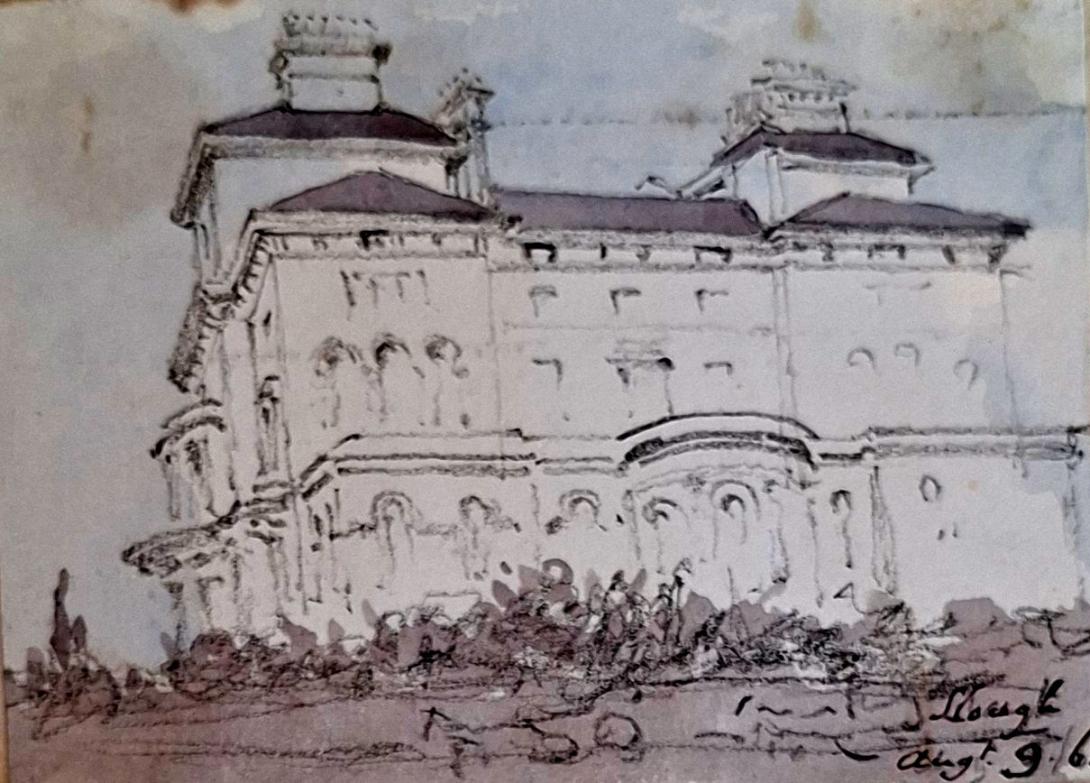
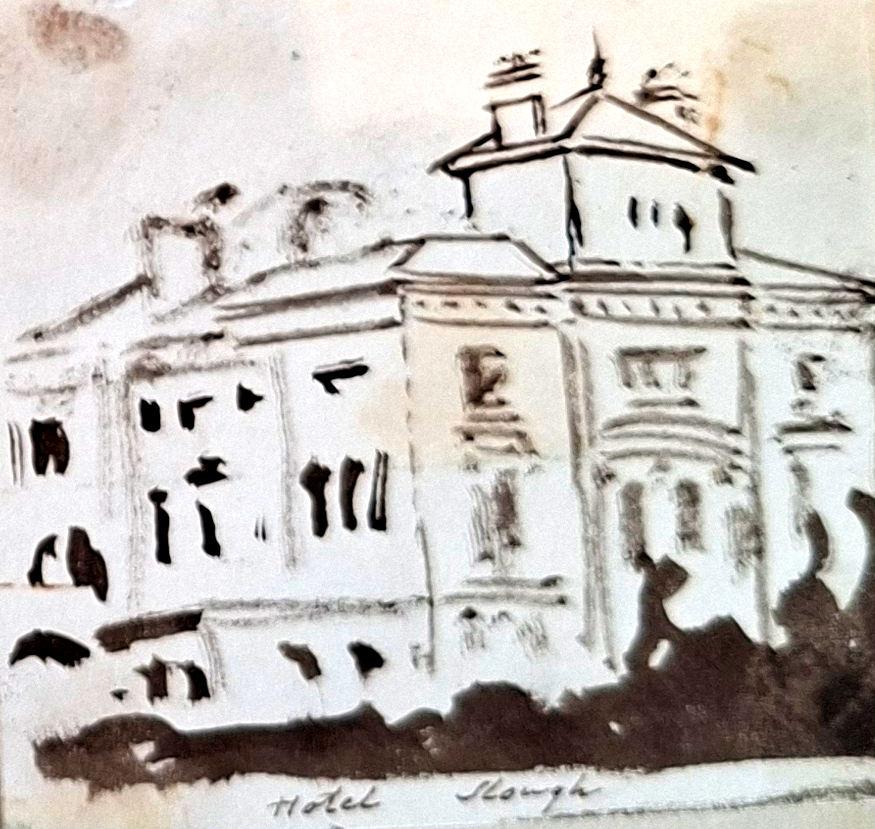
Slough Aug 9 61 and Hotel Slough
The Royal Hotel opened in 1842 and was used by Queen Victoria on her journeys to and from Paddington until a railway line to Windsor was built in 1849. The hotel was built by Charles Dotesio; it was constructed of yellow brick and stood in beautiful grounds. It was said to have some furniture from the royal palace at Versailles which had passed into the hands of dealers after the French Revolution, and some valuable Gobelin tapestries. Following the opening of the branch line to Windsor, the Royal Hotel fell upon hard times. Dotesio gave up the hotel in 1852 and the building was empty for many years. In 1863, Major Edward Mackenzie of Fawley Court near Henley gave the British Orphan Asylum the sum of £14,000 to buy and adapt the Royal Hotel as its new home.
The first station in Slough opened in 1840 and consisted of two separate buildings, some distance apart. On building was for 'down' traffic while the other was for 'up' traffic. For many years the station buildings were little more than ornamental sheds.There were two Royal Waiting Rooms, one for each up and down line and positioned furthest from the engine.The Windsor branch line from Slough opened in 1849. The Royal Hotel was built by a Monsieur Charles Dotesio of Corsican extraction. He managed to obtain financial backing and a licence was granted in September 1841 to build the hotel on the south side of the railway. When the branch line to Windsor was opened the hotel fell on hard times and lost overnight passengers and the Royal Posting between Windsor and Slough. In 1852 the hotel closed and remained empty for 11 years. In 1863 the building was altered to become the British Orphan Asylum and was opened the same year by the Prince and Princess of Wales. The Orphan Asylum moved in 1920 to Watford and the building was purchased by the Licensed Victuallers' Orphanage. It was pulled down in 1938 after construction of the Licensed Victuallers' School and now the site is occupied by Tescos.
Richard Suter was born in Greenwich, Kent on 30th March 1798, to William Suter and his wife Sarah Knights. On 7th January 1825 he married Anne Ruth Burn.
English architect. As Surveyor to The Fishmongers' Company he designed the severe Presbyterian churches for Ballykelly (1825–7) and Banagher (1825) on the Company's Estate in County Londonderry, drawings of which were exhibited at the Royal Academy in 1827. He was also responsible for the Model Farm (1823–4), the Lancasterian Schools (1828–30), the Company Agent's House (1830–2—now a hotel, much altered), a range of houses on the south side of the main road (1823–4), the lodge in the Presbyterian churchyard (1828), and the Dispensary (1829), all at Ballykelly, and all Classical. As Surveyor to Trinity House Corporation, he designed houses that were erected by Thomas Cubitt in 1821–3 on a site adjoining Trinity House. For The Fishmongers' Company he designed St Peter's Almshouses, Wandsworth, London (1849–51), and The Old School-House, Gresham's School, Holt, Norfolk(1859), in an Elizabethan style.
On the 1841 Census Richard, an architect and lawyer, can be found living in London with his wife Ann (listed as Ruth) and their two children, Richard George and Andrew Burn. Living with them is Edward D Suter. 1851 finds the family living in Tottenham Court in London, by this time Andrew had left the home, but I am unable to trace him on the 1851 Census. In 1860 Andrew marries Amelia Damaris Harrison. Both Richard George and Andrew were to become ordained ministers, with Andrew later becoming a Bishop and emigrating to New Zealand. Sadly in 1854 Anne Ruth was to pass away. In 1861, widowed Richard, Justice of the Peace for Maidenhead, is living at Castle Hill, Maidenhead, Berkshire. In 1862 he married Elizabeth Anne Pocock. In 1871 and 1881 Richard and Elizabeth are still living in Castle Hill. Richard was to pass away on 1st March1883.
Richard Suter & Annesley Voysey, architects, had their office at number 35 Fenchurch Street, but they did not have it all to themselves as they shared the premises with W.C. Franks, a tea broker, who will get a separate post some other time. The earliest mention I found of Richard Suter in Fenchurch Street is in 1832 when he is listed at that address in a list of contributing members of the Society for the Propagation of the Gospel in Foreign Parts. It says that he had been a member since 1829, but that does not mean he was already at 35 Fenchurch Street in that year. In fact, that seems unlikely as the Sun Fire Office records give Messrs. Short and Co., merchants, as paying the insurance premium on the premises in May 1830. The Directory of British Architects 1834-1914 give the year 1827, but I do not know on what evidence. When Suter and Voysey became partners is also uncertain, but they had known each other since at least 1825 as Suter is named as one of the executors of Voysey’s will which was dated 22 July, 1825. The address given for Suter in the will is Suffolk Street, Southwark. Voysey then lives at Conway Street, Fitzroy Square.