
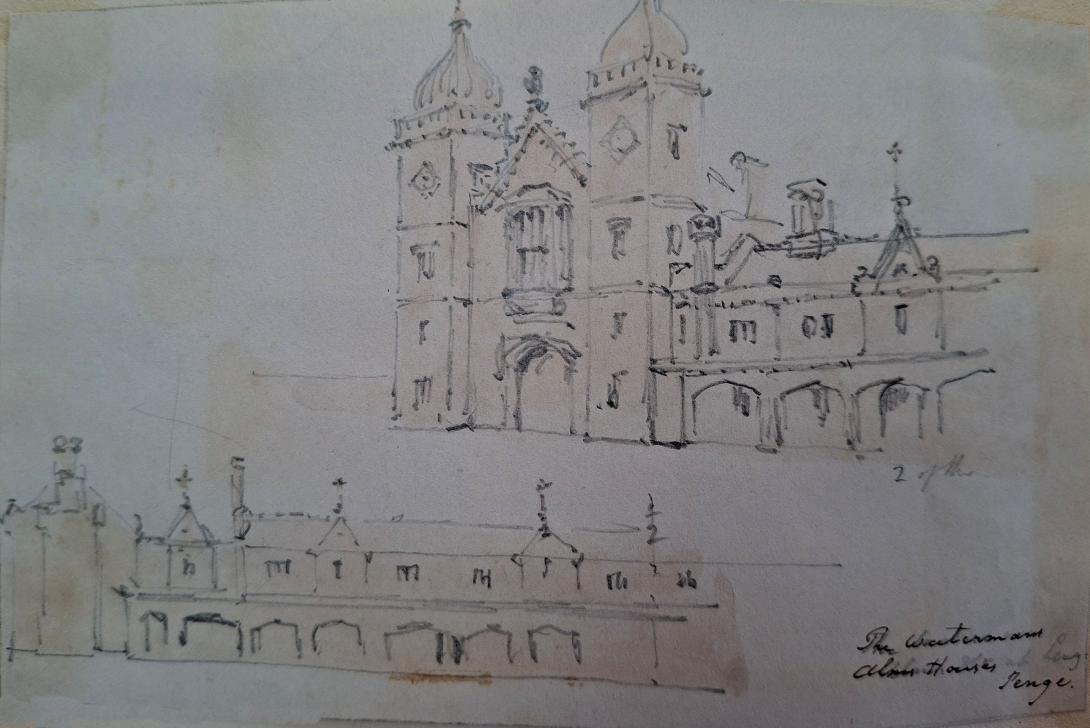
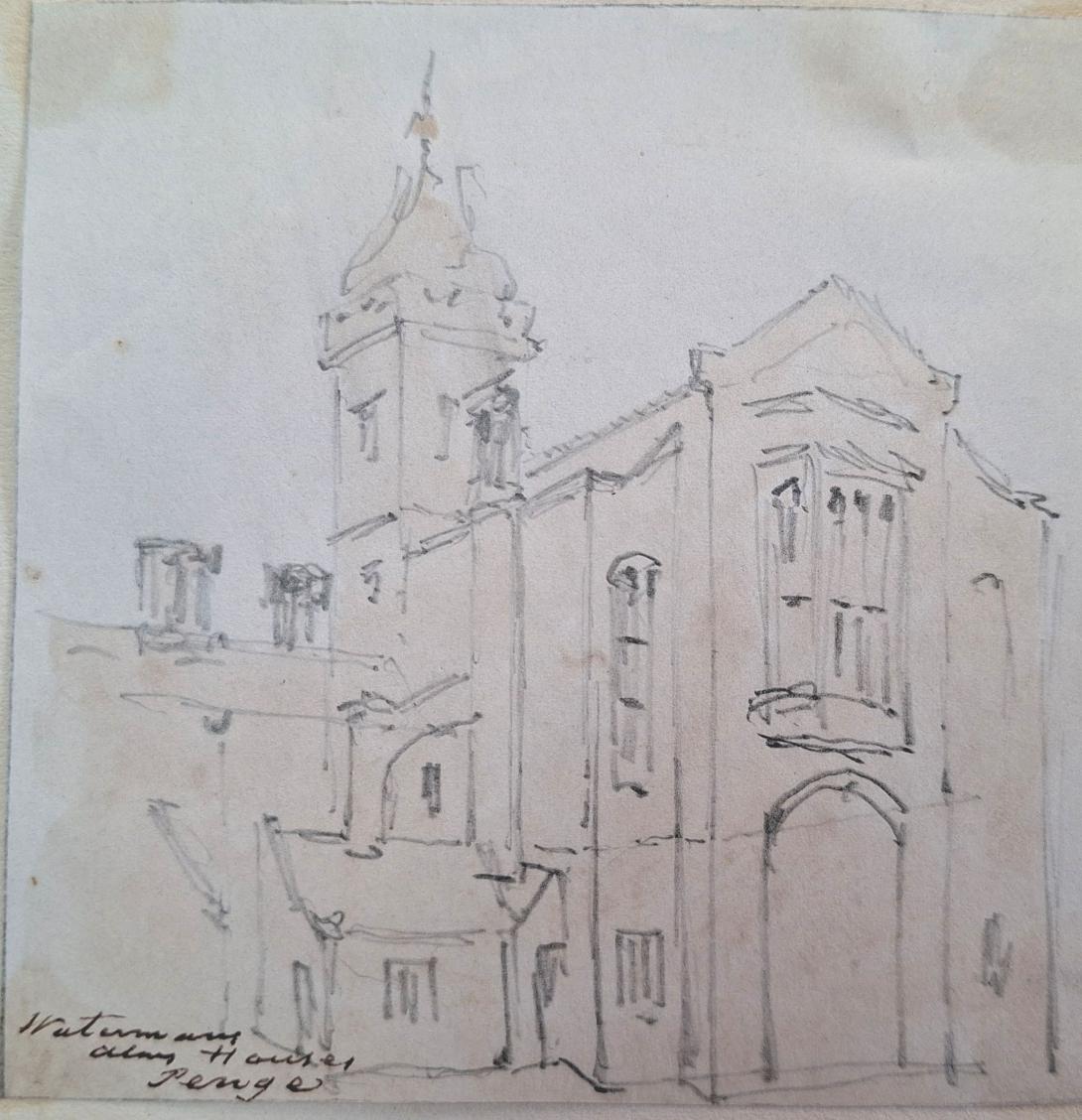
inscribed " Watermans / Alms Houses/ Penge"
Their mid-Victorian splendor is partially hidden behind high ornate iron railings on the high street, although some open on to Penge Lane behind small cottage gardens. There is the three-sided design of the period: blocks of housing surrounding a central garden or recreation area.
The former central chapel has attractive leaded windows and is topped by the blue and gold clock and a wind vane. In the central garden there are lawns and flowerbeds with a tall central marble obelisk and a long high wall with gargoyle statues atop. One of the gargoyles (heraldic beasts) inspired the Penge Heritage Trail logo.
The quirkiness of this Tudor revival masterpiece seems to anticipate the weirdness of Lewis Carroll’s Alice in Wonderland by twenty five years. A White Rabbit just might go scuttling by. They are unique in Britain and are locally and nationally-listed buildings since 1973. Although very compact inside, they do have access to a communal garden area which was a Victorian ideal.
Historic England has this to say: ‘These Almshouses were for aged watermen and lightermen and were built in 1839-4. The architect was George Porter. The ground was given by James Dudin Brown. They form 3 sides of a courtyard. 2 storeys. White brick. In the centre of the main block are 2 square towers of 4 storeys each with ogee-shaped lead. Between is a crow-stepped gable containing a royal cartouche and below an oriel window of 2 tiers of 5 lights on the first floor and a 4 centred archway on the ground floor. On each side of this central feature the centre block has 7 windows and 2 gables. The side blocks at right angles have 13 windows and 5 gables each. Projecting cloister to the whole. A balustrade completes the 4th side with 3 entrances flanked by brick piers surmounted by heraldic beasts.’
The almshouses were built in the days when Penge was a rural hamlet surrounded by Penge Common. The adjoining St John’s church was built a few years later, as wer the magnificent King William IV cottages. All three projects witnessed the Victorian philanthropic concern for the poor and the marginalized. And all three are splendid examples of mid-Victorian architecture. Some are nationally and locally-listed buildings.
The watermen ferried people across the Thames during the Victorian era when there was only one bridge. The lightermen were pilots of small boats who delivered goods from larger ships to the banks of the river. Ornate fish emblems fashioned in iron can be seen on the beautiful cast iron and wood water pump inside the grounds. Similar fish emblems in ironwork can be seen along the banks of the Thames at Westminster.
The residents moved out in 1973 to bungalows in Hastings. The alms-houses are now privately-owned. Unique in this country, they are one of the glories of Britain, let alone Penge.
Richard Suter (1797–1883).
Richard Suter was born in Greenwich, Kent on 30th March 1798, to William Suter and his wife Sarah Knights. On 7th January 1825 he married Anne Ruth Burn.
English architect. As Surveyor to The Fishmongers' Company he designed the severe Presbyterian churches for Ballykelly (1825–7) and Banagher (1825) on the Company's Estate in County Londonderry, drawings of which were exhibited at the Royal Academy in 1827. He was also responsible for the Model Farm (1823–4), the Lancasterian Schools (1828–30), the Company Agent's House (1830–2—now a hotel, much altered), a range of houses on the south side of the main road (1823–4), the lodge in the Presbyterian churchyard (1828), and the Dispensary (1829), all at Ballykelly, and all Classical. As Surveyor to Trinity House Corporation, he designed houses that were erected by Thomas Cubitt in 1821–3 on a site adjoining Trinity House. For The Fishmongers' Company he designed St Peter's Almshouses, Wandsworth, London (1849–51), and The Old School-House, Gresham's School, Holt, Norfolk(1859), in an Elizabethan style.
On the 1841 Census Richard, an architect and lawyer, can be found living in London with his wife Ann (listed as Ruth) and their two children, Richard George and Andrew Burn. Living with them is Edward D Suter. 1851 finds the family living in Tottenham Court in London, by this time Andrew had left the home, but I am unable to trace him on the 1851 Census. In 1860 Andrew marries Amelia Damaris Harrison. Both Richard George and Andrew were to become ordained ministers, with Andrew later becoming a Bishop and emigrating to New Zealand. Sadly in 1854 Anne Ruth was to pass away. In 1861, widowed Richard, Justice of the Peace for Maidenhead, is living at Castle Hill, Maidenhead, Berkshire. In 1862 he married Elizabeth Anne Pocock. In 1871 and 1881 Richard and Elizabeth are still living in Castle Hill. Richard was to pass away on 1st March1883.
Richard Suter & Annesley Voysey, architects, had their office at number 35 Fenchurch Street, but they did not have it all to themselves as they shared the premises with W.C. Franks, a tea broker, who will get a separate post some other time. The earliest mention I found of Richard Suter in Fenchurch Street is in 1832 when he is listed at that address in a list of contributing members of the Society for the Propagation of the Gospel in Foreign Parts. It says that he had been a member since 1829, but that does not mean he was already at 35 Fenchurch Street in that year.(1) In fact, that seems unlikely as the Sun Fire Office records give Messrs. Short and Co., merchants, as paying the insurance premium on the premises in May 1830. The Directory of British Architects 1834-1914 give the year 1827, but I do not know on what evidence. When Suter and Voysey became partners is also uncertain, but they had known each other since at least 1825 as Suter is named as one of the executors of Voysey’s will which was dated 22 July, 1825. The address given for Suter in the will is Suffolk Street, Southwark. Voysey then lives at Conway Street, Fitzroy Square.