
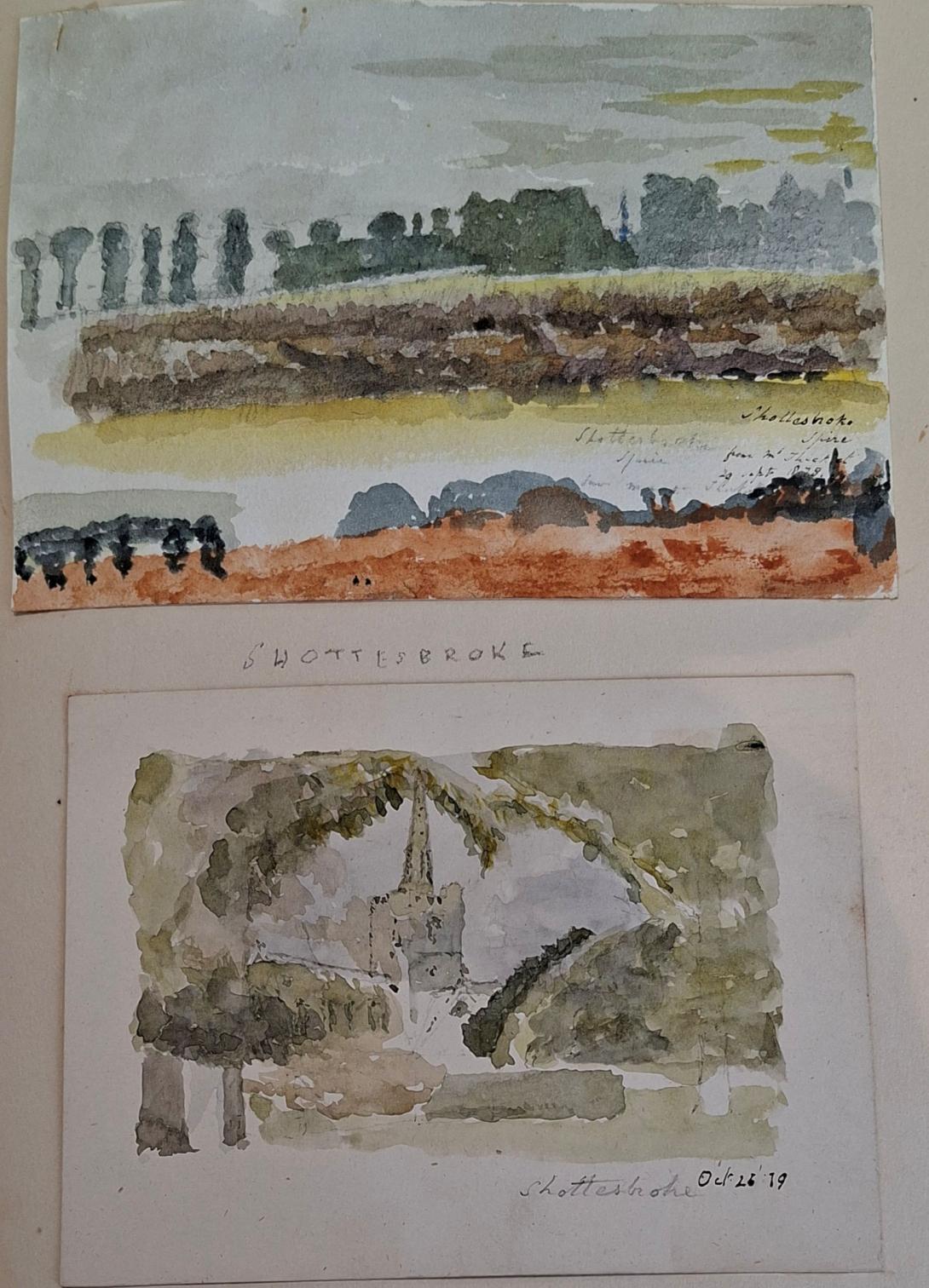
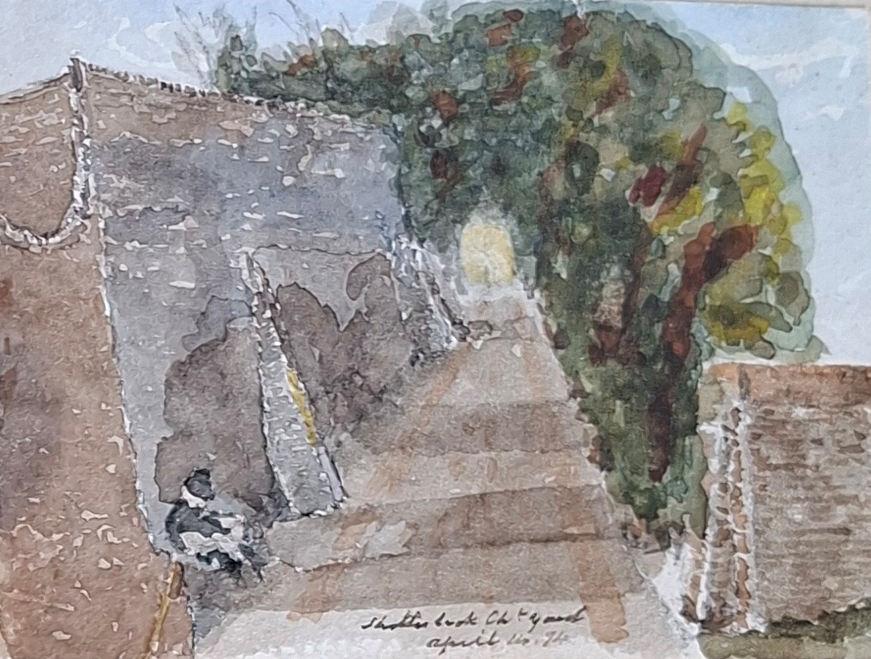
Shottesbroke Spire Sept 24 1878 from Mr Thicket and Shottesbroke Oct 26 19
Shottesbrooke Church is regarded as the finest decorated church in Berkshire. It was founded by Sir William Trussell in 1337 and the flowing tracery of its windows is typical of the C14th1 . The monuments seen by Elias Ashmole in the mid C17th are noted.2 Monuments put up since then are not listed as comprehensively. An account of armorial glass seen by Ashmole is available (see reference list) and contains details of both Trussell’s career and those commemorated in the glass.
There can be few medieval parish churches which exhibit more uniformity of style than St John's (more properly the Collegiate Church of St John the Baptist) at Shottesbrooke. The church stands in the grounds of Shottesbrooke Park manor and was built by the lord of Shottesbrooke estate, Sir William Trussell, in 1337.
The church originally stood as part of an ecclesiastical college, supporting a small community of a warden, five chaplains, and a pair of clerks. The last vestige of the collegiate heritage of St John's is the small door in the south wall, which once led to a covered walk linking the church to the chaplain's residence a short distance away.
Several stories surround the building of the church. whether they are true or not, well, who can say? The tale goes that Sir Willliam was a wild character, much given to overindulgence in drink.
When at last he was brought to see the error of his ways (helped, no doubt, by the fact that his wife never ceased to scold him for his behaviour) he vowed to build a church to commemorate his changed ways.
There is no zealot so officious as a reformed sinner, so the saying goes, and so it proved with Sir William. He poured money into the building of St John's until he had created one of the finest Decorated churches in Berkshire, with a spire meant to emulate the famous spire of Salisbury Cathedral. Sir William wanted a weather vane to stand atop the spire.
No one was brave enough to mount the spire until the brazier who had built the vane said he would do it. This brazier, one Dicken Smith, was perhaps possessed of more bravery than sense. He mounted the spire, affixed the weather vane, then called for a mug of ale to be sent up so he could toast the king.
You can perhaps guess the rest; he quaffed the ale and raised his mug high to salute the king, lost his balance, and fell to the ground. He lived just long enough to utter a few groans, interpreted as "Oh, oh ...". Then the poor fellow died.
They buried him where he fell, at the foot of the tower, with a gravestone inscribed with his final words 'O. O.' The moss-covered stone slab can be found near the south transept, by the path.
Within this lovely building are several fine monuments, including the canopied tomb of the founder, Sir William Trussell, and his long-suffering wife, Lady Alice Trussell. The width of the tomb is greater than the transept, suggesting that the tomb was prebuilt, and transferred to the church after it was complete.
There are a pair of quite wonderful 14th-century memorial brasses which may be the first warden of Sir William's chantry and his brother. There is also a 15th-century brass to Lady Margaret Pembridge, an early 16th century brass to Richard Gyll (d. 1511) and an effigy of William Throckmorton (d. 1535). There is also a 14th-century font.
St John the Baptist at Shottesbrooke is one of the great medieval churches of Berkshire, a county with more than its share of fine historic churches.
Shottesbrooke is a hamlet and civil parish administered by the unitary authority of the Royal Borough of Windsor and Maidenhead in the English county of Berkshire. The hamlet is mostly rural: 88% covered by agriculture or woodland and had a population of 141 at the 2011 census.
The parish saw an 8% decrease in population between 2001 and 2011 according to the UK census, from 154 in 2001 to 141 in 2011. This contrasts to an increase in the borough as a whole. The parish had 61 dwellings (i.e. homes) in 2011.The majority (4.972 km2 (1.920 sq mi)) of land is defined as agricultural or other greenspace, in the land use statistics of January 2005 and 0.149 km2 (0.058 sq mi) 14.9 hectares (37 acres) fell within either road or rail use. Gardens accounted for 0.054 square kilometres (0.021 sq mi) and water 0.027 km2 (0.010 sq mi) all of which was in tributaries or ponds rather than lakes or rivers. The remaining three categories were in decreasing overall size: other land use, non-domestic buildings and domestic buildings.
Shottesbrooke is a parish between Waltham St Lawrence on the west and White Waltham on the east. They were originally one place, Waltham, which was divided in the Saxon era. Today, as always, it is mostly farmland with some large areas of woodland in between, particularly the Great Wood. The hamlet of Cold Harbour is in the very north of the parish, with Shottesbrooke itself in the central area, between Shottesbrooke Park and Smewins' Farm, where the B3024 runs through the region. The M4 motorway crosses the south-east corner of the parish.
See also: Shottesbrooke Park
The Roman 'Camlet Way' between St Albans and Silchester would have crossed the parish at some point and the name 'Cold Harbour' indicates there was an inn or other stopping place nearby. In Saxon times, the manor was owned by the Royal goldsmiths and 'Alward the Goldsmith' was one of the few Saxons allowed to keep his manor here after the Norman Conquest. It is said that charcoal from the Great Wood which occupies most of the southern third of Shottesbrooke was used to melt the gold to make the Saxon Royal regalia.
Shottesbrooke was created a parish, endowed with its own church and priest mainly because of national wealth and later accomplishments of successive owners of Shottesbrooke Park. It was the home of Sir William Trussell, a prominent Royal diplomat in the mid-14th century. He built the Decorated Period parish church as an ecclesiastical college in 1337. The church is renowned for its fine memorial brasses and Trussell's beautifully carved double-recessed monument.
Towards the end of the reign of Edward III the church and college were almost destroyed by fire, but from the design of the existing church the damage done must have been almost entirely confined to the secular buildings. The building is remarkable both for its beauty and symmetry of design and its present good state of preservation. It is recorded that on Wednesday, 20 July 1757, a violent thunderstorm passed over Shottesbrook (a variant spelling until the 1930s), and the church was so damaged by the lightning that it had to be shut up for more than a year, during which time the parishioners attended White Waltham. It re-opened on Sunday, 24 September 1758, after repairs. The chief damage appears to have been done to the spire, which was so shaken that it was at first thought that it would have to be taken down. A gallery across the north transept (evidently an 18th-century addition, removed in 1854) was also damaged and so too the north porch. The falling stones from the spire slightly damaged the roof setting a few rafters on fire. In 1852–4 the church was thoroughly restored under the supervision of G. E. Street, R. A. Between 1870 and 1872 the village real property of £2,134 (equivalent to £257,911 in 2023) had 148 residents spread over 23 homes, fewer than 50% of the current number. Most adult residents in the 1871 census were employees at the few large houses and their associated farms.
A 17th century Speaker of the House of Commons, Henry Powle, lived at the Park. He was followed by Francis Cherry, the non-juror (unwilling to override his oath of recognition of the legal right to reign of the deposed Catholic monarch, James II of England) and guardian of Thomas Hearne and patron of Francis Brokesby. His friend, Henry Dodwell, the theologian, lived at Smewins. Later, Governor Henry Vansittart was in residence and his brother, Professor Robert Vansittart also grew up there. Until his death in 2007, the Park was the home of their heir and relation-by-marriage, Sir John Smith, the founder of the Landmark Trust, which has its headquarters in the adjoining farmhouse.
Richard Suter was born in Greenwich, Kent on 30th March 1798, to William Suter and his wife Sarah Knights. On 7th January 1825 he married Anne Ruth Burn.
English architect. As Surveyor to The Fishmongers' Company he designed the severe Presbyterian churches for Ballykelly (1825–7) and Banagher (1825) on the Company's Estate in County Londonderry, drawings of which were exhibited at the Royal Academy in 1827. He was also responsible for the Model Farm (1823–4), the Lancasterian Schools (1828–30), the Company Agent's House (1830–2—now a hotel, much altered), a range of houses on the south side of the main road (1823–4), the lodge in the Presbyterian churchyard (1828), and the Dispensary (1829), all at Ballykelly, and all Classical. As Surveyor to Trinity House Corporation, he designed houses that were erected by Thomas Cubitt in 1821–3 on a site adjoining Trinity House. For The Fishmongers' Company he designed St Peter's Almshouses, Wandsworth, London (1849–51), and The Old School-House, Gresham's School, Holt, Norfolk(1859), in an Elizabethan style.
On the 1841 Census Richard, an architect and lawyer, can be found living in London with his wife Ann (listed as Ruth) and their two children, Richard George and Andrew Burn. Living with them is Edward D Suter. 1851 finds the family living in Tottenham Court in London, by this time Andrew had left the home, but I am unable to trace him on the 1851 Census. In 1860 Andrew marries Amelia Damaris Harrison. Both Richard George and Andrew were to become ordained ministers, with Andrew later becoming a Bishop and emigrating to New Zealand. Sadly in 1854 Anne Ruth was to pass away. In 1861, widowed Richard, Justice of the Peace for Maidenhead, is living at Castle Hill, Maidenhead, Berkshire. In 1862 he married Elizabeth Anne Pocock. In 1871 and 1881 Richard and Elizabeth are still living in Castle Hill. Richard was to pass away on 1st March1883.
Richard Suter & Annesley Voysey, architects, had their office at number 35 Fenchurch Street, but they did not have it all to themselves as they shared the premises with W.C. Franks, a tea broker, who will get a separate post some other time. The earliest mention I found of Richard Suter in Fenchurch Street is in 1832 when he is listed at that address in a list of contributing members of the Society for the Propagation of the Gospel in Foreign Parts. It says that he had been a member since 1829, but that does not mean he was already at 35 Fenchurch Street in that year.(1) In fact, that seems unlikely as the Sun Fire Office records give Messrs. Short and Co., merchants, as paying the insurance premium on the premises in May 1830. The Directory of British Architects 1834-1914 give the year 1827, but I do not know on what evidence. When Suter and Voysey became partners is also uncertain, but they had known each other since at least 1825 as Suter is named as one of the executors of Voysey’s will which was dated 22 July, 1825. The address given for Suter in the will is Suffolk Street, Southwark. Voysey then lives at Conway Street, Fitzroy Square.