
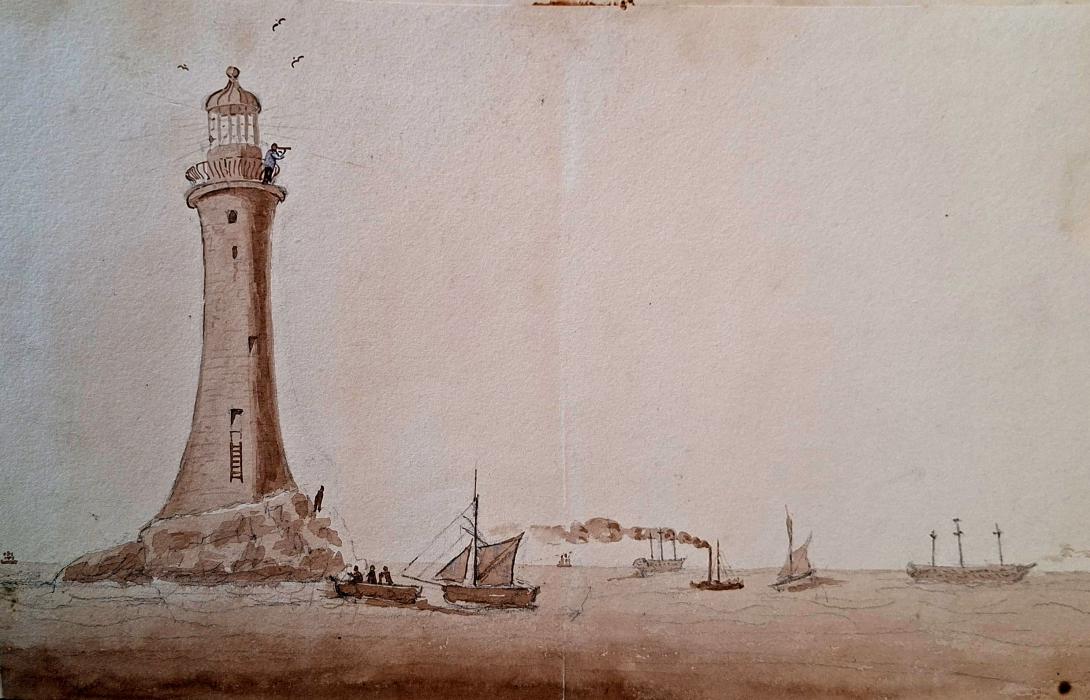
The Eddystone Lighthouse is a lighthouse on the Eddystone Rocks, 9 statute miles (14 km) south of Rame Head in Cornwall, England. The rocks are submerged, and are composed of Precambrian gneiss.
The current structure is the fourth to be built on the site. The first lighthouse (Winstanley's) was swept away in a powerful storm, killing its architect and five other men in the process. The second (Rudyard's) stood for fifty years before it burned down. The third (Smeaton's) is renowned because of its influence on lighthouse design and its importance in the development of concrete for building; its upper portions were re-erected in Plymouth as a monument. The first lighthouse, completed in 1699, was the world's first open ocean lighthouse, although the Cordouan Lighthouse off the western French coast preceded it as the first offshore lighthouse.
The Eddystone Rocks are an extensive reef approximately 12 miles (19 km) SSW off Plymouth Sound, one of the most important naval harbours of England, and midway between Lizard Point, Cornwall and Start Point. They are submerged at high spring tides and were so feared by mariners entering the English Channel that they often hugged the coast of France to avoid the danger, which thus resulted not only in shipwrecks locally, but on the rocks of the north coast of France and the Channel Islands. Given the difficulty of gaining a foothold on the rocks particularly in the predominant swell it was a long time before anyone attempted to place any warning on them.
The third lighthouse to be built on the Eddystone marked a major step forward in the design of such structures.
Design and building

Following the destruction of Rudyard's tower, Robert Weston sought advice on rebuilding the lighthouse from the Earl of Macclesfield, then President of the Royal Society. He recommended mathematical instrument maker and aspiring civil engineer, John Smeaton, who was introduced to Weston in February 1756. In May, following a series of visits to the rock, Smeaton proposed that the new lighthouse should be built of stone and modelled on the shape of an oak tree. He appointed Josias Jessop to serve as his general assistant, and established a shore base for the construction works at Millbay.
Work began on the reef in August 1756, with the gradual cutting away of recesses in the rock which were designed to dovetail in due course with the foundations of the tower. During the winter, the workers stayed ashore and were employed in dressing the stone for the lighthouse; work then resumed on the rock the following June, with the laying of the first courses of stone. The foundations and outside structure were built of local Cornish granite, while lighter Portland limestone masonry was used on the inside. As part of the construction process, Smeaton pioneered 'hydraulic lime', a concrete that cured under water, and developed a technique of securing the blocks using dovetail joints and marble dowels. Work continued over the course of the following two years, and the light was first lit on 16 October 1759.
Smeaton's lighthouse was 59 feet (18 m) high and had a diameter at the base of 26 feet (7.9 m) and at the top of 17 feet (5.2 m). It was lit by a chandelier of 24 large tallow candles.
Later modifications

In 1807 the 100-year lease on the lighthouse expired, whereupon ownership and management devolved to Trinity House. In 1810 they replaced the chandelier and candles with 24 Argand lamps and parabolic reflectors.
In 1841 major renovations were made, under the direction of engineer Henry Norris of Messrs. Walker & Burges, including complete repointing, replacement water tanks and filling of a large cavity in the rock close to the foundations. In 1845 the lighthouse was equipped with a new second-order fixed catadioptric optic, manufactured by Henry Lepaute of Paris, with a single multi-wick oil lamp, replacing the old lamps and reflectors. This was the first time that a fully catadioptric large optic (using prisms rather than mirrors above and below the lens) had been constructed, and the first such installation in any lighthouse. A new lantern was constructed and fitted to the top of the tower in 1848, as the original had proved unsatisfactory for housing the new optic.

From 1858 the tower's exterior was painted with broad red and white horizontal bands, so as to render it 'more distinctly visible during the day time'. In 1872 a 5 cwt (254 kg) fog bell was provided for the lighthouse; it was sounded 'five times in quick succession every half minute' in foggy weather. That same year an improved lamp was installed, which more than doubled the intensity of the light.
In 1877 it was resolved to build a replacement lighthouse, following reports that erosion to the rocks under Smeaton's tower was causing it to shake from side to side whenever large waves hit. During construction of the new lighthouse, the Town Council of Plymouth petitioned for Smeaton's tower to be dismantled and rebuilt on Plymouth Hoe, in lieu of a Trinity House daymark which stood there. Trinity House consented to the removal and delivery of the lantern and the upper four rooms of the tower, the cost of labour to be borne by Plymouth Council. While the new tower was being built the old lighthouse remained operational, up until 3 February 1882 (after which a temporary fixed light was shown from the top of the new tower). When the latter was complete, Smeaton's lighthouse was decommissioned and the crane which had been used to build the new lighthouse was transferred to the task of dismantling the old. William Tregarthen Douglass supervised the operation.
Richard Suter was born in Greenwich, Kent on 30th March 1798, to William Suter and his wife Sarah Knights. On 7th January 1825 he married Anne Ruth Burn.
English architect. As Surveyor to The Fishmongers' Company he designed the severe Presbyterian churches for Ballykelly (1825–7) and Banagher (1825) on the Company's Estate in County Londonderry, drawings of which were exhibited at the Royal Academy in 1827. He was also responsible for the Model Farm (1823–4), the Lancasterian Schools (1828–30), the Company Agent's House (1830–2—now a hotel, much altered), a range of houses on the south side of the main road (1823–4), the lodge in the Presbyterian churchyard (1828), and the Dispensary (1829), all at Ballykelly, and all Classical. As Surveyor to Trinity House Corporation, he designed houses that were erected by Thomas Cubitt in 1821–3 on a site adjoining Trinity House. For The Fishmongers' Company he designed St Peter's Almshouses, Wandsworth, London (1849–51), and The Old School-House, Gresham's School, Holt, Norfolk(1859), in an Elizabethan style.
On the 1841 Census Richard, an architect and lawyer, can be found living in London with his wife Ann (listed as Ruth) and their two children, Richard George and Andrew Burn. Living with them is Edward D Suter. 1851 finds the family living in Tottenham Court in London, by this time Andrew had left the home, but I am unable to trace him on the 1851 Census. In 1860 Andrew marries Amelia Damaris Harrison. Both Richard George and Andrew were to become ordained ministers, with Andrew later becoming a Bishop and emigrating to New Zealand. Sadly in 1854 Anne Ruth was to pass away. In 1861, widowed Richard, Justice of the Peace for Maidenhead, is living at Castle Hill, Maidenhead, Berkshire. In 1862 he married Elizabeth Anne Pocock. In 1871 and 1881 Richard and Elizabeth are still living in Castle Hill. Richard was to pass away on 1st March1883.
Richard Suter & Annesley Voysey, architects, had their office at number 35 Fenchurch Street, but they did not have it all to themselves as they shared the premises with W.C. Franks, a tea broker, who will get a separate post some other time. The earliest mention I found of Richard Suter in Fenchurch Street is in 1832 when he is listed at that address in a list of contributing members of the Society for the Propagation of the Gospel in Foreign Parts. It says that he had been a member since 1829, but that does not mean he was already at 35 Fenchurch Street in that year.(1) In fact, that seems unlikely as the Sun Fire Office records give Messrs. Short and Co., merchants, as paying the insurance premium on the premises in May 1830. The Directory of British Architects 1834-1914 give the year 1827, but I do not know on what evidence. When Suter and Voysey became partners is also uncertain, but they had known each other since at least 1825 as Suter is named as one of the executors of Voysey’s will which was dated 22 July, 1825. The address given for Suter in the will is Suffolk Street, Southwark. Voysey then lives at Conway Street, Fitzroy Square.