
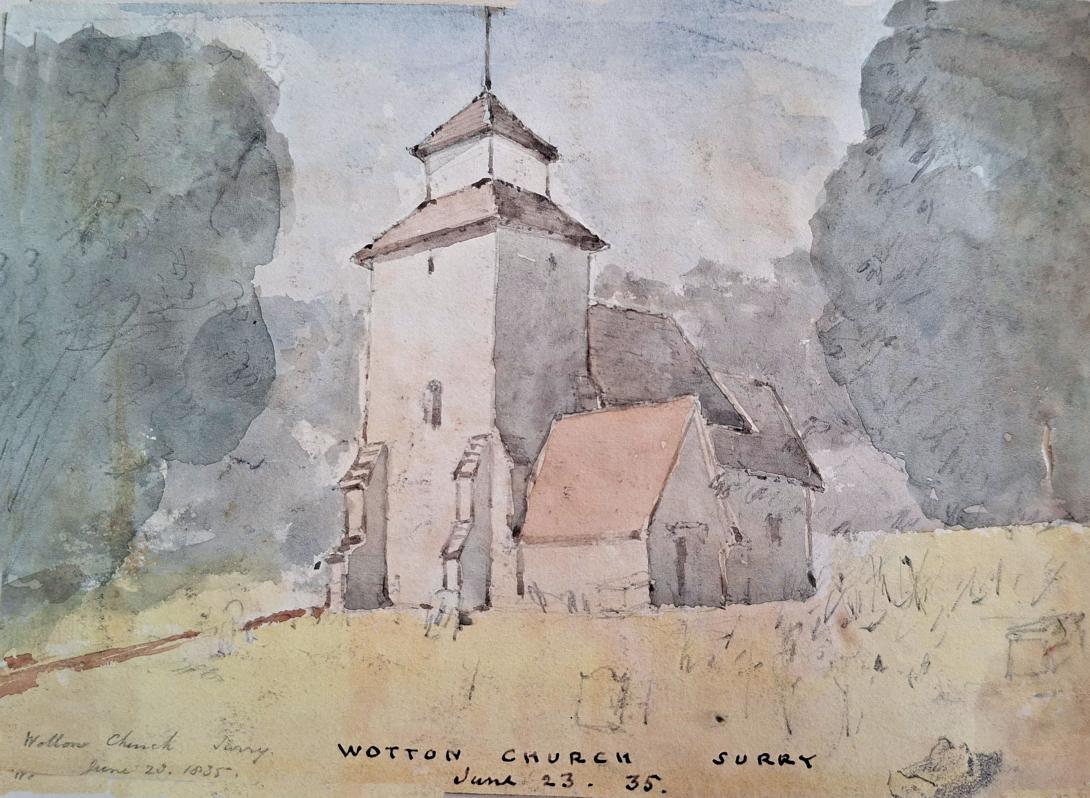
inscribed and dated " WOTTON CHURCH SURREY / June 23 35"
The parish church of St John the Evangelist is situated in the scattered hamlet of Wotton at the end of Church Lane overlooking a broad sweep of the North Downs.The founding of the church dates back to Saxon times, although only a few of the original footings now remain to the west of the Norman tower.The parish itself is shaped like a long finger stretching from the foot of the North Downs to Friday Street. Much of the church was, of necessity, restored in Victorian times, but there are still many interesting original features. John Evelyn, diarist, and Mary Evelyn are buried in the Evelyn Chapel in the church.
Wotton is a well-wooded parish with one main settlement, a small village mostly south of the A25 between Guildford in the west and Dorking in the east. The nearest village with a small number of shops is Westcott. Wotton lies in a narrow valley, collecting the headwaters of the Tilling Bourne which then has its first combined flow in the Vale of Holmesdale. The parish is long north to south, reaching to the North Downs escarpment (and the North Downs Way) in the north to the escarpment of the Greensand Ridge at Leith Hill in the south.
Wotton Common forming the south of the parish is elevated woodland dotted with a few vernacular-style houses and has the county's only natural waterfall. The common's main settlement is Friday Street.
The parish is shaped like a long finger stretching from the foot of the North Downs to Friday Street. The church dates back to Saxon times, although only a few of the original footings now remain to the west of the Norman tower.Much of the church was of necessity restored in Victorian times but there are still many interesting original features to see.Of particular note are some unusual carved heads around the porch door including those of King John and Archbishop Stephan Langton. The church also contains the Evelyn Chapel where there are some magnificent monuments and the tomb of John Evelyn, the diarist, who lived at nearby Wotton House.
In 1979, we became a Joint Benefice with the neighbouring parish of Holmbury St. Mary and conduct several joint services with them.Recently the Benefice has been expanded to include the other churches of the former Leith Hill Group: St. James, Abinger and Christ Church, Coldharbour.
Geography
The civil parish of Wotton is wholly within the Surrey Hills Area of Outstanding Natural Beauty and includes the small village itself, the smaller settlement of Friday Street, Leith Hill to the south and Ranmore Common to the north. Wotton lies in a small north then west facing valley, amassing the headwaters of the Tilling Bourne joining together in what becomes the west of the Vale of Holmesdale. The parish is long north to south, reaching to the North Downs escarpment (and the North Downs Way) in the north. To the south it reaches as far as the escarpment of the Greensand Ridge at Leith Hill.
History
Wotton appears in Domesday Book of 1086 as Odetone. It was held by Osuuold (Oswold). Its domesday assets were: 5 hides; 1 mill worth 1s 8d, 10 ploughs, 3 acres (1.2 ha) of meadow, woodland and herbage worth 73 hogs. It rendered £7 and a half (10s) per year to its overlords, a modest drop since the Norman Conquest.
The English Place-Name Society volume on Surrey (published 1934) records early spellings of Wotton as Wodeton (in 1235, 1258, 1291, 1304, 1317 and 1355), Wudeton (in 1235, 1242 and 1259), Woddeton (in 1304), Woditon (1279) and Wodyton (1443); and variants such as Wodenton (1270) Wodinton (1276 and 1302), Wodynton (1355), Wodyngton (1292, 1380, 1382 and 1456) and Wodington (1324). In 1548 it was "Wodyngeton alias Wotton" and in 1610 it was "Wutton". The same source explains the name as meaning "Farm by the wood", the first element being "Wood" and the final element being "tun" or farmstead.
Wotton House

John Evelyn, the diarist was born at Wotton House in 1620. In 1694 he moved in as the main legatee. After the Evelyn family relinquished occupation, Wotton House was leased as a training college for the Fire Service from 1947 to 1981.
After being empty for nearly 13 years, it was converted into a hotel and conference centre with over 100 bedrooms.
Three areas of the house remain in the original layout and architectural style, and the hotel has grounds of historic importance from the 17th century. Its II* grade is above the grade that many comparable parks achieve and its garden and architecture are well documented.
In the grounds on the South side are two grottos. There is also an orangery with decorative parapet and banded piers, terracotta decorations on brickwork, octagonal turrets and stacks, winged gryphons on the porch and Jean Derraux Chinese panels.
Richard Suter (1797–1883).
Richard Suter was born in Greenwich, Kent on 30th March 1798, to William Suter and his wife Sarah Knights. On 7th January 1825 he married Anne Ruth Burn.
English architect. As Surveyor to The Fishmongers' Company he designed the severe Presbyterian churches for Ballykelly (1825–7) and Banagher (1825) on the Company's Estate in County Londonderry, drawings of which were exhibited at the Royal Academy in 1827. He was also responsible for the Model Farm (1823–4), the Lancasterian Schools (1828–30), the Company Agent's House (1830–2—now a hotel, much altered), a range of houses on the south side of the main road (1823–4), the lodge in the Presbyterian churchyard (1828), and the Dispensary (1829), all at Ballykelly, and all Classical. As Surveyor to Trinity House Corporation, he designed houses that were erected by Thomas Cubitt in 1821–3 on a site adjoining Trinity House. For The Fishmongers' Company he designed St Peter's Almshouses, Wandsworth, London (1849–51), and The Old School-House, Gresham's School, Holt, Norfolk(1859), in an Elizabethan style.
On the 1841 Census Richard, an architect and lawyer, can be found living in London with his wife Ann (listed as Ruth) and their two children, Richard George and Andrew Burn. Living with them is Edward D Suter. 1851 finds the family living in Tottenham Court in London, by this time Andrew had left the home, but I am unable to trace him on the 1851 Census. In 1860 Andrew marries Amelia Damaris Harrison. Both Richard George and Andrew were to become ordained ministers, with Andrew later becoming a Bishop and emigrating to New Zealand. Sadly in 1854 Anne Ruth was to pass away. In 1861, widowed Richard, Justice of the Peace for Maidenhead, is living at Castle Hill, Maidenhead, Berkshire. In 1862 he married Elizabeth Anne Pocock. In 1871 and 1881 Richard and Elizabeth are still living in Castle Hill. Richard was to pass away on 1st March1883.
Richard Suter & Annesley Voysey, architects, had their office at number 35 Fenchurch Street, but they did not have it all to themselves as they shared the premises with W.C. Franks, a tea broker, who will get a separate post some other time. The earliest mention I found of Richard Suter in Fenchurch Street is in 1832 when he is listed at that address in a list of contributing members of the Society for the Propagation of the Gospel in Foreign Parts. It says that he had been a member since 1829, but that does not mean he was already at 35 Fenchurch Street in that year.(1) In fact, that seems unlikely as the Sun Fire Office records give Messrs. Short and Co., merchants, as paying the insurance premium on the premises in May 1830. The Directory of British Architects 1834-1914 give the year 1827, but I do not know on what evidence. When Suter and Voysey became partners is also uncertain, but they had known each other since at least 1825 as Suter is named as one of the executors of Voysey’s will which was dated 22 July, 1825. The address given for Suter in the will is Suffolk Street, Southwark. Voysey then lives at Conway Street, Fitzroy Square.