
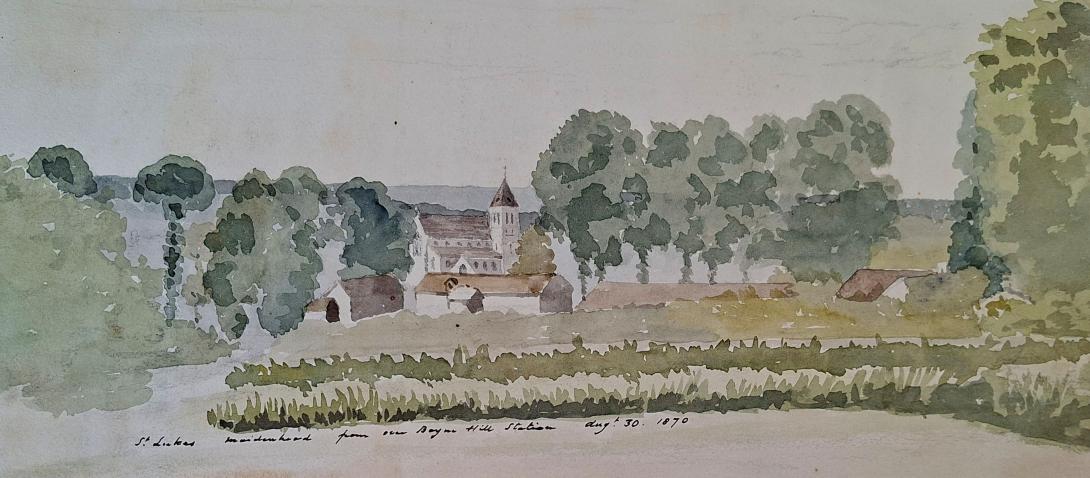
St Lukes Church Maidenhead from Over Boyn Hill Staion Aug 30 th 1870
St Luke's Church is a Church of England parish church in Maidenhead in the English county of Berkshire. St Luke's Church was consecrated in 1866 by William Wilberforce. At a cost of £3500, it was designed by architect George Row Clarke of London, and built by James Griffiths of Eldersfield.[1] A tower was added in 1869, and then a spire was built in 1894.The church building remains the largest church in Maidenhead, and as a result has been used for the recording of Songs of Praise on two occasions. Recent alterations to the church include new glazed entrance doors, a new servery at the west end, refurbished kitchen and toilets, and new vestry and office created in the former Parish Centre.
1865 Foundation stone laid Ceremony performed by Samuel Wilberforce1, Bishop oOxford on 4 November. Expenses of ceremony included printing special service sheets, the hire of a tent and the hire & porterage of a harmonium (from exhibition at Berkshire Record Office to commemorate the 200th anniversary of the Bishop’s birthsee BRO records D/P181/5/3,7,8)
.
1866 ST LUKE’S consecrated by Samuel Wilberforce, Bishop of Oxford New church dedicated 23rd August 1866. Church in early english style - cost £3500. The architect was George Row Clarke of London and the builder James Griffiths of Eldersfield, Worcs (Illustrated London News, Supplement Nov 10 1866 p 461 No 1398
Drawings by Clarke in Berkshire Record Office (5/P/181/6/2) show that the font wasoriginally to be west of the entrance from the tower into the church. The base of the tower itself is marked “children”. On the north east corner of the church was located the organs with the vestry to the east of it. For list of subscribers to 2 March 1867 see BRO D/P 181/5/2/2. Altar given by Mr Alfred Kent, pulpit by Mr Clarke, the architect, font by Mr Griffith, the builder, choir seats & eagle by Rev W.B. Hole, the Vicar (S.N.).
1867 First memorial window inserted on south side of chancel In memory of Dr Bellis (M.Ad Dec 12 1894). Taken out 1952 - now lost.
1868 Nave completed ( S.N.-has list of subscribers)
1870-1 Tower added (S.N.) BELLS: Calling Bell - Mears & Stainbank , Founders, London ?1870 Clock Bell - Gillett Bland & Co, Croydon - London 1878.
1871 East window and north window of chancel added Latter taken out in 1952, though upper tracery, of winged bull of St Luke, remains. East window by O’Connor (N. Pevsner 1966, “Berkshire”). A second two light O’Connor window inserted on the north side of the nave: Christ in the Garden of Gethsemane and Christ the Shepherd
1872 Chancel decorated Reredos gift of Rev G.H. Hodson, Rural Dean (S.N.) late incumbent of Cookham Dean (not sure when put in - probably already there in 1872). Reredos removed in 1952.
1879 Clock added
1883 Model of St Luke’s made by W.E. Harper This model is still kept in the church. In 1883 St Luke’s did not have a spire. The spire was added to the model, almost certainly by Harper c. 1894, the original case being *Third son of William Wilberforce, the philanthropist and advocate of the abolition of the slave trade. Wilberforce born 7 Sept 1805 was Bishop of Oxford from 1845-1869. His birth was commemorated on 7 Sept 2005 at a service in The Minster Church of St Mary the Virgin in Reading to which representatives of the churches he reopened or consecrated were invited modified to take it. The present case (of perspex and oak) was made by Richard Burdett, PCC Treasurer, in 1991 after the arson attack, refixing the original brass plaque. The plaque has the following inscription. Maidenhead Working Men’s Club Exhibition 1883 W.E. HARPER 1 st Prize – Model of St Luke’s Church William Harper was parish clerk of St Luke’s for forty years (see inscription on his grave stone on the west side of the churchyard). The Working Men’s Club was based in what is now St Luke’s community hall
1885 Fresco tile painting, Jacobs Ladder, on chancel arch dedicated at Advent in memory of mother of Thomas J. Nunns See brass plaque on side of arch. Fresco made by W.B. Simpson and Sons of St Martins Lane, London; painter unknown, though has been suggested might be W.J. Neatby.
Rev. Thomas Jackson Nunns was Headmaster of Cordwalles College (the forerunner of St Piran’s) from 1873-90 (M.Ad Nov 27 and Dec 18 1992).
Scroll This is none other than the House of God, this is the Gate of Heaven painted by Jeseph Rust (Platford )
1887 St Peter’s Iron Church opened (S.N.)
1888 West Window on north aisle Christ teaching people out of the ship by Clayton & Bell given in memory of Admiral the Right Honorable Astley Cooper Key G.C.B. Donors include W.H.Grenfell Esq who gave 5 guineas and Rev T.J.Nunns who gave 2 guineas (M.Ad. 28 Nov 1888 p3). List of subscribers in S.N.
1891 Lectern given
1893 Great West Window inserted and west wall decorated with fresco Both done by Clayton & Bell. Inscription on a brass plaque under the window reads: To the Glory of God and in affectionate remembrance of the late Francis Goolden F.R.C.S. of the Wilderness, Maidenhead. Churchwarden of this parish from the consecration of the church Aug: 23rd 1866, until his death Feb: 15th 1892. The above window has been inserted and this wall decorated by his friends and relatives in the year of our Lord 1893. Dr Goolden is said to have been a major donor in the building of the church and his
profession may be why it was dedicated to St Luke who was a doctor.,The stained glass of this window is arranged as follows.,Top in the centre the, Lamb of God holding a pennant. Below the Lamb and on each ,side roundels bear an angel with multicoloured wings holding a scroll with the words “Holy, Holy, Holy” The rest of the window, above and below the transom, is arranged into five lights.
Above the transom from the New Testament 1)Annunciation of the Blessed Virgin;2)the Last Supper with the institution of the Eucharist, 3) the Crucifixion;4) the Resurrection; 5)the Descent of the Holy Spirit.: Below the transom from the Old Testament 1)Adam and Eve in the Garden of Eden;2) the Falling of the Manna;3)the Brazen Serpent; 4) Jonah delivered from the Whale;5) the Giving of the Law. (SPLM April 1893, p3)
Also inserted in south aisle, a smaller window by Savell & Co. Window given by Mrs Cope in memory of her late husband, Charles West Cope R.A., and designed from his own drawings - Theme 1) Our Lord as the Good Shepherd 2) The Prodigal Son (SLPM April 1893 p 3 & 7). Note: Charles West Cope R.A.(1811-1890) was a noted Victorian painter of historical, literary and biblical subjects. He took part in the competition to decorate the Houses of
Parliament, winning in 1843 a prize for his cartoon of “Trial by Jury” Bryan’s Dictionary of Painters and Engravers. The murals he created in the Peers’ Corridor of the Houses of Parliament between 1856 and 1866 can still be seen by those lucky enough to visit. Cope and his wife are buried in the large cemetery off All Saint’s Avenue, Maidenhead.
1894 Spire put up Of Bath Stone, from designs by J.Oldrid Scott F.S.A.; built by Silver & Sons Ltd; vane and double cross on stone pinnacles at each angle of tower made by Barford & Norkett; both local firms (M.Ad Dec. 12, 1894). The architect, Oldrid Scott, was a son of that famous Victorian restorer of cathedrals, George Gilbert Scott and uncle to the architect of Liverpool Cathedral, Giles Gilbert Scott. Note: Inscription on the springing of the spire: 3 “THIS SPIRE WAS BUILT 1894 - REV H. C. J. MEARA VICAR - J. FULLER, T.G. WYATT CHURCHWARDENS - J. OLDRID SCOTT ARCHITECT - SILVER & SONS BUILDER”. Note: Spire required because the roof of the tower was damaged (SLPM March 1894
p3). Both W.W. Astor (William Waldorf Astor of Cliveden) and Mrs Robson subscribed £5 to the tower fund (SLPM no 47 Nov 1894). 1896 Architect’s plans for construction of the daughter church of St Peter’s Approved and money begins to be collected. Amount to be raised £1400 (SLPM Feb
1897 p3, March p3).
1898 Linenfold oak seats for south west porch given in memory of the Duncan family of Hampstead and Maidenhead.
1901 New organ given by Mrs Cope -”£1100 for 1100 pipes” Provided by Wm Hill & Co of Islington (M.Ad, June 19 1901). See above 1893.
1902 Choir stalls given in memory of Elizabeth Meara, sister of Rev. Meara Original choir seats gift of Rev W.B.Hole.
1910 Wrought iron and gold leaf screen dedicated Made by local firm of Edward Norkett (given by Rev Meara - M.Ad March 16 1932). Edward Norkett was one of St Luke’s choristers (Platford) and played the violin in church (see SLPM Nov 1892 p 4).
1917 Font cover Given by Miss(es) Spindler as a memorial to Eustace Spindler who was baptised in the font and whose father had been a sidesman (SLPM Dec 1917). To the Glory of God in loving memory of Eustace L. Spindler wh died on active service
Easter Day 1916 1918 Death of Mrs Cope (benefactress)
SLPM Nov 1918.
1923 War memorial chapel dedicated Old vestry enlarged & remodelled: builder Messrs J.K. Cooper (local firm - SLPM Aug
1922), architect Mr Cheadle (SLPM Aug 1923); Lord Desborough* gave 5 guineas and Lady Desborough 2 guineas (SLPM March 1923). Oak Altar presented by Sawyer family (SLPM Aug 1923). Carved oak altar rails given by Mrs Bird in memory of her father, Rev W.R. Rogers, Vicar of Cookham at the time St Luke’s parish was formed (SLPM Nov 1923). East window of three lights with figures of St Luke, the Virgin Mary and St Martin of Tours, given in memory of Canon Meara by 500 parishioners and friends.. Made by A.K Nicholson, 105 Gower St, London. Names of the fallen carved on the wooden panelling. *William Henry Grenfell of Taplow Court whose grandfather, Charles Pascoe Grefell, by March 1867, had subscribed £100 to help build the church (BRO D/P 181/5/2/2).
1927 West screen ordered SLPM Sept 1927.
1928 Money raised for memorial to churchwardens Lemon and Wyatt SLPM March 1928; used to obtain a south screen for the chapel.
1930 War Memorial Chapel completed Cost of £2500 built, furnished and decorated the chapel. The third screen and gates dedicated by Bishop Shaw on Sunday 24th August 1930, given by the sons in memory of Thomas Charles Fry, 1846-1930, Dean of Lincoln, and Julia Isabella, his wife, 1846-
1928. J.O. Cheadle of New Square, Lincolns Inn designed the chapel and practically everything in it. He designed also the screens worked by Messrs Bowman & Sons of Stamford; the chairs made by Messrs Wake & Dean of Yatton, Somerset and the wrought iron gates produced by the Widney Manufacturing Company, Maidenhead (SLPM Sept 1930). Sanctuary lamp given by Mr Oakley (Churchwarden when the
memorial chapel and new vestry were completed) in memory of his son killed in the
Great War.
Richard Suter was born in Greenwich, Kent on 30th March 1798, to William Suter and his wife Sarah Knights. On 7th January 1825 he married Anne Ruth Burn.
English architect. As Surveyor to The Fishmongers' Company he designed the severe Presbyterian churches for Ballykelly (1825–7) and Banagher (1825) on the Company's Estate in County Londonderry, drawings of which were exhibited at the Royal Academy in 1827. He was also responsible for the Model Farm (1823–4), the Lancasterian Schools (1828–30), the Company Agent's House (1830–2—now a hotel, much altered), a range of houses on the south side of the main road (1823–4), the lodge in the Presbyterian churchyard (1828), and the Dispensary (1829), all at Ballykelly, and all Classical. As Surveyor to Trinity House Corporation, he designed houses that were erected by Thomas Cubitt in 1821–3 on a site adjoining Trinity House. For The Fishmongers' Company he designed St Peter's Almshouses, Wandsworth, London (1849–51), and The Old School-House, Gresham's School, Holt, Norfolk(1859), in an Elizabethan style.
On the 1841 Census Richard, an architect and lawyer, can be found living in London with his wife Ann (listed as Ruth) and their two children, Richard George and Andrew Burn. Living with them is Edward D Suter. 1851 finds the family living in Tottenham Court in London, by this time Andrew had left the home, but I am unable to trace him on the 1851 Census. In 1860 Andrew marries Amelia Damaris Harrison. Both Richard George and Andrew were to become ordained ministers, with Andrew later becoming a Bishop and emigrating to New Zealand. Sadly in 1854 Anne Ruth was to pass away. In 1861, widowed Richard, Justice of the Peace for Maidenhead, is living at Castle Hill, Maidenhead, Berkshire. In 1862 he married Elizabeth Anne Pocock. In 1871 and 1881 Richard and Elizabeth are still living in Castle Hill. Richard was to pass away on 1st March1883.
Richard Suter & Annesley Voysey, architects, had their office at number 35 Fenchurch Street, but they did not have it all to themselves as they shared the premises with W.C. Franks, a tea broker, who will get a separate post some other time. The earliest mention I found of Richard Suter in Fenchurch Street is in 1832 when he is listed at that address in a list of contributing members of the Society for the Propagation of the Gospel in Foreign Parts. It says that he had been a member since 1829, but that does not mean he was already at 35 Fenchurch Street in that year.(1) In fact, that seems unlikely as the Sun Fire Office records give Messrs. Short and Co., merchants, as paying the insurance premium on the premises in May 1830. The Directory of British Architects 1834-1914 give the year 1827, but I do not know on what evidence. When Suter and Voysey became partners is also uncertain, but they had known each other since at least 1825 as Suter is named as one of the executors of Voysey’s will which was dated 22 July, 1825. The address given for Suter in the will is Suffolk Street, Southwark. Voysey then lives at Conway Street, Fitzroy Square.