
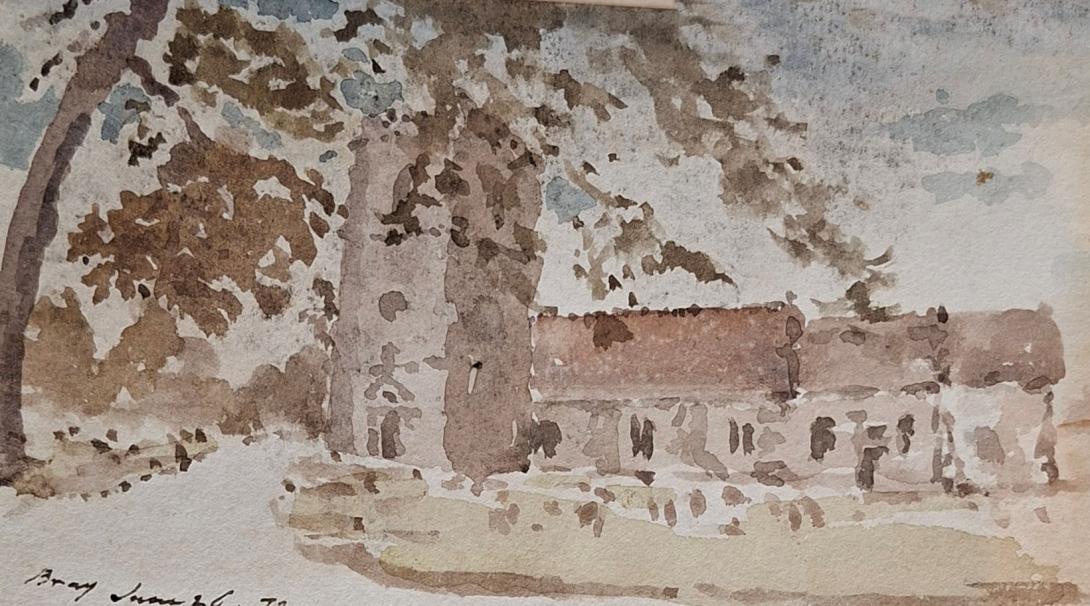
Bray Church January 26 1872
St Michael's Church, Bray, is a Grade II* listed parish church in the Church of England in Bray, Berkshire.
The church dates from 1293, supposedly to replace a Saxon church at Water Oakley.
It was partly rebuilt ca. 1500 and extensively restored 1857–82 by Thomas Henry Wyatt.
It has a number of sculptures which may have come from the earlier church, including a damaged Sheela na Gig.
The ecclesiastical parish shares the wider parish boundaries so is named Bray St Michael with Braywoodside.
In 1938, the royal funeral of George Mountbatten, 2nd Marquess of Milford Haven, was held at St Michael's, after which the marquess was buried in Bray Cemetery.

The church contains several brasses from the fourteenth to sixteenth centuries, notably that of 1378 to Sir John Foxley, the Constable of Southampton Castle. Other monuments are:
- William Goddard of Philibert, d.1609, founder of Jesus Hospital, and Joyce Maunsell his wife, d.1622.
- Mary Hanger (d.1738) sculpted by Peter Scheemakers.
Vicars of Bray
See The Vicar of Bray for the satirical description, or The Vicar of Bray (song) for the English folk song.
- Reinbald 1081
- Roger 1288
- Henry de Chilbalton 1301
- Roger de Crossby 1327
- William Scherreve 1368–75
- John Dray 1382
- Thomas Gernon 1382–96
- William Dyer 1396–1440
- Robert Manfelde 1440–43
- Thomas Pashe 1443–44
- Thomas Topclyf 1444
- Thomas Luyde 1444–54
- William Morris 1454–79
- Thomas Phillippis 1479–97
- John Perkwyn 1497
- John Halle 1504
- Richard Watts 1504–20
- John Mogeryge 1521–23
- Simon Symonds 1523–47
- William Stafferton 1548–55
- Alexander Barlo 1556
- Simon Aleyn 1557–65
- Henry Cranshawe 1565
- David Tuke 1589–99
- Edward Cranceshaw 1599
- Edward Boughton 1621–40
- Anthony Faringdon 1640–42
- Hezekiah Woodward 1649–60
- Edward Boughton 1660
- Edward Fulham 1660–62
- Francis Carswell 1665–1709
- Thomas Brown 1709–59
- George Berkeley 1759–69
- Hon George Hamilton 1769–87
- Edward Townshend 1787–1822
- Walter Levett 1822–25
- George Legge 1825–26
- Walter Levett 1826–53
- James Austen Leigh 1853–74
- William Brassey Hole 1874–87
- Charles Raymond 1887–1915
- William Riddelsdell 1915–31
- Arthur Jones 1931–45
- Edward Lowman 1945–58
- Sidney Doran 1958–77
- Neil Howells 1977–84
- George Repath 1985–2007
- Richard Cowles 2008
Richard Suter was born in Greenwich, Kent on 30th March 1798, to William Suter and his wife Sarah Knights. On 7th January 1825 he married Anne Ruth Burn.
English architect. As Surveyor to The Fishmongers' Company he designed the severe Presbyterian churches for Ballykelly (1825–7) and Banagher (1825) on the Company's Estate in County Londonderry, drawings of which were exhibited at the Royal Academy in 1827. He was also responsible for the Model Farm (1823–4), the Lancasterian Schools (1828–30), the Company Agent's House (1830–2—now a hotel, much altered), a range of houses on the south side of the main road (1823–4), the lodge in the Presbyterian churchyard (1828), and the Dispensary (1829), all at Ballykelly, and all Classical. As Surveyor to Trinity House Corporation, he designed houses that were erected by Thomas Cubitt in 1821–3 on a site adjoining Trinity House. For The Fishmongers' Company he designed St Peter's Almshouses, Wandsworth, London (1849–51), and The Old School-House, Gresham's School, Holt, Norfolk(1859), in an Elizabethan style.
On the 1841 Census Richard, an architect and lawyer, can be found living in London with his wife Ann (listed as Ruth) and their two children, Richard George and Andrew Burn. Living with them is Edward D Suter. 1851 finds the family living in Tottenham Court in London, by this time Andrew had left the home, but I am unable to trace him on the 1851 Census. In 1860 Andrew marries Amelia Damaris Harrison. Both Richard George and Andrew were to become ordained ministers, with Andrew later becoming a Bishop and emigrating to New Zealand. Sadly in 1854 Anne Ruth was to pass away. In 1861, widowed Richard, Justice of the Peace for Maidenhead, is living at Castle Hill, Maidenhead, Berkshire. In 1862 he married Elizabeth Anne Pocock. In 1871 and 1881 Richard and Elizabeth are still living in Castle Hill. Richard was to pass away on 1st March1883.
Richard Suter & Annesley Voysey, architects, had their office at number 35 Fenchurch Street, but they did not have it all to themselves as they shared the premises with W.C. Franks, a tea broker, who will get a separate post some other time. The earliest mention I found of Richard Suter in Fenchurch Street is in 1832 when he is listed at that address in a list of contributing members of the Society for the Propagation of the Gospel in Foreign Parts. It says that he had been a member since 1829, but that does not mean he was already at 35 Fenchurch Street in that year.(1) In fact, that seems unlikely as the Sun Fire Office records give Messrs. Short and Co., merchants, as paying the insurance premium on the premises in May 1830. The Directory of British Architects 1834-1914 give the year 1827, but I do not know on what evidence. When Suter and Voysey became partners is also uncertain, but they had known each other since at least 1825 as Suter is named as one of the executors of Voysey’s will which was dated 22 July, 1825. The address given for Suter in the will is Suffolk Street, Southwark. Voysey then lives at Conway Street, Fitzroy Square.