
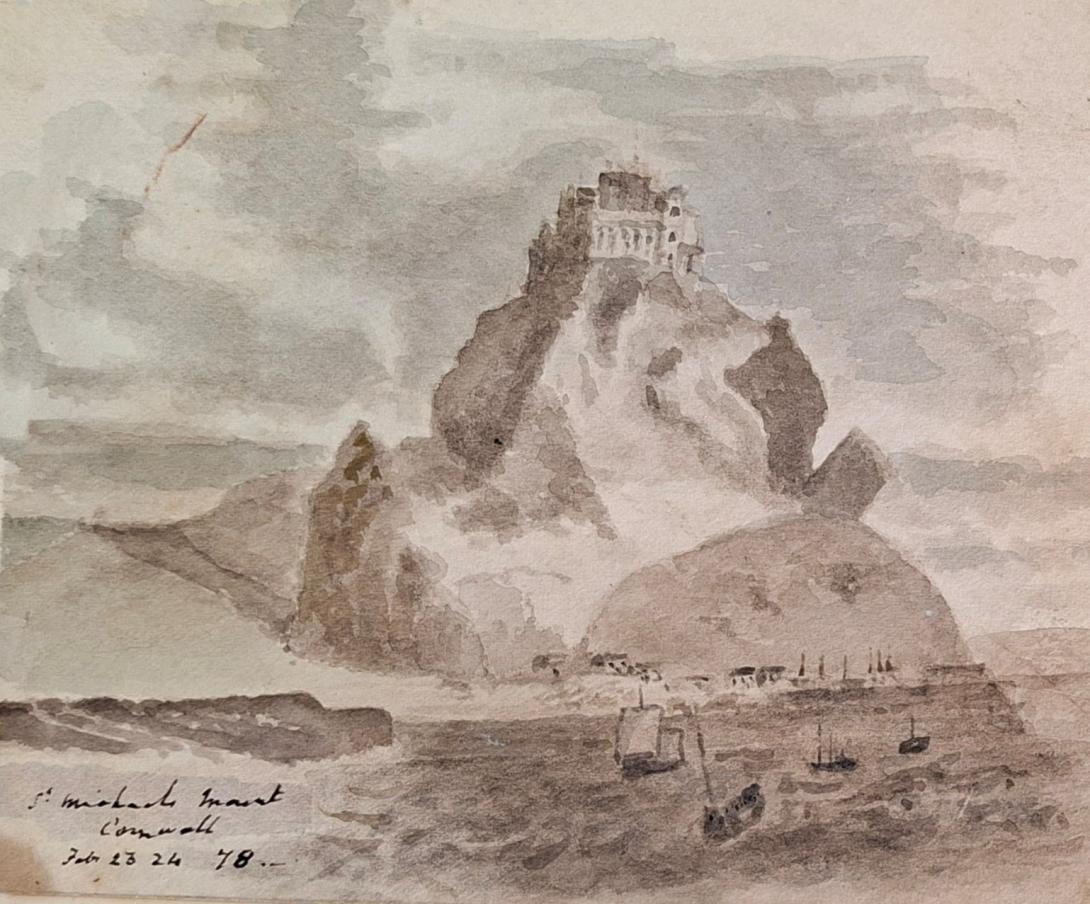
St Michaels Mount Cornwall Feb 23-24 1878
St Michael's Mount Karrek Loos yn Koos, meaning "hoar rock in woodland" is a tidal island in Mount's Bay near Penzance, Cornwall, England, United Kingdom. The island is a civil parish and is linked to the town of Marazion by a causeway of granite setts, passable (as is the beach) between mid-tide and low water. It is managed by the National Trust, and the castle and chapel have been the home of the St Aubyn family since around 1650.
Historically, St Michael's Mount was an English counterpart of Mont-Saint-Michel in Normandy, France, which is also a tidal island, and has a similar conical shape, though Mont-Saint-Michel is much taller.
St Michael's Mount is one of 43 unbridged tidal islands accessible by foot from mainland Britain. Part of the island was designated as a Site of Special Scientific Interest in 1995 for its geology. Sea height can vary by up to around 5 metres (16 ft) between low and high tide.
St Michael's Mount may have been the site of a monastery from the 8th to the early 11th centuries. Edward the Confessor gave the site to the Benedictine order of Mont-Saint-Michel. In 967 AD King Edgar granted to Wulfnoth Rumuncant land in the Charter of Lesneague and Pennarth. Lesneague, together with Traboe, was later granted to the Benedictine monks of St Michael's Mount by Robert Count of Mortain. It was a priory of that Mont-Saint-Michel until the dissolution of the alien houses as a side-effect of the war in France by Henry V. Subsequently, it ceased to be a priory, but was reduced to being a secular chapel which was given to the Abbess and Convent of Syon at Isleworth, Middlesex, in 1424. Thus ended its association with Mont-Saint-Michel, and any connection with Looe Island (dedicated to the Archangel Michael). It was a destination for pilgrims, whose devotions were encouraged by an indulgence granted by Pope Gregory VII in the 11th century. The earliest buildings on the summit, including a castle, date to the 12th century.
By 1811, there were 53 houses and four streets. The pier was extended in 1821 and the population peaked in the same year, when the island had 221 people. There were three schools, a Wesleyan chapel, and three public houses, mostly used by visiting sailors. Following major improvements to nearby Penzance harbour, and the extension of the railway to Penzance in 1852, the village went into decline, and many of the houses and other buildings were demolished.
During the 18th and 19th centuries, the structure of the castle was romanticised. In the late 19th century, the remains of an anchorite were discovered in a tomb within the domestic chapel.
Main article: St Michael's Mount Tramway
A short, underground narrow gauge railway was constructed in about 1900. It was used to bring goods up to the castle and take away rubbish. In 2018, the tramway was reported as being "still in regular use, perhaps not every day", and is not open to the general public, although a small stretch is visible at the harbour. It is Britain's last functionally operational 4 ft 6 in (1,372 mm) railway.
Some sources, including in the British industrial narrow gauge railways, a list of track gauges and, in 2018, on an information board near the line, suggest a different gauge of 2 ft 5 in (737 mm) while The Railway Magazine says it has a gauge of 2 ft 5+1⁄2 in (750 mm).
Richard Suter was born in Greenwich, Kent on 30th March 1798, to William Suter and his wife Sarah Knights. On 7th January 1825 he married Anne Ruth Burn.
English architect. As Surveyor to The Fishmongers' Company he designed the severe Presbyterian churches for Ballykelly (1825–7) and Banagher (1825) on the Company's Estate in County Londonderry, drawings of which were exhibited at the Royal Academy in 1827. He was also responsible for the Model Farm (1823–4), the Lancasterian Schools (1828–30), the Company Agent's House (1830–2—now a hotel, much altered), a range of houses on the south side of the main road (1823–4), the lodge in the Presbyterian churchyard (1828), and the Dispensary (1829), all at Ballykelly, and all Classical. As Surveyor to Trinity House Corporation, he designed houses that were erected by Thomas Cubitt in 1821–3 on a site adjoining Trinity House. For The Fishmongers' Company he designed St Peter's Almshouses, Wandsworth, London (1849–51), and The Old School-House, Gresham's School, Holt, Norfolk(1859), in an Elizabethan style.
On the 1841 Census Richard, an architect and lawyer, can be found living in London with his wife Ann (listed as Ruth) and their two children, Richard George and Andrew Burn. Living with them is Edward D Suter. 1851 finds the family living in Tottenham Court in London, by this time Andrew had left the home, but I am unable to trace him on the 1851 Census. In 1860 Andrew marries Amelia Damaris Harrison. Both Richard George and Andrew were to become ordained ministers, with Andrew later becoming a Bishop and emigrating to New Zealand. Sadly in 1854 Anne Ruth was to pass away. In 1861, widowed Richard, Justice of the Peace for Maidenhead, is living at Castle Hill, Maidenhead, Berkshire. In 1862 he married Elizabeth Anne Pocock. In 1871 and 1881 Richard and Elizabeth are still living in Castle Hill. Richard was to pass away on 1st March1883.
Richard Suter & Annesley Voysey, architects, had their office at number 35 Fenchurch Street, but they did not have it all to themselves as they shared the premises with W.C. Franks, a tea broker, who will get a separate post some other time. The earliest mention I found of Richard Suter in Fenchurch Street is in 1832 when he is listed at that address in a list of contributing members of the Society for the Propagation of the Gospel in Foreign Parts. It says that he had been a member since 1829, but that does not mean he was already at 35 Fenchurch Street in that year.(1) In fact, that seems unlikely as the Sun Fire Office records give Messrs. Short and Co., merchants, as paying the insurance premium on the premises in May 1830. The Directory of British Architects 1834-1914 give the year 1827, but I do not know on what evidence. When Suter and Voysey became partners is also uncertain, but they had known each other since at least 1825 as Suter is named as one of the executors of Voysey’s will which was dated 22 July, 1825. The address given for Suter in the will is Suffolk Street, Southwark. Voysey then lives at Conway Street, Fitzroy Square.