
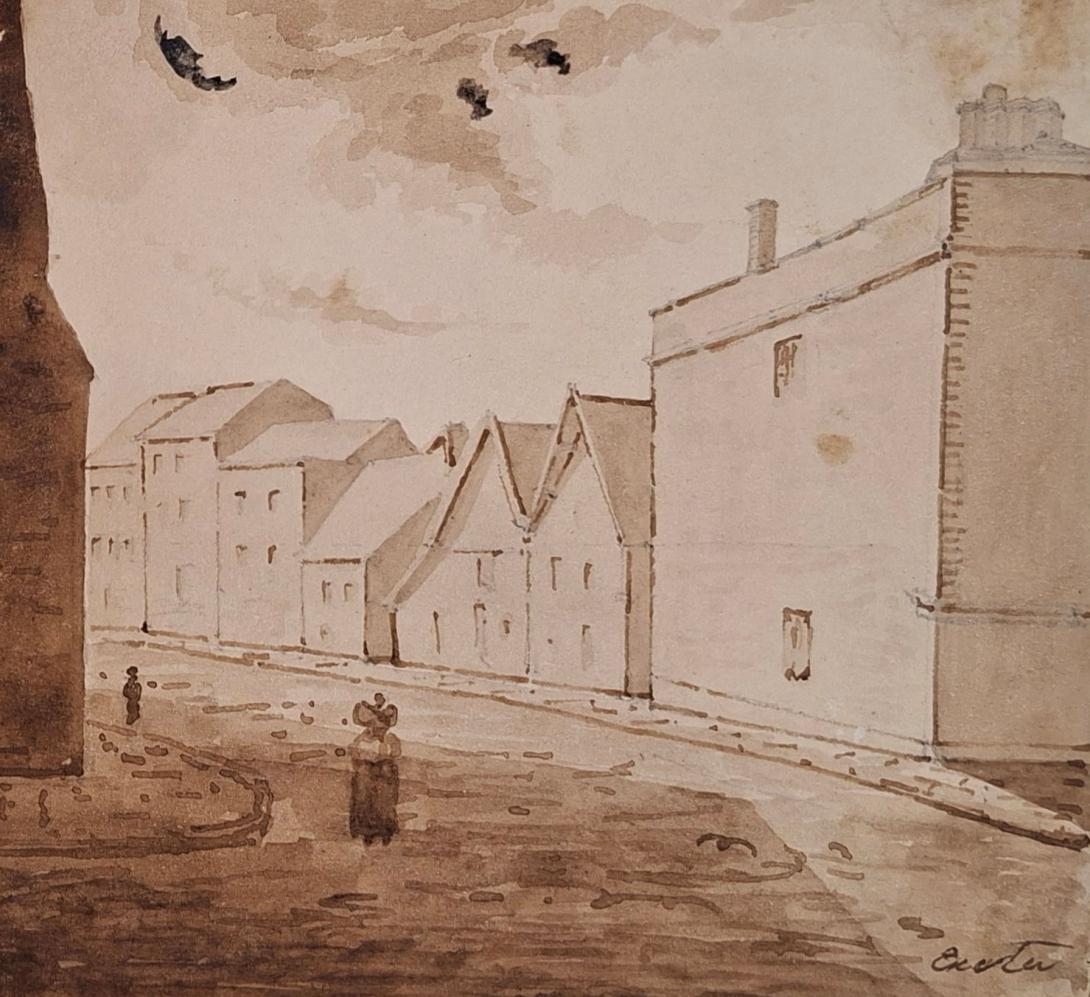
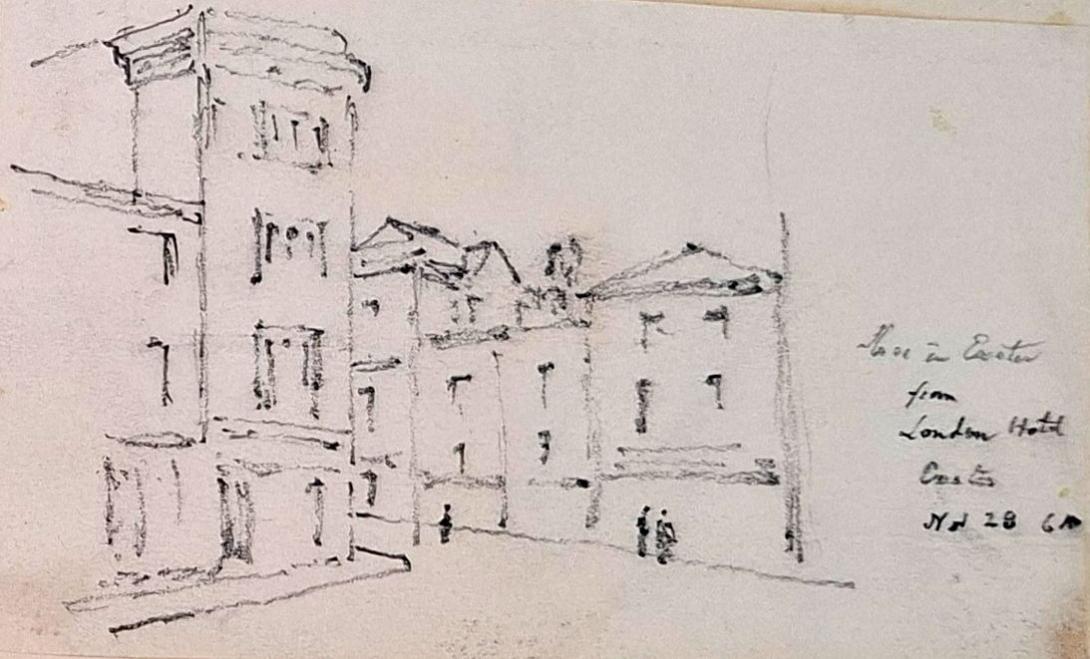
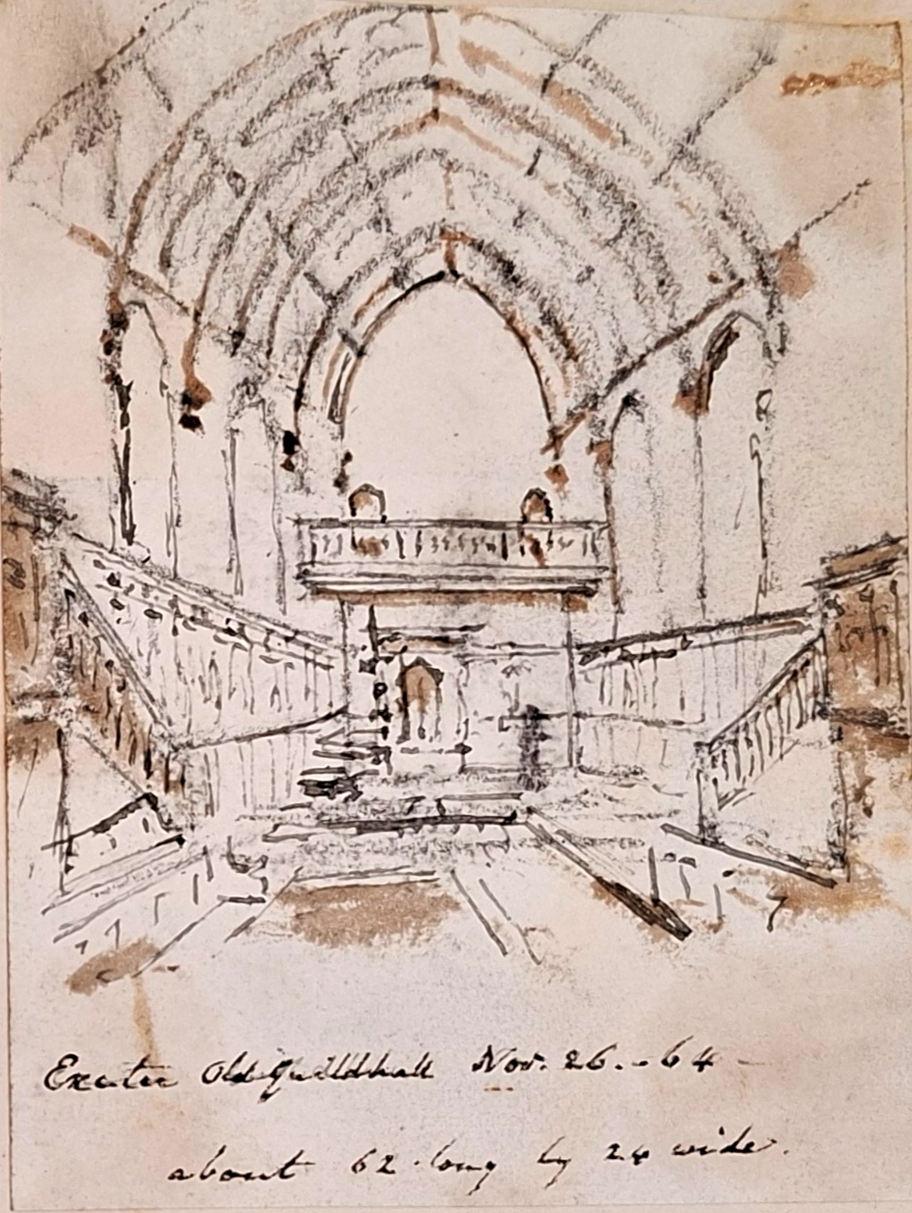
Street in Exeter July 1832 , view from New London Hotel & The Guildhall Exeter Nov 28 1861
Longbrook Street and Sidwell Street once met in what was almost a point somewhere to the right hand side of Waterstones. Set back towards the rear of the Waterstones site, was the New London Inn and the area in the front formed the London Inn Square. The inn was built at the rear of the square in 1793-94 for Mr John Land on the site of the Oxford Inn, which had closed in March 1790. The New London Inn opened on 17 July 1794.
At right angles and to the left of the New London Inn was a mixed terrace of buildings known as Northernhay Place, which stretched up the hill, towards the entrance to Northernhay Park. The second building in the terrace was the Royal Public Rooms, built in 1820. It became the Hippodrome in 1908 and the Plaza Cinema in 1931. It is now the site of Boots.
The right side of the London Inn Square consisted of a couple of shops at the point formed by Sidwell and Longbrook Street. In 1898, could be found Thomas Edmund Bartlett fruiterer and Mousell Brothers, furniture depository. By 1939 only one business was listed, the fruiterer, Henry Hill.
London Inn Square has seen numerous interesting events. Many visitors crossed the square by foot or in a carriage to enter the inn or attend a ball or variety show at the Royal Public Rooms and the later Hippodrome and Plaza Cinema. Princess Victoria addressed a crowd from her carriage, while Robert Louis Stevenson, Charles Dickens and Jane Austin have all passed across the cobbles of the square.
There was a rivalry between the Trinity boys' and the St Mary Major boys' when beating the bounds of the city, in the first half of the 19th Century. When the two factions met at the end of the bounds, in London Inn Square, then there a fight would often break out between the young men of each side. The parishioners sometimes were obliged to intervene, there being no police force then.
Two Theatre Royals were positioned at the meeting point of Longbrook Street and New North Road, and it was the tragic fire that destroyed the first, in September 1887 with the loss of 186 lives that saw some of the most distressing scenes in London Inn Square. A poem written by William Topaz McGonagal, at the time, has the verse:
The shrieks of those trying to escape were fearful to hear,
Especially the cries of those who had lost their friends most dear;
Oh, the scene was most painful in the London Inn Square,
To see them wringing their hands and tearing their hair!
In 1935, the New London Inn was demolished to make way for the Savoy Cinema, which covered the same footprint as the old hotel. The only building to survive the bombing of May 1942 was the Savoy - the southern end of Northernhay Place was destroyed when the Plaza Cinema was hit by a single, high explosive bomb. The High Street, opposite and the end of Sidwell Street were also destroyed.
The New London inn was built for John Land, former proprietor of the London inn, on the site of the ancient Oxford inn to designs by Exeter's foremost Georgian architect, Matthew Nosworthy. Nosworthy was already in the process of planning his magnificent terraces in Southernhay, but the New London inn preceded them by a couple of years and was one of his first major contributions to Exeter's cityscape. The Oxford inn was demolished in September 1793 and the New London Inn was completed ten months later in the summer of 1794.
The inn was constructed in a small square, later known as London Inn Square, just beyond the boundary of the city wall and at the junction of the High Street, Southernhay, Sidwell Street, Paris Street and Longbrook Street. The map right shows the location of the New London inn in 1905 overlaid onto a modern aerial view of the same area. The inn itself, with its central courtyard, is highlighted in red. The quadrangular plot shown at the rear of the inn, not highlighted, was probably the site of the stables. The street plan has been so completely altered by post-war reconstruction that today it's almost impossible to visualise where the New London inn once stood. The former Debenhams building is visible to the far left. The pretentious oval bulk of the new Next building on the corner of Paris Street and the High Street is at the bottom. Southernhay originally exited onto the High Street at a point almost opposite the New London inn until it was rerouted into Paris Street during the post-war rebuilding.
The engraving above from 1830 shows the view into the New London Inn Square from the High Street, before the construction of Northernhay Place. The neo-Classical Subscription Rooms of 1820 are on the left. The New London inn, shown without its pillared entrance porch, is to the right.
The New London inn's position provided great ease of access to all the major roads out of Exeter, especially towards London and Bristol. By the end of the 18th century Exeter was still a major city and the regional capital for the south-west of England. Fast transport to the rest of the country was an absolute necessity. The inn quickly became a hive of activity as coaches shuttled in and out of Exeter from all parts of Britain. From here it was possible to take a coach almost anywhere. Many serviced small local towns and villages with mail and stage coaches going out across Devon, to Barnstaple via Tiverton, to Budleigh Salterton, Dawlish and Exmouth, to Falmouth via Okehampton, as well as to Plymouth, Sidmouth, Teignmouth and Torquay.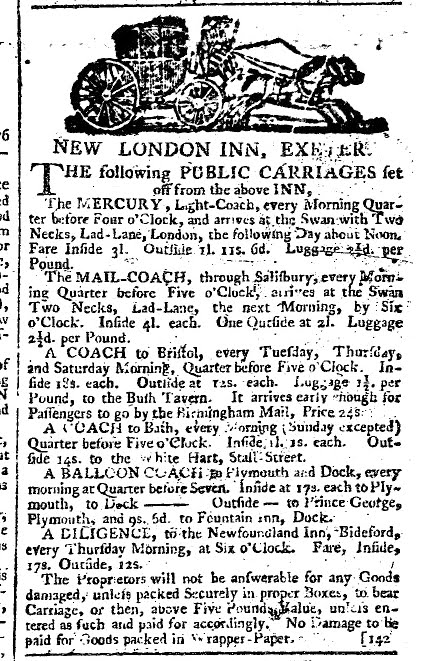
Other coaches provided transport to much larger cities. For example, in 1800 the "Mercury" coach departed from the New London inn at 3.45 in the morning and arriving at the charmingly-named Swan with Two Necks Inn at Cheapside, London the following day at noon. The fare cost anything from £1 18s to £3 10s depending on where you sat in the coach. A similar service, called The London Mail went to London via Salisbury. By the 1820s coaches were leaving the New London Inn daily for Bristol, Bath, Southampton and Brighton, with five different coaches travelling to London every day. The "Traveller" coach left the New London inn each morning at 8am and travelled to London via Chard, Crewkerne, Yeovil, Sherborne, Shaftesbury and Salisbury before arriving in the capital at noon the following day. At its busiest the Inn would see as many as 70 coaches arriving or departing within a single day.
Something extraordinary happened to the Exeter mail coach service known as "Quicksilver" on the night of 20 October 1816. Having left the New London inn with bags of mail, the coach headed towards London and by evening had arrived at Winterslow Hut, seven miles from Salisbury. As the coachman pulled up outside the Pheasant Inn one of the lead horses was attacked by a lioness, the blood "flying as if a vein had been opened by a lancet". The panic of the other horses nearly overturned the coach itself. Two passengers inside the coach sprang out in terror and ran into the Pheasant Inn, locking themselves in an upstairs room. A large mastiff ran out from the inn's yard and launched itself at the lion, causing the lion to release the horse and pursue the dog. The lion was eventually cornered beneath a granary. It had escaped from a travelling menagerie that was camping nearby. When the lion's keeper arrived both he and some assistants crawled beneath the granary with a large sack, captured the lion, tied it up and took it back to the camp. A replacement horse was found and the mail coach resumed its journey having lost only 45 minutes from its schedule. This incident was recalled in a stamp issued by the Royal Mail in 1984 and shown above left.
Anyway, back in Exeter and Nosworthy designed the New London inn with spacious accommodation spread over three floors. Like the terraces in Southernhay and Dix's Field, the inn was constructed from locally-fired red bricks. Pedestrian access into the High Street and New London Inn Square was through a simple portico supported by two fluted columns and two fluted pilasters. This must've been a later addition as an engraving from 1830 shows the facade of the inn with only an arched entrance. The floor plan consisted of a quadrangle, with the accommodation constructed around a central cobbled courtyard.

The service part of the Inn was at the rear with stabling for the horses and large gates which allowed entry into the courtyard for the delivery of goods and the collection of luggage and mail sacks. By the close of the 19th century the courtyard had received a glass roof and was furnished with rugs, tables, chairs, palms and ferns to provide a lounge area above. Supporting the upper floors were a series of slender, marbled columns. Running around the entire courtyard was a decorative frieze. Nosworthy gave the exterior elevations some interest with the use of arched windows on the ground floor with simpler rectangular windows above. A string course, probably made from Coadestone, ran across the facade at ground floor level. Comparison with Nosworthy's surviving work in Southernhay shows the consistency of his architectural style.
An early visitor to the New London inn was the Romantic poet and future Poet Laureate, Robert Southey. Probably best-known today for his biography of Nelson, he stayed at the inn in 1802. He was less than enamoured with the city of Exeter itself, praising the High Street but referring to the rest as nothing but "dirty lanes" and having the "unsavoury odour of Lisbon", but he was impressed with the New London inn. He wrote: "At length we crossed the river Exe by a respectable bridge, and immediately entered the city of Exeter, and drove up a long street to an inn as large as a large convent. 'Is it possible' I asked [the coachman], 'that this immense house can ever be filled with travellers?'". Southey continued his observations in a letter the following day, dated Saturday 24 April 1802: "If the outside of this New London inn, as it is called, surprised me, I was was far more surprised at the interior". He goes on to cite the "sofa in the apartment" and the "sideboard...set forth with china and plate", noting that none of these were essential for travelling and would probably only add to the cost of his stay.
Another literary guest was Charles Dickens above left c1839, who stayed at the New London inn in March 1839 whilst looking for a house for his parents. In a letter he wrote from the inn Dickens said that "my quarters are excellent", praising the head waiter for the good service he received. (Dickens did indeed find a house for his parents in Exeter, "about a mile beyond the city on the Plymouth Road" in what he called "this most beautiful of English counties". The house, incredibly, still stands today in Alphington). Other notable visitors included the Duke of Wellington, the Prince of Wales (later Edward VII), H Rider Haggard, George V, Beatrix Potter and Robert Louis Stevenson. Stevenson had been detained at the inn by illness for several weeks in September 1885. Upon leaving he wrote in the visitors' book: "I cannot go without recording my obligations to everyone in the house: if it is your fate to fall sick at an inn, pray heaven it may be the New London!". Jane Austen mentions the inn in chapter 47 of 'Sense and Sensibility'. For service, food, convenience and accommodation, the New London inn was one of the finest inns in south-west England.
When John Land died in 1817 aged 86 his obituary stated that he was "the oldest, and supposed to be nearly the richest, inn-keeper in the kingdom". The inn had various proprietors throughout the 19th century but in 1935 it was purchased by Associated British Cinemas and just five months later, in 1936, the entire building was demolished to construct the Savoy, later the ABC cinema.
The photograph right © Devon County Council shows the The Savoy cinema after the bombing raid of 04 May 1942, which it somehow managed to survive. The Theatre Royal is on the left. Between the Theatre and the cinema is New North Road. In his book, 'Aspects of Exeter', Peter Thomas reports how the decision to destroy the 18th century inn was met with anger in some quarters, with one citizen writing at the time saying: "It seems incredible that anyone should be guilty of such vandalism", deploring the "ruthless destruction". As Peter Thomas states: "Such sentiments are traditionally the losers in Exeter when there is hope of replacing an old building with some money-making structure". And so the inn came down. Ironically, and unlike almost everything else in the vicinity, the ABC cinema survived World War Two unscathed but was itself demolished in 1987, being replaced with an almost equally charmless bookshop.
Today nothing remains of either the New London inn or the square which was named after it. The two photographs below show what the site of the New London inn looks like today. Much of the site is under Bailey Street which was forced through from New North Road and Longbrook Street during the post-war reconstruction. The first building sits almost on top of what was London Inn Square itself. The second shows one side of Northernhay Place as it rises towards Northernhay Gardens, the same road visible in the photograph at the top of this post.
The Guildhall Exeter
It is certain that the hall has been on its present site since the 14th century, and most probably since the second half of the 12th century. It is also known that there was a guild in Exeter by 1000 AD whose hall was most likely here too. On this basis it has been claimed to be the oldest municipal building in England still in use.
The current building was constructed between 1468 and 1470.The roof timbers and walls are thought to date from 1466. Dendrochronology or tree-ring dating of the timbers give a range between 1463 and 1498. It was refaced between 1593 and 1596 at a cost of £789 in an ornate Italian style that was described by Nikolaus Pevsner as being "as picturesque as it is barbarous". The portico that juts out over the pavement is dated 1594 and its four sturdy granite columns are surmounted by highly decorated corbels of Beer stone. The upper floor, also in Beer stone, is more restrained with strapwork and 16 smaller paired pillars framing large windows that have both mullions and transoms. During renovation work it has been noted that the stonework had once been painted in cream with details in red and blue and the pillars gilded.
The city stocks were once under the portico. The elaborately carved oak door, dated 1593, was made by Nicholas Baggett, a local carpenter. It leads via an anteroom to the council chamber which apparently dates between 1468 and 1470, though it was much restored in Victorian times. The oak panelling around the main hall probably dates from 1594 when the portico was added. The arch-braced roof with seven bays is original; its main trusses rest on carved corbels representing grotesque animals.
It was in Exeter Guildhall that, in the aftermath of the Monmouth Rebellion, Judge Jeffreys held the Bloody Assizes on 14 September 1685.
A large chandelier hangs from the centre of the roof. It was made by Thomas Pyke of Bridgwater and installed in 1789. Apart from this and the roof, all the internal fittings are Victorian, including the stained glass, the gallery, the furniture and the stone floor (all 1863) and the heavily restored Tudor panelling (1887). Above the fireplace is a bust of Queen Victoria by Henry Hugh Armstead.

Under the council chamber there is an early 14th-century cellar. This was once a prison that was known as the "pytt of the Guyldhall". In the 16th century another prison, for women, was built on the ground floor at the back of the building. It remained in use until 1887. In 1858 a room was built above this to store the city's records; it was later used as a jury room.
Richard Suter was born in Greenwich, Kent on 30th March 1798, to William Suter and his wife Sarah Knights. On 7th January 1825 he married Anne Ruth Burn.
English architect. As Surveyor to The Fishmongers' Company he designed the severe Presbyterian churches for Ballykelly (1825–7) and Banagher (1825) on the Company's Estate in County Londonderry, drawings of which were exhibited at the Royal Academy in 1827. He was also responsible for the Model Farm (1823–4), the Lancasterian Schools (1828–30), the Company Agent's House (1830–2—now a hotel, much altered), a range of houses on the south side of the main road (1823–4), the lodge in the Presbyterian churchyard (1828), and the Dispensary (1829), all at Ballykelly, and all Classical. As Surveyor to Trinity House Corporation, he designed houses that were erected by Thomas Cubitt in 1821–3 on a site adjoining Trinity House. For The Fishmongers' Company he designed St Peter's Almshouses, Wandsworth, London (1849–51), and The Old School-House, Gresham's School, Holt, Norfolk(1859), in an Elizabethan style.
On the 1841 Census Richard, an architect and lawyer, can be found living in London with his wife Ann (listed as Ruth) and their two children, Richard George and Andrew Burn. Living with them is Edward D Suter. 1851 finds the family living in Tottenham Court in London, by this time Andrew had left the home, but I am unable to trace him on the 1851 Census. In 1860 Andrew marries Amelia Damaris Harrison. Both Richard George and Andrew were to become ordained ministers, with Andrew later becoming a Bishop and emigrating to New Zealand. Sadly in 1854 Anne Ruth was to pass away. In 1861, widowed Richard, Justice of the Peace for Maidenhead, is living at Castle Hill, Maidenhead, Berkshire. In 1862 he married Elizabeth Anne Pocock. In 1871 and 1881 Richard and Elizabeth are still living in Castle Hill. Richard was to pass away on 1st March1883.
Richard Suter & Annesley Voysey, architects, had their office at number 35 Fenchurch Street, but they did not have it all to themselves as they shared the premises with W.C. Franks, a tea broker, who will get a separate post some other time. The earliest mention I found of Richard Suter in Fenchurch Street is in 1832 when he is listed at that address in a list of contributing members of the Society for the Propagation of the Gospel in Foreign Parts. It says that he had been a member since 1829, but that does not mean he was already at 35 Fenchurch Street in that year.(1) In fact, that seems unlikely as the Sun Fire Office records give Messrs. Short and Co., merchants, as paying the insurance premium on the premises in May 1830. The Directory of British Architects 1834-1914 give the year 1827, but I do not know on what evidence. When Suter and Voysey became partners is also uncertain, but they had known each other since at least 1825 as Suter is named as one of the executors of Voysey’s will which was dated 22 July, 1825. The address given for Suter in the will is Suffolk Street, Southwark. Voysey then lives at Conway Street, Fitzroy Square.