
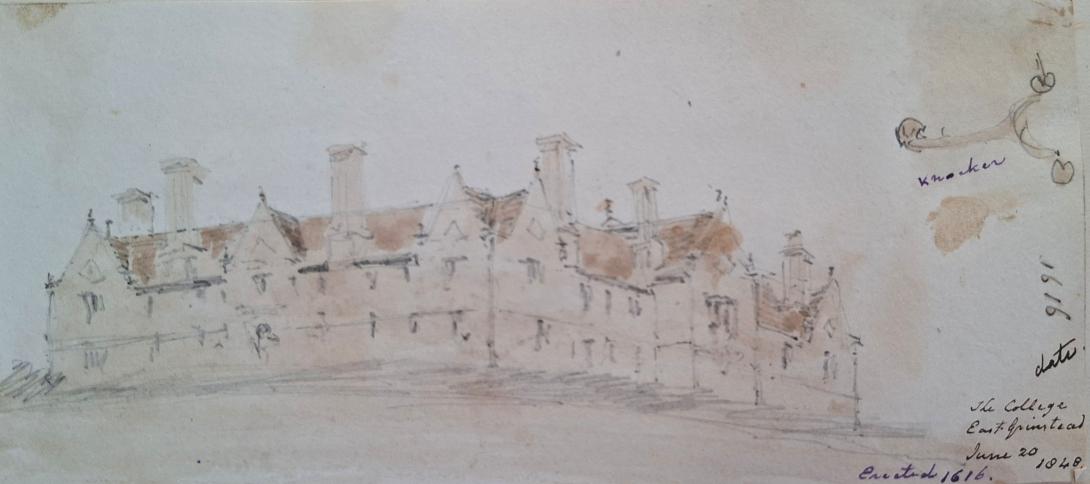
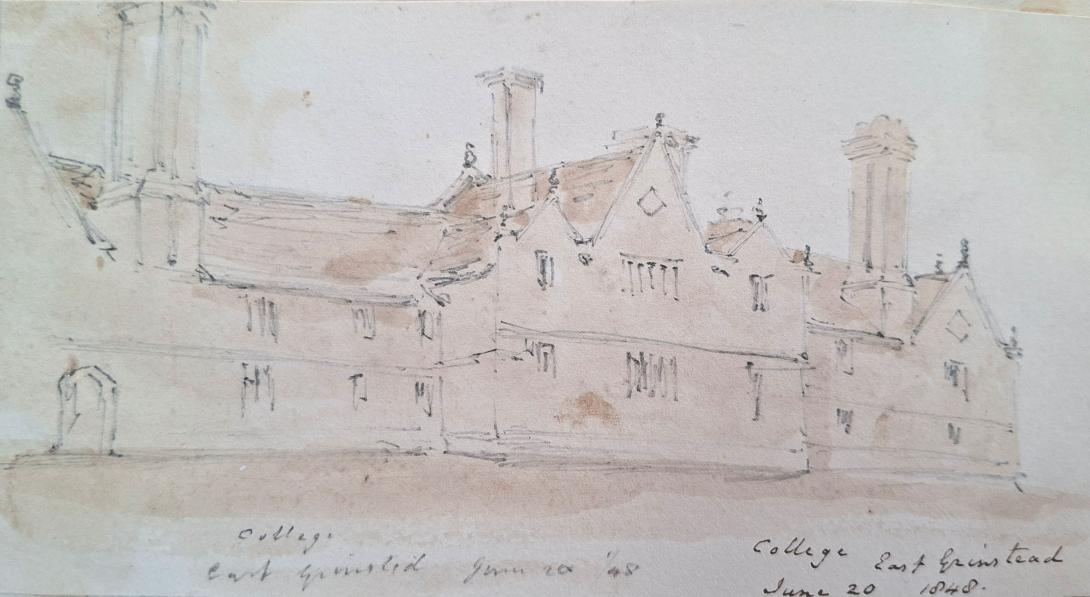
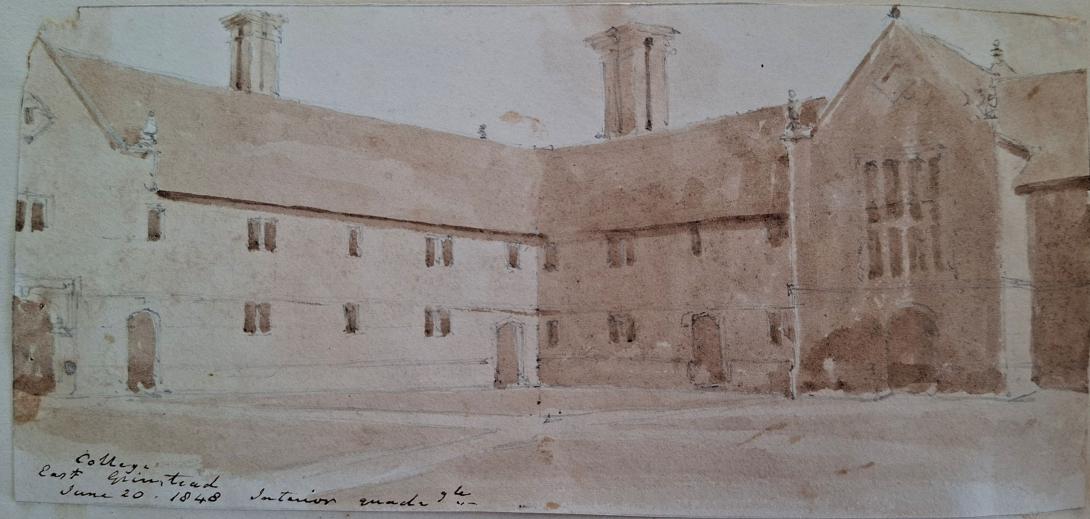
inscribed and dated " The Collge/ East Grinstead/ June 20 1848/ erected 1616" and inscribed and dated " college/ East Grinstead June 20 1848" and further inscribed and dated " College/ East Grinstead/ June 20 1848 Interior Quadrangle"
Sackville College is a Jacobean almshouse in the town of East Grinstead, West Sussex, England.
It was founded in 1609 with money left by Robert Sackville, 2nd Earl of Dorset. Throughout its history it has provided sheltered accommodation for the elderly.
Foundation
Robert Sackville left £1,000 for the building and a rent charge of £330, for the endowment of a 'hospital or college' for twenty-one poor men and ten poor women, to be under the patronage and government of his heirs. This may have been an imitation of Emanuel College, Westminster, founded by his aunt, Anne Fiennes, Lady Dacre. The building of the almshouse known as 'Sackville College for the Poor' at East Grinstead was commenced about 1616 by the executors, his brother-in-law, Lord William Howard, and Sir George Rivers of Chafford. It was occupied before 1622.
Most of the Sackville lands were soon alienated by the founder's son, and the buyers refused to acknowledge the estate's liability to the college. On 6 July 1631 the poor inmates received a charter of incorporation, but their revenues were still irregularly paid. But in 1700, after long litigation, a reduced rent charge was imposed on the Sackville estates on behalf of the college, and the number of inmates reduced to twelve, with a warden. The college buildings were restored in the nineteenth century by the Countess Amherst and the Countess De la Warr.
The College is run as a charity, operating under an Act of Parliament from 1624 and a royal charter from 1631. The College continues to receive patronage from William Sackville, 11th Earl De La Warr. The building is located at the end of the High Street close to St Swithun's Church.
It is built from local sandstone. The main building was completed in 1619, and remains exceptionally well preserved. The original lock is still used on the Chapel door and much furniture from the seventeenth and eighteenth centuries is preserved inside. It is a Grade I listed building. The building surrounds a courtyard which contains a well. The internal walls have large mullioned windows. The Great Hall features the original hammer-beam roof. Inside, the residences for the elderly have been modernized.
The College is run by a warden, who lives in part of the building that was originally used by the Sackville family on visits to their Sussex estates. The warden's office has not changed substantially since it was used by the Revd Dr John Mason Neale, who was warden from 1846 until his death in 1866. J.M. Neale was a hymn writer notable as the author of Good King Wenceslas. The warden's office is a good example of a Victorian study. The chapel was restored 1846–1866, in early C14 style by William Butterfield under the direction of Dr Neale.
Richard Suter (1797–1883).
Richard Suter was born in Greenwich, Kent on 30th March 1798, to William Suter and his wife Sarah Knights. On 7th January 1825 he married Anne Ruth Burn.
English architect. As Surveyor to The Fishmongers' Company he designed the severe Presbyterian churches for Ballykelly (1825–7) and Banagher (1825) on the Company's Estate in County Londonderry, drawings of which were exhibited at the Royal Academy in 1827. He was also responsible for the Model Farm (1823–4), the Lancasterian Schools (1828–30), the Company Agent's House (1830–2—now a hotel, much altered), a range of houses on the south side of the main road (1823–4), the lodge in the Presbyterian churchyard (1828), and the Dispensary (1829), all at Ballykelly, and all Classical. As Surveyor to Trinity House Corporation, he designed houses that were erected by Thomas Cubitt in 1821–3 on a site adjoining Trinity House. For The Fishmongers' Company he designed St Peter's Almshouses, Wandsworth, London (1849–51), and The Old School-House, Gresham's School, Holt, Norfolk(1859), in an Elizabethan style.
On the 1841 Census Richard, an architect and lawyer, can be found living in London with his wife Ann (listed as Ruth) and their two children, Richard George and Andrew Burn. Living with them is Edward D Suter. 1851 finds the family living in Tottenham Court in London, by this time Andrew had left the home, but I am unable to trace him on the 1851 Census. In 1860 Andrew marries Amelia Damaris Harrison. Both Richard George and Andrew were to become ordained ministers, with Andrew later becoming a Bishop and emigrating to New Zealand. Sadly in 1854 Anne Ruth was to pass away. In 1861, widowed Richard, Justice of the Peace for Maidenhead, is living at Castle Hill, Maidenhead, Berkshire. In 1862 he married Elizabeth Anne Pocock. In 1871 and 1881 Richard and Elizabeth are still living in Castle Hill. Richard was to pass away on 1st March1883.
Richard Suter & Annesley Voysey, architects, had their office at number 35 Fenchurch Street, but they did not have it all to themselves as they shared the premises with W.C. Franks, a tea broker, who will get a separate post some other time. The earliest mention I found of Richard Suter in Fenchurch Street is in 1832 when he is listed at that address in a list of contributing members of the Society for the Propagation of the Gospel in Foreign Parts. It says that he had been a member since 1829, but that does not mean he was already at 35 Fenchurch Street in that year.(1) In fact, that seems unlikely as the Sun Fire Office records give Messrs. Short and Co., merchants, as paying the insurance premium on the premises in May 1830. The Directory of British Architects 1834-1914 give the year 1827, but I do not know on what evidence. When Suter and Voysey became partners is also uncertain, but they had known each other since at least 1825 as Suter is named as one of the executors of Voysey’s will which was dated 22 July, 1825. The address given for Suter in the will is Suffolk Street, Southwark. Voysey then lives at Conway Street, Fitzroy Square.