
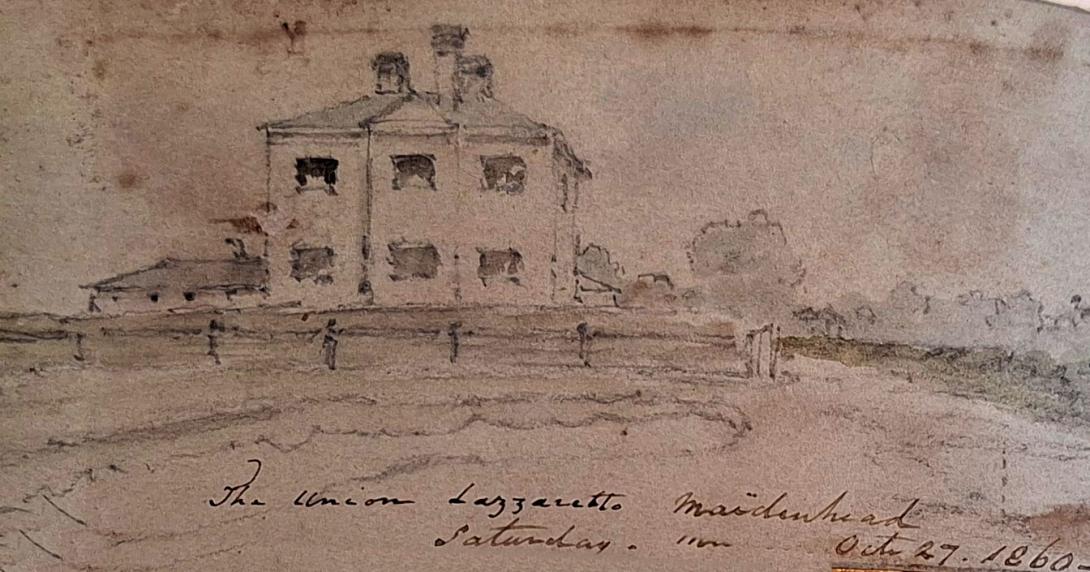
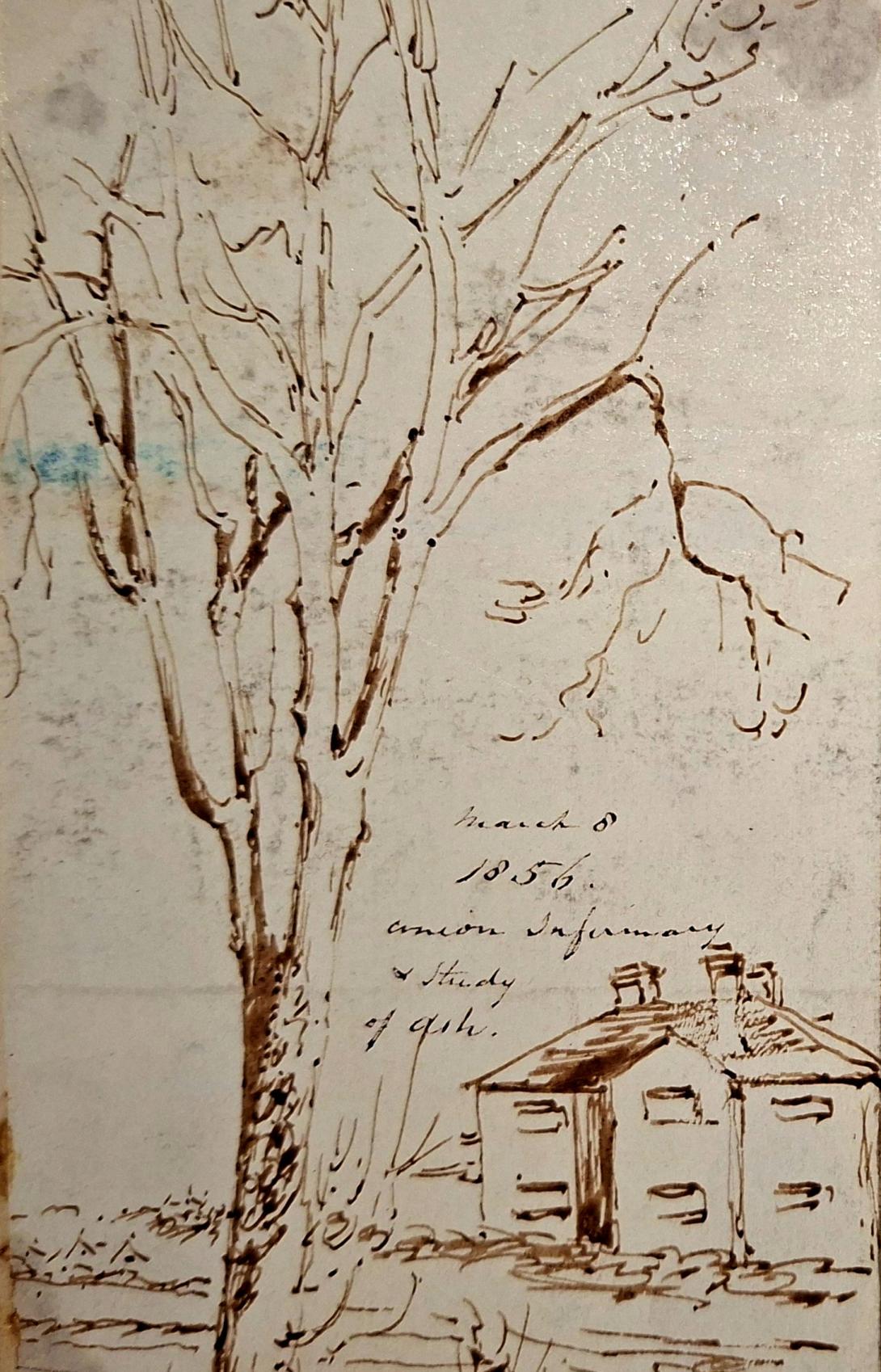
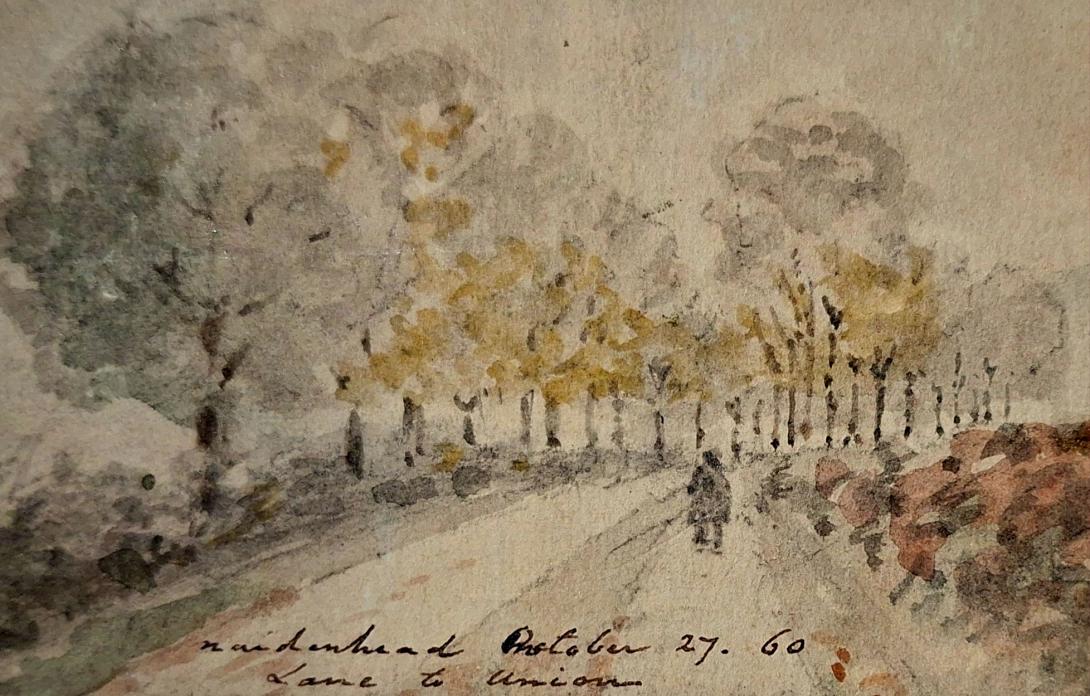
"The Infirmary at the Union Oct 27 1860 / The Union Lazzaretto Maidenhead / Saturday Oct 27 1860" and Infirmary of the Union March 6 1856 , and Road to Union Oct 27 1860
The Maidenhead Union Workhouse (officially the Cookham Union workhouse until the 1890s) was located on the north side of St Mark's Road, Maidenhead, and was operational in 1860. The workhouse had an infirmary wing or dedicated area for the "infirm" and the sick, a common feature in most workhouses of that era. Inmates with medical conditions were typically cared for here, separated from the able-bodied paupers, with the infirm often receiving slightly better treatment.
Surviving records for the Maidenhead (Cookham) Union workhouse and its infirmary are held in local or county archives, specifically the Royal Berkshire Archives (formerly the Berkshire Record Office). These records may include admission and discharge registers and other documents that detail inmates' names, dates of stay, and reasons for being there (such as sickness or old age).You can also search online genealogy sites like Findmypast or Ancestry for transcribed pauper records from 1860. In 1860, workhouse conditions were generally harsh and designed to deter all but the truly destitute. Families were typically separated upon entry. The workhouse infirmary system later formed the foundation for many local hospitals that eventually joined the National Health Service in 1948.
The Workhouse of Cookham Union was built in 1837, is a structure of brick arranged to hold 250 inmates; particulars of the union are given under Maidenhead. The charities for distribution, including Mrs. Poole of Wargrave’s cloth charity, are of the value of £70. Here is an extensive paper mill, which gives employment to many of the inhabitants. In the 16th century, the Mores, previously of Salop, resided here, and at the visitation in 1664 the families of Robinson, Salter, Turberville and Weldon recorded their pedigrees and arms of this place. The principal landowners are Henry Duncan Skrine esq. of Claverton, Bath, who is lord of the manor. John Thornton Rogers of Sevenoaks, Kent. John Philip Weatherby esq. Francis Devereux Lambert esq. Ernest Gardener esq. and the Vaughan trustees. The soil is various, but generally good corn land; subsoil, gravel, chalk and loam. The chief crops are wheat, barley and oats. The area is 4,474 acres; rateable value, £22,510; the population in 1891, including the district of Cookham Dean, was 2,965 (including the 196 officers and inmates of the workhouse). Holy Trinity district has a population of 1,358. Maidenhead once partly in this parish has been entirely separated from it.
Richard Suter was born in Greenwich, Kent on 30th March 1798, to William Suter and his wife Sarah Knights. On 7th January 1825 he married Anne Ruth Burn.
English architect. As Surveyor to The Fishmongers' Company he designed the severe Presbyterian churches for Ballykelly (1825–7) and Banagher (1825) on the Company's Estate in County Londonderry, drawings of which were exhibited at the Royal Academy in 1827. He was also responsible for the Model Farm (1823–4), the Lancasterian Schools (1828–30), the Company Agent's House (1830–2—now a hotel, much altered), a range of houses on the south side of the main road (1823–4), the lodge in the Presbyterian churchyard (1828), and the Dispensary (1829), all at Ballykelly, and all Classical. As Surveyor to Trinity House Corporation, he designed houses that were erected by Thomas Cubitt in 1821–3 on a site adjoining Trinity House. For The Fishmongers' Company he designed St Peter's Almshouses, Wandsworth, London (1849–51), and The Old School-House, Gresham's School, Holt, Norfolk(1859), in an Elizabethan style.
On the 1841 Census Richard, an architect and lawyer, can be found living in London with his wife Ann (listed as Ruth) and their two children, Richard George and Andrew Burn. Living with them is Edward D Suter. 1851 finds the family living in Tottenham Court in London, by this time Andrew had left the home, but I am unable to trace him on the 1851 Census. In 1860 Andrew marries Amelia Damaris Harrison. Both Richard George and Andrew were to become ordained ministers, with Andrew later becoming a Bishop and emigrating to New Zealand. Sadly in 1854 Anne Ruth was to pass away. In 1861, widowed Richard, Justice of the Peace for Maidenhead, is living at Castle Hill, Maidenhead, Berkshire. In 1862 he married Elizabeth Anne Pocock. In 1871 and 1881 Richard and Elizabeth are still living in Castle Hill. Richard was to pass away on 1st March1883.
Richard Suter & Annesley Voysey, architects, had their office at number 35 Fenchurch Street, but they did not have it all to themselves as they shared the premises with W.C. Franks, a tea broker, who will get a separate post some other time. The earliest mention I found of Richard Suter in Fenchurch Street is in 1832 when he is listed at that address in a list of contributing members of the Society for the Propagation of the Gospel in Foreign Parts. It says that he had been a member since 1829, but that does not mean he was already at 35 Fenchurch Street in that year.(1) In fact, that seems unlikely as the Sun Fire Office records give Messrs. Short and Co., merchants, as paying the insurance premium on the premises in May 1830. The Directory of British Architects 1834-1914 give the year 1827, but I do not know on what evidence. When Suter and Voysey became partners is also uncertain, but they had known each other since at least 1825 as Suter is named as one of the executors of Voysey’s will which was dated 22 July, 1825. The address given for Suter in the will is Suffolk Street, Southwark. Voysey then lives at Conway Street, Fitzroy Square.