
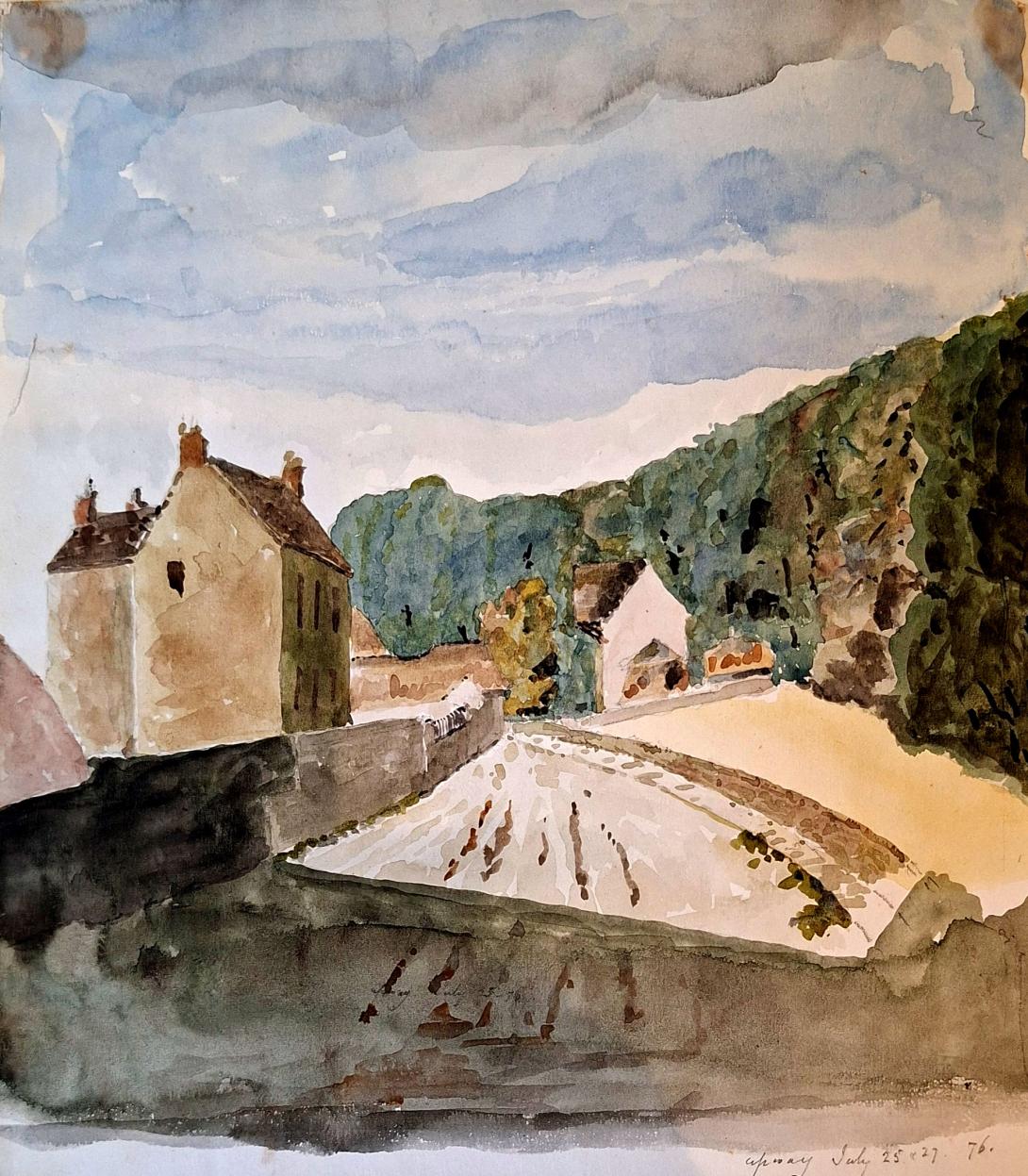
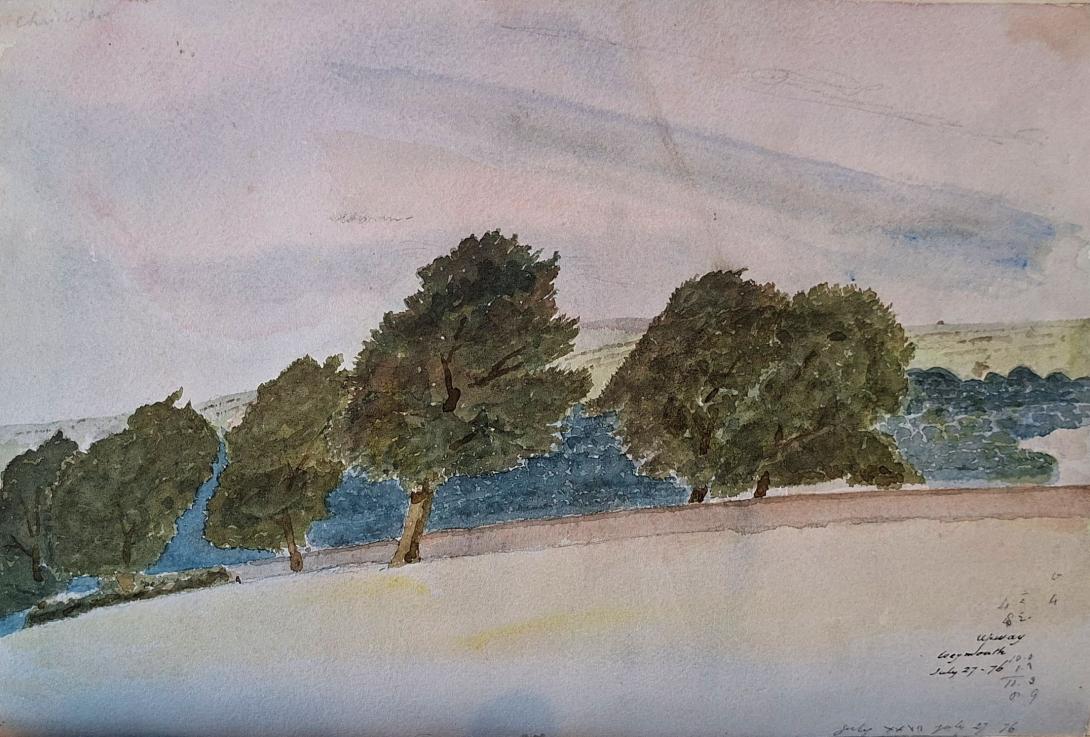
inscribed and dated " Upwey July 25 & 29 76" (2)
Upwey is a suburb of Weymouth in south Dorset, England. The suburb is situated on the B3159 road in the Wey valley. The area was formerly a village until it was absorbed into the Weymouth built-up area. It is located four miles north of the town centre in the outer suburbs. In the Census 2001 the combined population of Upwey and neighbouring Broadwey was 4,349.
The village has a 13th-century parish church, dedicated to Saint Laurence, and a manor house, Upwey Manor, a Grade II* listed building dated to 1639, which was owned by the Gould family.[1] A disc barrow is located above the village on the Ridgeway at map reference SY 663866. The former United Reformed Church was built in 1880–81 and closed in 1992.
The River Wey rises at the foot of the chalk ridge of the South Dorset Downs, which rise above Upwey to the north, and flows through the village. The source is known as the Upwey wishing well and was a tourist attraction as far back as the Victorian era. There is now a tea room at the site, complete with mature water gardens. In the 18th century a water mill was built on the river, rebuilt in 1802, it featured in Thomas Hardy's The Trumpet Major. The mill is now Grade II* listed. Hardy also wrote a poem "At the Railway Station, Upway", which most likely relates to Upwey station.
Upwey features in Edward Chaney's Genius Friend: G.B. Edwards and The Book of Ebenezer le Page as the place in which Chaney got to know Gerald Edwards and encouraged him to complete his novel. Edwards died in the since-demolished 654 Dorchester Road, Upwey, on 29 December 1976.
Upwey has two public houses. The Old Ship features in Thomas Hardy's Under the Greenwood Tree, while The Royal Standard was once run by an aunt of Thomas Hardy on his father's side.
Upwey lends its name to Upwey, Victoria, in Melbourne, near Belgrave, Victoria.
Richard Suter was born in Greenwich, Kent on 30th March 1798, to William Suter and his wife Sarah Knights. On 7th January 1825 he married Anne Ruth Burn.
English architect. As Surveyor to The Fishmongers' Company he designed the severe Presbyterian churches for Ballykelly (1825–7) and Banagher (1825) on the Company's Estate in County Londonderry, drawings of which were exhibited at the Royal Academy in 1827. He was also responsible for the Model Farm (1823–4), the Lancasterian Schools (1828–30), the Company Agent's House (1830–2—now a hotel, much altered), a range of houses on the south side of the main road (1823–4), the lodge in the Presbyterian churchyard (1828), and the Dispensary (1829), all at Ballykelly, and all Classical. As Surveyor to Trinity House Corporation, he designed houses that were erected by Thomas Cubitt in 1821–3 on a site adjoining Trinity House. For The Fishmongers' Company he designed St Peter's Almshouses, Wandsworth, London (1849–51), and The Old School-House, Gresham's School, Holt, Norfolk(1859), in an Elizabethan style.
On the 1841 Census Richard, an architect and lawyer, can be found living in London with his wife Ann (listed as Ruth) and their two children, Richard George and Andrew Burn. Living with them is Edward D Suter. 1851 finds the family living in Tottenham Court in London, by this time Andrew had left the home, but I am unable to trace him on the 1851 Census. In 1860 Andrew marries Amelia Damaris Harrison. Both Richard George and Andrew were to become ordained ministers, with Andrew later becoming a Bishop and emigrating to New Zealand. Sadly in 1854 Anne Ruth was to pass away. In 1861, widowed Richard, Justice of the Peace for Maidenhead, is living at Castle Hill, Maidenhead, Berkshire. In 1862 he married Elizabeth Anne Pocock. In 1871 and 1881 Richard and Elizabeth are still living in Castle Hill. Richard was to pass away on 1st March1883.
Richard Suter & Annesley Voysey, architects, had their office at number 35 Fenchurch Street, but they did not have it all to themselves as they shared the premises with W.C. Franks, a tea broker, who will get a separate post some other time. The earliest mention I found of Richard Suter in Fenchurch Street is in 1832 when he is listed at that address in a list of contributing members of the Society for the Propagation of the Gospel in Foreign Parts. It says that he had been a member since 1829, but that does not mean he was already at 35 Fenchurch Street in that year.(1) In fact, that seems unlikely as the Sun Fire Office records give Messrs. Short and Co., merchants, as paying the insurance premium on the premises in May 1830. The Directory of British Architects 1834-1914 give the year 1827, but I do not know on what evidence. When Suter and Voysey became partners is also uncertain, but they had known each other since at least 1825 as Suter is named as one of the executors of Voysey’s will which was dated 22 July, 1825. The address given for Suter in the will is Suffolk Street, Southwark. Voysey then lives at Conway Street, Fitzroy Square.