
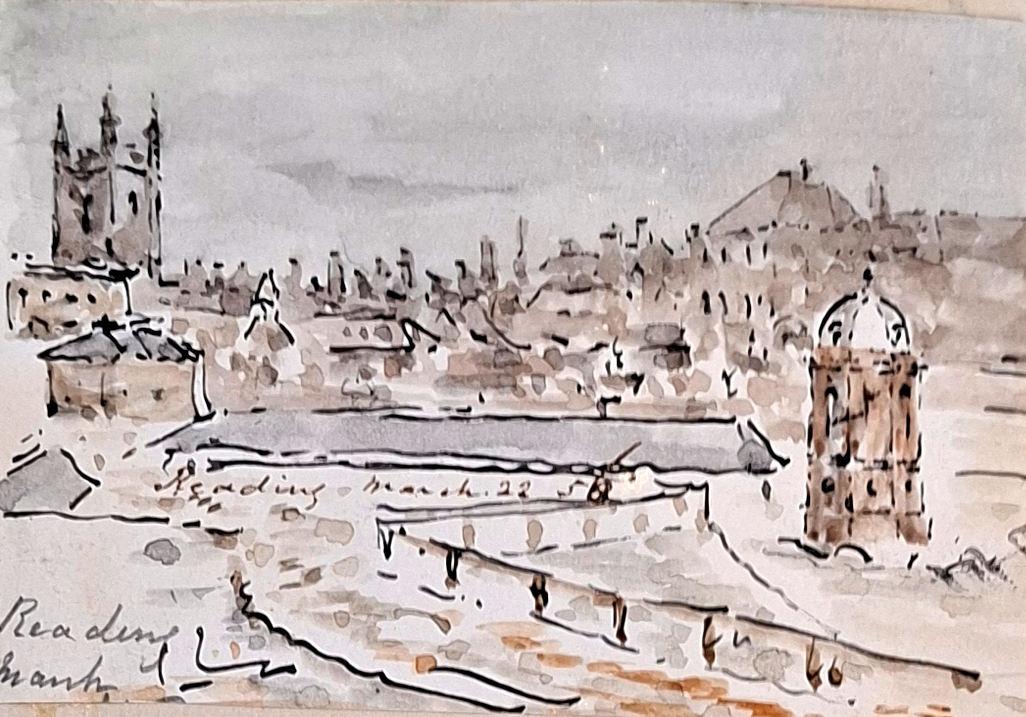
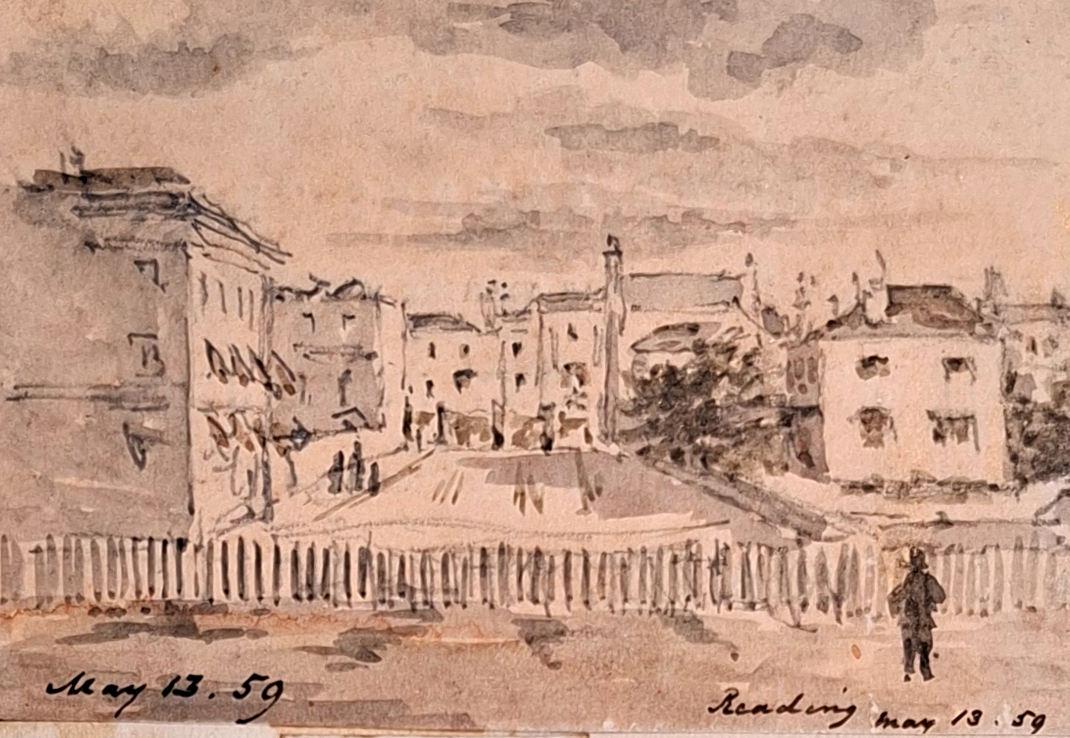
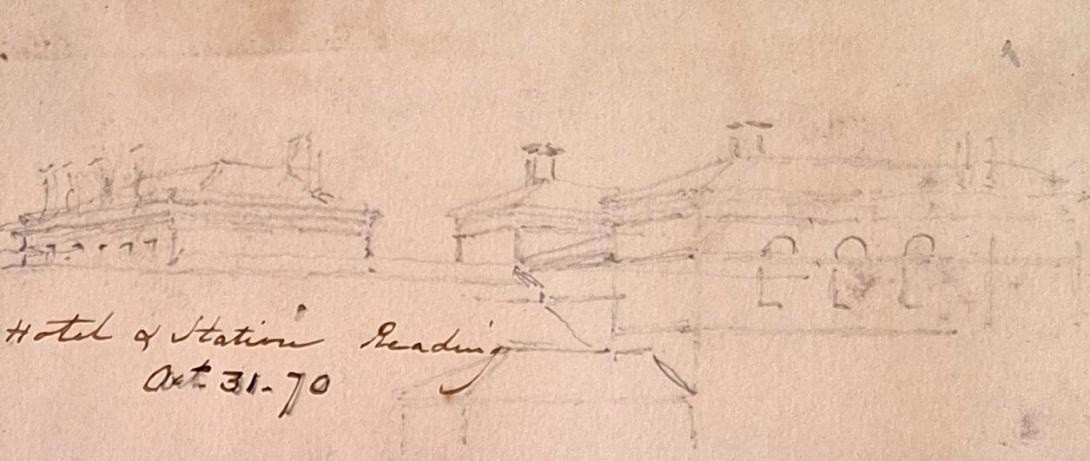
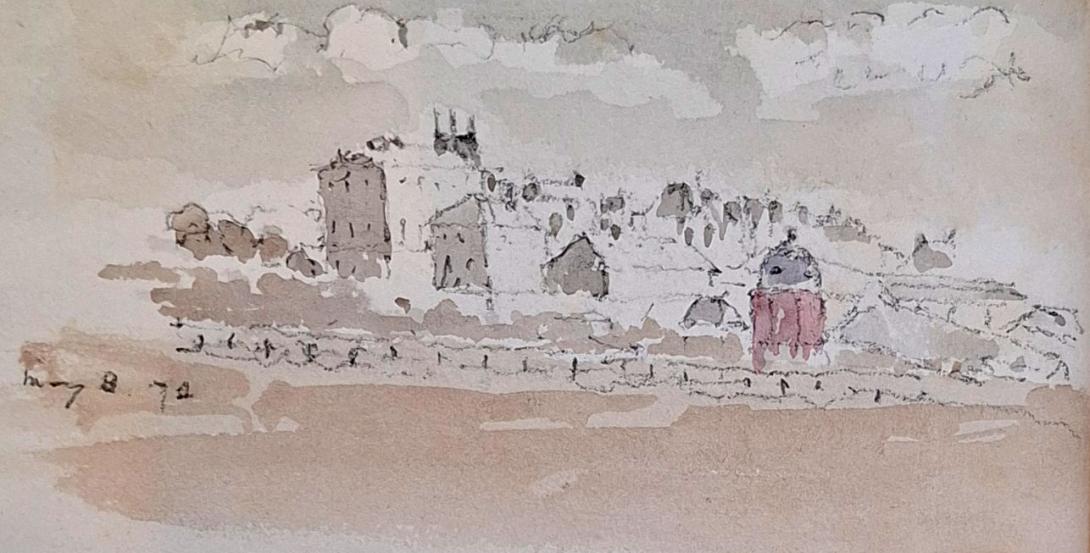
Reading May 13 1859
Reading is a borough in Berkshire, England, and the county town of Berkshire. It is Berkshire's largest town, with a total built-up area population of 355,596. Most of its built-up area lies within the Borough of Reading, although some outer suburbs are parts of neighbouring local authority areas. It is located in the Thames Valley at the confluence of the rivers Thames and Kennet.
Reading is a major commercial centre, especially for information technology and insurance. It is also a regional retail centre, serving a large area of the Thames Valley with its shopping centres, including the Oracle, the Broad Street Mall, and the pedestrianised area around Broad Street. It is home to the University of Reading. Every year it hosts the Reading Festival, one of England's biggest music festivals. Reading has a professional association football team, Reading F.C., and participates in many other sports.
Reading dates from the 8th century. It was a trading and ecclesiastical centre in the Middle Ages, the site of Reading Abbey, one of the largest and richest monasteries of medieval England with royal connections, of which the 12th-century abbey gateway and significant ancient ruins remain. By 1525, Reading was the largest town in Berkshire, and tenth in England for taxable wealth. The town was seriously affected by the English Civil War, with a major siege and loss of trade, but played a pivotal role in the Glorious Revolution, whose only significant military action was fought on its streets. The 18th century saw the beginning of a major ironworks in the town and the growth of the brewing trade for which Reading was to become famous. The 19th century saw the coming of the Great Western Railway and the development of the town's brewing, baking and seed-growing businesses, and the town grew rapidly as a manufacturing centre.
The earliest known name for Reading is Readingas, from the 8th century. The name probably comes from the Readingas, an Anglo-Saxon tribe whose name means Reada's People in Old English (the Anglo-Saxons often had the same name for a place and its inhabitants).
The demonym for a person from Reading is Redingensian, giving the name of the local rugby team Redingensians, based in Sonning, and of former members of Reading School.
Main article: History of Reading, Berkshire
For a chronological guide, see Timeline of Reading, Berkshire.
Origins


Occupation at the site of Reading may date back to the Roman period, possibly in the form of a trading port for Calleva Atrebatum.[7] However, the first clear evidence for Reading as a settlement dates from the 8th century, when the town came to be known as Readingas. In late 870, an army of Danes invaded the kingdom of Wessex and set up camp at Reading. On 4 January 871, in the first Battle of Reading, King Ethelred and his brother Alfred the Great attempted unsuccessfully to breach the Danes' defences. The battle is described in the Anglo-Saxon Chronicle, and that account provides the earliest known written record of the existence of Reading. The Danes remained in Reading until late in 871, when they retreated to their winter quarters in London.
Following the Norman conquest of England, William the Conqueror gave land in and around Reading to his foundation of Battle Abbey. In Domesday Book, the town was explicitly described as a borough. The presence of six mills is recorded: four on land belonging to the king and two on the land given to Battle Abbey. Reading Abbey was founded in 1121 by Henry I, who is buried within the Abbey grounds. As part of his endowments, he gave the abbey his lands in Reading, along with land at Cholsey.
The town grew around a crossing of the River Kennet, about 1 mile (1.6 km) upstream from its confluence with the River Thames. In 1312, King Edward II directed that its bridges should be kept in good order. It is not known how badly Reading was affected by the Black Death that swept through England in the 14th century, but it is known that the abbot, Henry of Appleford, was one of its victims in 1361, and that nearby Henley lost 60% of its population.The Abbey was largely destroyed in 1538 during Henry VIII's dissolution of the monasteries. The last abbot, Hugh Faringdon, was subsequently tried and convicted of high treason and hanged, drawn and quartered in front of the Abbey Church.
By 1525, Reading was the largest town in Berkshire and the tenth largest town in England when measured by taxable wealth reported in tax returns. By 1611, it had a population of over 5,000 and had grown rich on its trade in cloth, as instanced by the fortune made by local merchant John Kendrick. Reading played a role during the English Civil War. Despite its fortifications, it had a Royalist garrison imposed on it in 1642. The subsequent Siege of Reading by Parliamentary forces succeeded in April 1643.The town's cloth trade was especially badly damaged, and the town's economy did not fully recover until the 20th century. Reading played a significant role during the Glorious Revolution: the second Battle of Reading was the only substantial military action of the campaign.
The 18th century saw the beginning of a major iron works in the town and the growth of the brewing trade for which Reading was to become famous. Reading's trade benefited from better designed turnpike roads which helped it establish its location on the major coaching routes from London to Oxford and the West Country. In 1723, despite considerable local opposition, the Kennet Navigation opened the River Kennet to boats as far as Newbury. Opposition stopped when it became apparent that the new route benefited the town. After the opening of the Kennet and Avon Canal in 1810, one could go by barge from Reading to the Bristol Channel. From 1714, and probably earlier, the role of county town of Berkshire was shared between Reading and Abingdon. In the eighteenth and nineteenth centuries it was one of the southern termini of the Hatfield and Reading Turnpike that allowed travellers from the north to continue their journey to the west without going through the congestion of London.
During the 19th century, the town grew rapidly as a manufacturing centre. The Great Western Railway arrived in 1841, followed by the South Eastern Railway in 1849 and the London and South Western Railway in 1856. After the Summer Assizes (courts of assize) were moved from Abingdon to Reading in 1867, the privy council made Reading the sole county town of Berkshire in 1869. The town became county borough under the Local Government Act 1888. In the 19th and 20th centuries, the town's three largest industries were known as the Three Bs: beer (1785–2010, H & G Simonds), bulbs (1837–1974, Suttons Seeds), and biscuits (1822–1976, Huntley and Palmers).
Richard Suter was born in Greenwich, Kent on 30th March 1798, to William Suter and his wife Sarah Knights. On 7th January 1825 he married Anne Ruth Burn.
English architect. As Surveyor to The Fishmongers' Company he designed the severe Presbyterian churches for Ballykelly (1825–7) and Banagher (1825) on the Company's Estate in County Londonderry, drawings of which were exhibited at the Royal Academy in 1827. He was also responsible for the Model Farm (1823–4), the Lancasterian Schools (1828–30), the Company Agent's House (1830–2—now a hotel, much altered), a range of houses on the south side of the main road (1823–4), the lodge in the Presbyterian churchyard (1828), and the Dispensary (1829), all at Ballykelly, and all Classical. As Surveyor to Trinity House Corporation, he designed houses that were erected by Thomas Cubitt in 1821–3 on a site adjoining Trinity House. For The Fishmongers' Company he designed St Peter's Almshouses, Wandsworth, London (1849–51), and The Old School-House, Gresham's School, Holt, Norfolk(1859), in an Elizabethan style.
On the 1841 Census Richard, an architect and lawyer, can be found living in London with his wife Ann (listed as Ruth) and their two children, Richard George and Andrew Burn. Living with them is Edward D Suter. 1851 finds the family living in Tottenham Court in London, by this time Andrew had left the home, but I am unable to trace him on the 1851 Census. In 1860 Andrew marries Amelia Damaris Harrison. Both Richard George and Andrew were to become ordained ministers, with Andrew later becoming a Bishop and emigrating to New Zealand. Sadly in 1854 Anne Ruth was to pass away. In 1861, widowed Richard, Justice of the Peace for Maidenhead, is living at Castle Hill, Maidenhead, Berkshire. In 1862 he married Elizabeth Anne Pocock. In 1871 and 1881 Richard and Elizabeth are still living in Castle Hill. Richard was to pass away on 1st March1883.
Richard Suter & Annesley Voysey, architects, had their office at number 35 Fenchurch Street, but they did not have it all to themselves as they shared the premises with W.C. Franks, a tea broker, who will get a separate post some other time. The earliest mention I found of Richard Suter in Fenchurch Street is in 1832 when he is listed at that address in a list of contributing members of the Society for the Propagation of the Gospel in Foreign Parts. It says that he had been a member since 1829, but that does not mean he was already at 35 Fenchurch Street in that year.(1) In fact, that seems unlikely as the Sun Fire Office records give Messrs. Short and Co., merchants, as paying the insurance premium on the premises in May 1830. The Directory of British Architects 1834-1914 give the year 1827, but I do not know on what evidence. When Suter and Voysey became partners is also uncertain, but they had known each other since at least 1825 as Suter is named as one of the executors of Voysey’s will which was dated 22 July, 1825. The address given for Suter in the will is Suffolk Street, Southwark. Voysey then lives at Conway Street, Fitzroy Square.