
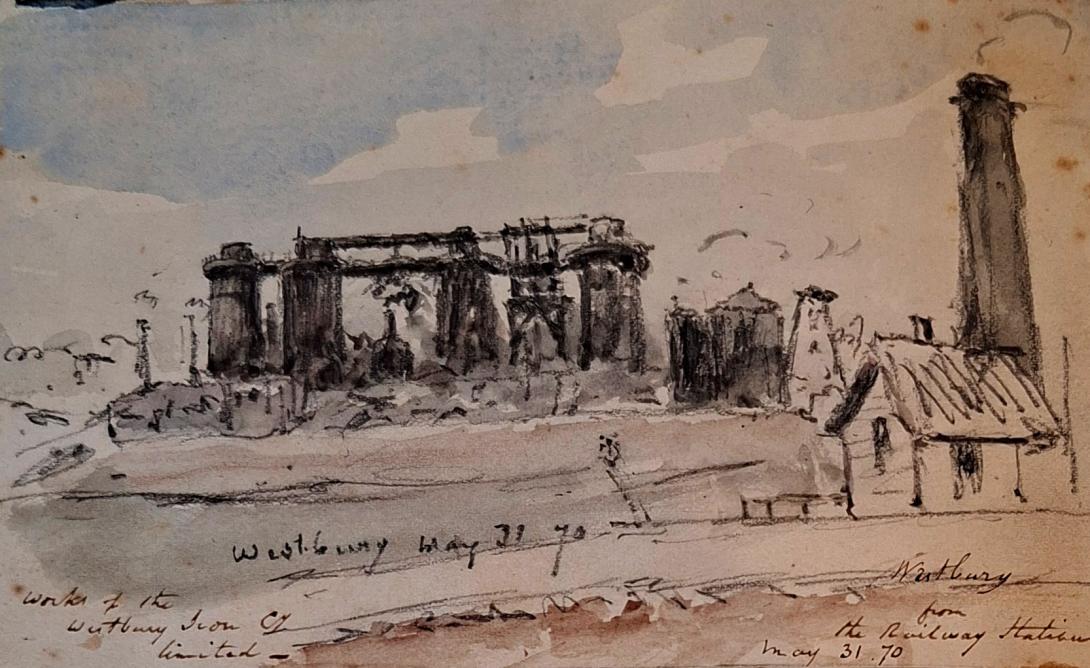
"Westbury May 31 70/ from the railway station /works of the westbury iron co/limited"
When the new railway was being built in the 1840s, deposits of iron ore were discovered in the area. In 1857, a group of investors got together to form the Westbury Iron Company with the aim of producing iron from this natural resource. Conditions were favourable as limestone, another necessary raw
material was also available nearby and there was abundant water from Biss Brook which flowed near the site. Coal would be brought by rail from the Somerset mines and the finished produce would find a market in Staffordshire and the Midlands.
Foundations for the first furnace were quickly laid on a site to the north of Westbury Station and by May 1858, it was reported that a chimney reaching to 100 ft. high had been built. The first molten metal was produced on 14 July 1858 and this was celebrated by a procession from the works to the Lopes Arms Inn where a “sumptuous” dinner was eaten by about 40 investors and supporters of the project. Speeches were made and toasts were drunk.
At first chalk was brought by horse and cart from a quarry on Long River Road. Later limestone was found in the area just to the south of The Ham and a quarry was dug there. A series of pits for the iron ore were dug more or less along the line of the railway track from near Penleigh to just beyond Hawkeridge Road near Shallow Wagon Lane. In places the ore could be on the surface, in others the pits went to a depth of 30 feet. A tramway was built to haul the ore in wagons back to the works. To start with, horses were used to pull the wagons, but in the 1870s narrow gauge locomotives were brought into use.
The ironworks prospered for most of the rest of the nineteenth century. The furnaces burnt night and day, seven days a week. A third furnace was built and later a fourth. It survived the economic recession of the 1870s, although wages were cut. By 1883, approximately 200 men worked there and in 1894 the average age for a seven day week was 24s.
By the start of the twentieth century, steel had become cheaper to produce and was favoured over iron which fell in value. In 1901, it was announced that the iron works would close because of its liabilities and about 150 men lost their jobs. The town rallied round and tradesmen and others from the area offer £4000 in an effort to keep it open. Eventually a group of investors formed and the New Westbury Iron Company came into being. Production restarted in 1903 and the number of jobs gradually rose. But the works were not really viable. Its product could not find a market and costs were rising. By 1908 iron production stopped again.
This was not the final end however. Iron ore was still being dug and processed to make iron oxide to be sold to gas companies. So the company survived until 1919
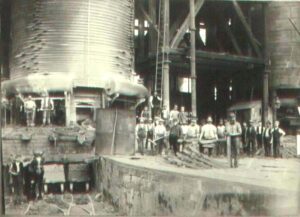
The workshop at Westbury ironworks
in this way. A brief post-war recovery saw a short-lived return to iron production, but a strike by the ironworkers and later a national miners’ strike came at the wrong time. There were problems refitting the site and repairing broken machinery. Some iron was produced in 1922 and again in 1923, then the furnace developed a “hot spot” and production finally ceased. Men were laid off again.
Some activity did continue on the site for the next 16 years, although on a lesser scale. Iron ore was still processed into iron oxide. This continued until just before the Second World War. In early 1939 the machinery at the works was auctioned for a total of £13,000 and a couple of months later an auction was held for the site of about 100 acres.
So where does the slag come into it? The finished product at the works was pig iron, so called because of the shape of the moulds for the liquid metal. Slag was a by-product, but there was a lot of it. In the early days, three times as much slag came out of the furnaces as pure iron. But it did not go to waste. It could be used for road surfacing in the days before tarmac. It was considered to be better than Mendip limestone as it did not get muddy in winter or dusty in summer. So it was laid on Long River Road to improve access to the chalk quarry and on Brook Lane, Storridge Road and, of course, Slag Lane between the quarries on either side. On Station Road, it was used to raise the incline from the Railway Hotel to the bridge and to raise Slag Lane to its junction with Station Road. Crushed slag could be used for railway ballast and it was side that the line built by GWR in 1900 from Newbury to Westbury was ballasted by slag from the ironworks.
Westbury Ironworks may be gone, but its legacy remains in the town. Most of the pits flooded and became “the mineholes”. Some have been filled in and houses now stand there. If you take the path from Edward Street to the car park behind the High Street, you can see a wall partly built with slag. There is another wall near the junction of Leigh Road and Warminster Road. Slag Lane appears on a map of the ironworks from about 1923 and a hundred years later reminds us of our heritage.
Richard Suter was born in Greenwich, Kent on 30th March 1798, to William Suter and his wife Sarah Knights. On 7th January 1825 he married Anne Ruth Burn.
English architect. As Surveyor to The Fishmongers' Company he designed the severe Presbyterian churches for Ballykelly (1825–7) and Banagher (1825) on the Company's Estate in County Londonderry, drawings of which were exhibited at the Royal Academy in 1827. He was also responsible for the Model Farm (1823–4), the Lancasterian Schools (1828–30), the Company Agent's House (1830–2—now a hotel, much altered), a range of houses on the south side of the main road (1823–4), the lodge in the Presbyterian churchyard (1828), and the Dispensary (1829), all at Ballykelly, and all Classical. As Surveyor to Trinity House Corporation, he designed houses that were erected by Thomas Cubitt in 1821–3 on a site adjoining Trinity House. For The Fishmongers' Company he designed St Peter's Almshouses, Wandsworth, London (1849–51), and The Old School-House, Gresham's School, Holt, Norfolk(1859), in an Elizabethan style.
On the 1841 Census Richard, an architect and lawyer, can be found living in London with his wife Ann (listed as Ruth) and their two children, Richard George and Andrew Burn. Living with them is Edward D Suter. 1851 finds the family living in Tottenham Court in London, by this time Andrew had left the home, but I am unable to trace him on the 1851 Census. In 1860 Andrew marries Amelia Damaris Harrison. Both Richard George and Andrew were to become ordained ministers, with Andrew later becoming a Bishop and emigrating to New Zealand. Sadly in 1854 Anne Ruth was to pass away. In 1861, widowed Richard, Justice of the Peace for Maidenhead, is living at Castle Hill, Maidenhead, Berkshire. In 1862 he married Elizabeth Anne Pocock. In 1871 and 1881 Richard and Elizabeth are still living in Castle Hill. Richard was to pass away on 1st March1883.
Richard Suter & Annesley Voysey, architects, had their office at number 35 Fenchurch Street, but they did not have it all to themselves as they shared the premises with W.C. Franks, a tea broker, who will get a separate post some other time. The earliest mention I found of Richard Suter in Fenchurch Street is in 1832 when he is listed at that address in a list of contributing members of the Society for the Propagation of the Gospel in Foreign Parts. It says that he had been a member since 1829, but that does not mean he was already at 35 Fenchurch Street in that year.(1) In fact, that seems unlikely as the Sun Fire Office records give Messrs. Short and Co., merchants, as paying the insurance premium on the premises in May 1830. The Directory of British Architects 1834-1914 give the year 1827, but I do not know on what evidence. When Suter and Voysey became partners is also uncertain, but they had known each other since at least 1825 as Suter is named as one of the executors of Voysey’s will which was dated 22 July, 1825. The address given for Suter in the will is Suffolk Street, Southwark. Voysey then lives at Conway Street, Fitzroy Square.