
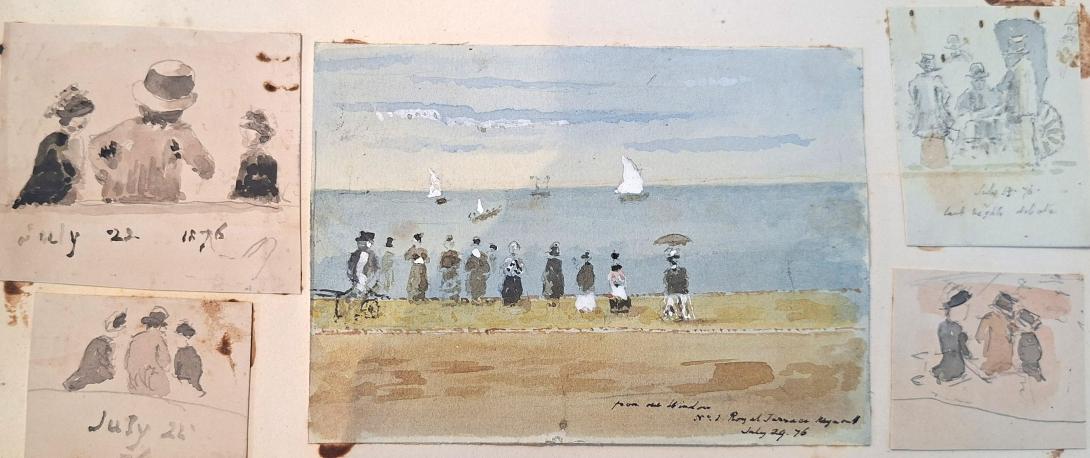
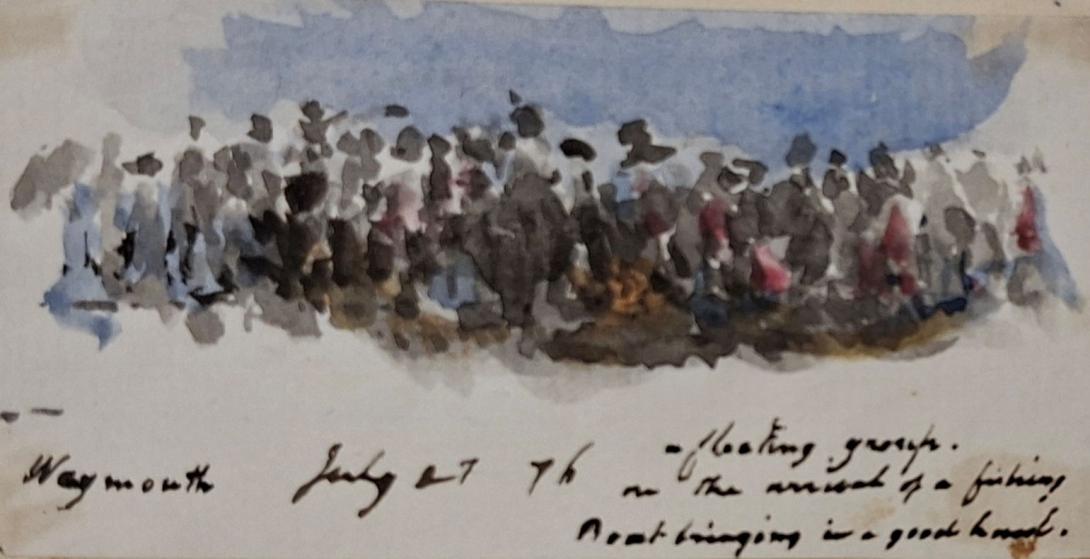
From the Window of No 1 Royal Terrace Weymouth July 29 1876 and a Fleeting group on the arrival of a fishing Boat bringing in a good catch Weyymouth July 27th 76"
A Georgian Terrace by the Sea – the Royal Terrace, Southend ...Royal Terrace in Weymouth is a historic Georgian residential area, developed around 1816 on land once belonging to Gloucester Lodge to extend the town's famous Esplanade, making it continuous after King George III's royal visits boosted Weymouth as a resort. Built in two phases, originally as 18 houses, it features Flemish bond brickwork, distinctive balconies, and spearhead railings, with some properties modified for shops, but largely retaining its early 19th-century character as part of the town's grand seaside development. Key Historical Points: Context: Its development followed King George III's famous stays in Weymouth (late 1780s-early 1800s), making the town a leading health and pleasure resort. Construction: Built in phases starting around 1816, creating a continuous seafront promenade with other terraces like Frederick Place and Brunswick Terrace. Design: The terrace features classic Georgian elements like Flemish bond brick, slate roofs, basements, and projecting balconies, with some end houses slightly higher. Original Layout: It was intended to be a grand crescent but ended up as a straight terrace, with original plans for 18 houses, including taller end units. Notable Features: Original spearhead railings, basement steps, and distinctive chimney stacks remain on many parts, though some ground floors were altered for shops. Listed Status: Many sections of Royal Terrace are Grade II listed by Historic England, recognising their architectural and historic importance. Significance: Royal Terrace is a key component of Weymouth's Georgian and Regency architectural heritage, showcasing the town's transformation into a fashionable seaside destination, with buildings reflecting the period's urban development and design.
"Has any coast town a more spectacular seafront than Weymouth, the terraces continuous for half a mile, fronting the expanse of Weymouth Bay?" (Newman and Pevsner 453). This small town in Dorset, not far from Dorchester, has the good fortune to lie on a wide sheltered bay on the English Channel. Like a handful of other seaside towns, including Brighton in the south-east, its popularity was already established by Victorian times. Like Brighton too, Weymouth had the stamp of royal approval: George III often visited his brother at his grand house on the esplanade, Gloucester Lodge, in an attempt to regain his health in the sea air. The arrival of the railways in 1857 brought a new breed of holidaymakers flocking in. A Pictorial and Descriptive Guide to the area sums up its appeal, then as now: "Arrived on the 'Front,' with its noble curve, one quickly realizes the principal attraction of Weymouth, its splendid bay. Many of the houses on the Esplanade are pure Georgian, and with their genuine curved bow windows, red-brick façades, and red-tiled roofs, give the town a peculiar charm that is possessed by no other seaside resort" (12). By the end of the Victorian period, Weymouth had its colourful Jubilee clocktower (1887), a prominent statue of Queen Victoria (1896), and splendid new Royal Hotel (designed by Charles Orlando Law (1871-1918), and built 1897-99).
Gloucester Lodge has been converted into flats, above The Gloucester public house, but the Royal Hotel is still in operation. It was advertised in the Pictorial and Descriptive Guide as "FACING the Beautiful and Picturesque Bay," and as being "Most Comfortable, Modern, and Well Furnished," with "Excellent Cuisine. Choicest Wines. Lift. Electric Light Throughout" — and as having "Perfect Sanitation" (facing p. ix). Hardy once lunched there with his wife on one of his later visits to the town (Holland 128). St John the Evangelist's church is also Victorian, having been designed by Thomas Talbot Bury (1809–1877), who studied with A.W.N. Pugin under the famous architect's father.


From left to right: (a) A bathing machine, preserved as a heritage item. (b) The splendid clock-tower erected in celebration of Queen Victoria's Golden Jubilee in 1887. (c) Close-up of the inscription.
Queen Victoria was not the first royal personage to avail himself of a bathing machine. During her time as Second Mistress of the Robes to Queen Charlotte, Fanny Burney records how George III fared when he tried it here: "Think but of the surprise of His Majesty, when the first time of his bathing, he had no sooner popped his Royal head under the water, than a band of music, concealed in a neighbouring machine, struck up 'God save great George our King!'" (qtd. in Hill 297). The King, says Burney, soon gave up the experiment. But most of those who went bathing in what came to be called, rather comically, "the English Bay of Naples," had a less eventful experience. They could also enjoy Punch and Judy shows and donkey rides on the beach, or take a pleasure boat. They could explore other parts of the coast or, if they liked longer trips, venture as far as the Channel Islands.


From left to right: (a) Punch and Judy on the beach, still popular today. (b) Mr Punch, from the Dorchester Museum. (c) Donkey rides, also still popular today.
Weymouth and nearby Lulworth Cove have several literary associations, but the pre-eminent one is with Thomas Hardy, who calls it Budmouth or Budmouth Regis, notably in The Trumpet Major. Early in his career as an architect, Hardy had spent some months here, taking advantage of all the resort had to offer, "bathing at seven in the morning and rowing in the bay almost every evening in the summer; in winter he enjoyed a quadrille class" (Pinion 6). The young architect was writing too, both poetry and prose — much of his first novel, Desperate Remedies, was written here. On one of his later visits, he attended John Drinkwater's adaptation of the The Mayor Casterbridge in Weymouth: "He met with a wonderful reception in the theatre, the people rising and cheering and clapping their hands and waving handkerchiefs, and very much the same reception outside the Pavilion Theatre on the pier at the close of the performance" (Holland 237).
Not surprisingly, Weymouth and Portland folk have always looked to the sea for their favour and fortunes.
However, old Father Neptune is a fickle master, sometimes he gives us untold riches…but he also has the ability to take those we love. Such was the sad case in September of 1869.
You and I might think of Greenhill as a place where we dabble our toes when the weather is warm, or somewhere we sit in pleasant sunshine to enjoy stunning views with a cup of tea or an ice cream. The long shingle beach littered with the last of the sun worshipers and the hardy bathers.
To our ancestors though, Greenhill was not just for recreation, it was very much a workplace.
One September Sunday became a memorable day in Weymouth’s history.
Rich pickings entered the bay, a vast shoal of pilchards spotted heading for the beach. Of course, despite atrocious conditions, local fishermen did what had to be done, chase the liquid money. ‘During the whole of the day parties of fishermen had been engaged on the beach near Greenhill, in the pilchard fishery.’
But that Sunday also harboured tragedy for the fishermen. The weather certainly wasn’t in their favour, ‘the wind which was blowing in very strong gusts from the north-west’ had made for a ‘very sloppy sea.’
Victorian ancestors were out in force that Sunday, partaking in the day of the Lord, dressed warmly to keep out the Autumn chill, little knowing that as they strolled ‘in the presence of hundreds of promenaders, bent on pleasure,’ they would become witnesses that were ‘entirely unprepared for the terrible sensation that awaited them.’
Folks lined the grassy slopes along Greenhill common, watching as men dragged their wooden boats and heavy rope nets down the beach and into the water.
Time after time they rowed out into the wind swept bay, laying nets behind them. Having circled round, they then began the hard work. Men heaved and hauled in their cumbersome nets, moving ever closer to shore.
The sea literally boiled with thousands of erupting fish, screaming gulls circled above, diving again and again to greedily snatch their fill. A productive days fishing was on the cards.
Fishermen spoke of many a celebration that would be enjoyed that night at inns and taverns around town.
But about four o’clock that afternoon,‘opposite the house of Mr Trenchard,’ four men clambered into their vessel, ‘a trough, a little flat-bottomed craft.’ They too were going to grab their share of nature’s riches.
First to climb in was fifty-seven-year-old William Watch. Despite his goodly age, William was a strong man and a powerful swimmer. He sometimes worked as a porter, but fishing was in his blood, it didn’t always pay the bills though.
William lived in a cottage on Chapelhay Stairs along with his wife Elizabeth and their growing brood.
Fellow fisherman, Samuel Chick, clambered in next, a mere whippersnapper at 27. Samuel Charles was the illegitimate son of Eliza Chick. Mother and son lived in Conygar Lane.
Also in the boat was William Chick of West Quay (or John, depending on which newspaper you read!)
The forth man to board that fated vessel was George Watts, a Blandford carpenter, but one who’d moved recently to Wyke Regis. During the inquest he was referred to as ‘George ‘Smuggler’ Watts.’ Maybe a somewhat checkered past?
Rowing hard against the wind, the four headed for the tell-tell signs of the rich vein of pilchards, their vessel’s stern low in the water, weighed down by nets and rope.
Once they reached their destination, the fishermen hurriedly began to lay their nets. Only problem was, the added weight of sodden nets dragging in the water made her stern sink her even lower. Fate waited patiently in the wings…but only for so long. A sudden swell swamped their low-lying boat, overturning her and catapulting all four fishermen into choppy seas.
Back on land, the unfolding tragedy was watched by horrified spectators. Boats set out from the shore, rowing furiously against the waves in a desperate attempt to reach the floundering men.
One of those boats heading for the upturned vessel contained Sergeant Brine, P.C. Hansford and William Burt.
Old William Burt kept his eyes firmly on the spot where he witnessed ‘ Watch rising and sinking,’ but once they reached the spot, Watch was not to be seen, only a man’s cap being tossed around on the swell. William reached in as far as he safely could and managed to grab hold of someone’s hair. Hauling in the fully clothed, sodden body was difficult, but the men managed and lay it out in the bottom of their boat. He was still alive, but only just. This was William Watch.
William Chick, (or was it John?) had launched himself clear of the tangled nets and rope as their boat overturned. He was found exhausted, frozen, but still clinging onto an oar some way away from the boat. William Chick was hauled ashore by one of the many men who had taken to the waters in a desperate bid to save the drowning fishermen.
By now the upturned fishing boat had righted itself again, but no sign of any of its other crew members. Fears were that they had been trapped by their own heavy nets and ropes which were now dragging the seabed. Sergeant Brine and P.C. Hansford clambered into the empty vessel. They frantically tried to free the dragging nets,‘but the party found they had but one knife between them.’ It was a slow and arduous task as they cut one rope after another, though far too late to save anyone still entangled.
Meanwhile, William Burt, of a goodly age, but one that hadn’t robbed him of his strength, rowed a semi-conscious William Watch towards the beach. At one stage, Watch rallied slightly and muttered “Oh, Burt,” and he moved his hands and feet,’ but soon after fell silent. It took old William nearly fifteen minutes to finally reach dry land, where crowds had gathered.
Once ashore, Watch’s now motionless body was laid out on the shingle, he was quickly stripped of his sodden clothing. Desperate to help, residents of Brunswick Terrace had been busy, they ‘pulled the blankets from their own beds, and hurried down to the beach.’
Even Mayor Devenish arrived on scene to take charge, bringing with him stone water bottles and a supply of suitable stimulants. He ordered that troops be sent for to keep the rapidly gathering crowds back from the scene of the tragedy. That summons for help also brought two surgeons of the 51st Regiment from the barracks, they attempted to help local doctors in their frantic attempts to revive a by now seemingly lifeless Watch. For the next two hours, Dr Tizard, Dr Griffin and Dr Rhodes tried all within their means to resuscitate William Watch’s cold body, but to no avail.
Back out in the bay, fellow fishermen were still searching for the missing corpses of their comrades, George Watts and Samuel Chick. There was not a sign of them.
The inquest on the death of William Watch was held in the Burdon Hotel Tap, where his corpse was laid out for jurors to peruse. When Superintendent Vickery was questioned by the coroner about William Watch, he rather oddly replied that ‘he believed Watch had left eight or nine children; but Burt made a mystery about that.’
The body of 57-year-old William Watch, (father of an undisclosed number of offspring,) was laid to rest in Wyke Regis churchyard on the 24th September 1869.
Richard Suter was born in Greenwich, Kent on 30th March 1798, to William Suter and his wife Sarah Knights. On 7th January 1825 he married Anne Ruth Burn.
English architect. As Surveyor to The Fishmongers' Company he designed the severe Presbyterian churches for Ballykelly (1825–7) and Banagher (1825) on the Company's Estate in County Londonderry, drawings of which were exhibited at the Royal Academy in 1827. He was also responsible for the Model Farm (1823–4), the Lancasterian Schools (1828–30), the Company Agent's House (1830–2—now a hotel, much altered), a range of houses on the south side of the main road (1823–4), the lodge in the Presbyterian churchyard (1828), and the Dispensary (1829), all at Ballykelly, and all Classical. As Surveyor to Trinity House Corporation, he designed houses that were erected by Thomas Cubitt in 1821–3 on a site adjoining Trinity House. For The Fishmongers' Company he designed St Peter's Almshouses, Wandsworth, London (1849–51), and The Old School-House, Gresham's School, Holt, Norfolk(1859), in an Elizabethan style.
On the 1841 Census Richard, an architect and lawyer, can be found living in London with his wife Ann (listed as Ruth) and their two children, Richard George and Andrew Burn. Living with them is Edward D Suter. 1851 finds the family living in Tottenham Court in London, by this time Andrew had left the home, but I am unable to trace him on the 1851 Census. In 1860 Andrew marries Amelia Damaris Harrison. Both Richard George and Andrew were to become ordained ministers, with Andrew later becoming a Bishop and emigrating to New Zealand. Sadly in 1854 Anne Ruth was to pass away. In 1861, widowed Richard, Justice of the Peace for Maidenhead, is living at Castle Hill, Maidenhead, Berkshire. In 1862 he married Elizabeth Anne Pocock. In 1871 and 1881 Richard and Elizabeth are still living in Castle Hill. Richard was to pass away on 1st March1883.
Richard Suter & Annesley Voysey, architects, had their office at number 35 Fenchurch Street, but they did not have it all to themselves as they shared the premises with W.C. Franks, a tea broker, who will get a separate post some other time. The earliest mention I found of Richard Suter in Fenchurch Street is in 1832 when he is listed at that address in a list of contributing members of the Society for the Propagation of the Gospel in Foreign Parts. It says that he had been a member since 1829, but that does not mean he was already at 35 Fenchurch Street in that year.(1) In fact, that seems unlikely as the Sun Fire Office records give Messrs. Short and Co., merchants, as paying the insurance premium on the premises in May 1830. The Directory of British Architects 1834-1914 give the year 1827, but I do not know on what evidence. When Suter and Voysey became partners is also uncertain, but they had known each other since at least 1825 as Suter is named as one of the executors of Voysey’s will which was dated 22 July, 1825. The address given for Suter in the will is Suffolk Street, Southwark. Voysey then lives at Conway Street, Fitzroy Square.