
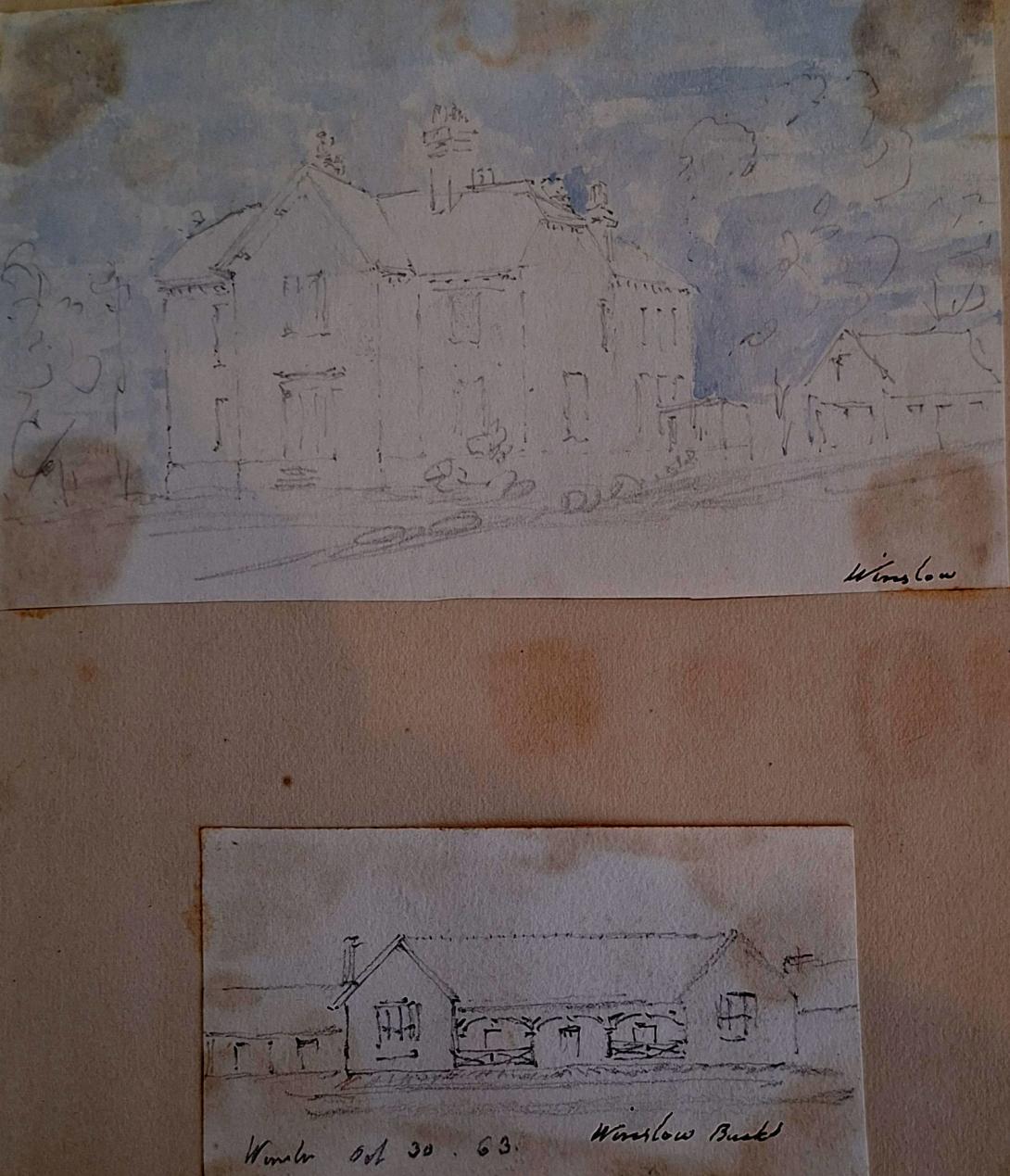
Winslow Bucks Oct 30 1863
These documents record the arrangements for rebuilding the Vicarage
1863 Letter 7 Oct
I Richard Suter of No 28 Fenchurch Street in the City of London architect and surveyor certify that I have surveyed the house and offices in the Glebe of the Vicarage of Winslow Bucks and that the same is old and dilapidated unable to be repaired and requiring to be wholly rebuilt and that there is no growing timber on the said Glebe nor any of the old materials in the present structure fit to be employed in the new works the old materials I estimate might fetch £34
26 Nov Permission from Bishop of Oxford to Rev Alfred Matthew Preston Vicar of Winslow for rebuilding residence house and offices
We the Rev John Wheeler Hayward Vicar of Grandborough in the county of Bucks and the Rev James Niven Vicar of Swanbourne in the said County of Bucks being two clergymen within the Diocese of the Lord Bishop of Oxford do hereby certify to the said Lord Bishop pursuant to the directions and instructions sent by him to us that we have made enquiry into the state and condition of the buildings upon the Glebe belonging to the Vicarage of Winslow within the said Diocese at the time of the Rev Alfred Matthew Preston, the present incumbent thereof, entered upon the said living which was in about the year of our lord 1863, and do find that the same have by wilful negligence been suffered to go to decay and that they have sustained damage from a want of common and ordinary repair to the account of £158 5s that is to say the vicarage house and premises, the amount of £130, and the buildings on the vicarage farm to the amount of £28 5s And we have also enquired into the money received by the said Rev Alfred Matthew Preston for dilapidations from the former incumbent and do find that he hath received the sum of £158 5s for such dilapidations and that the same hath not been laid out or expended in repairing the buildings upon the glebe belonging to the said living.
The parish of Winslow, which comprises the market town of Winslow and hamlet of Shipton, covers an area of 1,919 acres, of which 162 acres are arable land, 1,501 acres are laid down in pasture, and 31 acres are woods and plantations. The soil is of Oxford Clay, which has been worked in a pit at Tinker's End. The land rises from 290 ft. in the south-west to 410 ft. in the north-east, and the town of Winslow stands on the brow of a small ridge of hills which stretches from Bedfordshire to Oxfordshire. It is approached from the south-east through the small hamlet of Shipton by the road from Aylesbury to Buckingham, which becomes the High Street, as it passes through the town. The town is built round the square neat market-place, and along the three streets, High Street, Sheep Street, and Horn Street. The houses are almost entirely of red brick, and the appearance of the town is bright and pleasing.
The church occupies a central position and stands in a churchyard separated from High Street by a wall within which trees have been planted. The vicarage lies to the west of the church. In the south-east corner of the square is the Bell Hotel, the name of which occurs in the early 17th century. It is said by Lipscomb about the middle of the 19th century, to have been the only inn in Winslow. Since then with the growth of the town about a dozen others have come into existence. The inn itself is not very ancient, but the gateway and out-buildings are of half-timber with modern brick filling and date back to the early part of the 17th century. There are a few 16th-century houses and cottages, and several of the 17th century. They are for the greater part of timber framing with brick filling and have thatched roofs, though many are tiled. Market House, in the Square, is of the early part of the 18th century. Both it and the George Hotel have iron balconies of elaborate scrollwork, said to have been brought from Claydon House.
Richard Suter was born in Greenwich, Kent on 30th March 1798, to William Suter and his wife Sarah Knights. On 7th January 1825 he married Anne Ruth Burn.
English architect. As Surveyor to The Fishmongers' Company he designed the severe Presbyterian churches for Ballykelly (1825–7) and Banagher (1825) on the Company's Estate in County Londonderry, drawings of which were exhibited at the Royal Academy in 1827. He was also responsible for the Model Farm (1823–4), the Lancasterian Schools (1828–30), the Company Agent's House (1830–2—now a hotel, much altered), a range of houses on the south side of the main road (1823–4), the lodge in the Presbyterian churchyard (1828), and the Dispensary (1829), all at Ballykelly, and all Classical. As Surveyor to Trinity House Corporation, he designed houses that were erected by Thomas Cubitt in 1821–3 on a site adjoining Trinity House. For The Fishmongers' Company he designed St Peter's Almshouses, Wandsworth, London (1849–51), and The Old School-House, Gresham's School, Holt, Norfolk(1859), in an Elizabethan style.
On the 1841 Census Richard, an architect and lawyer, can be found living in London with his wife Ann (listed as Ruth) and their two children, Richard George and Andrew Burn. Living with them is Edward D Suter. 1851 finds the family living in Tottenham Court in London, by this time Andrew had left the home, but I am unable to trace him on the 1851 Census. In 1860 Andrew marries Amelia Damaris Harrison. Both Richard George and Andrew were to become ordained ministers, with Andrew later becoming a Bishop and emigrating to New Zealand. Sadly in 1854 Anne Ruth was to pass away. In 1861, widowed Richard, Justice of the Peace for Maidenhead, is living at Castle Hill, Maidenhead, Berkshire. In 1862 he married Elizabeth Anne Pocock. In 1871 and 1881 Richard and Elizabeth are still living in Castle Hill. Richard was to pass away on 1st March1883.
Richard Suter & Annesley Voysey, architects, had their office at number 35 Fenchurch Street, but they did not have it all to themselves as they shared the premises with W.C. Franks, a tea broker, who will get a separate post some other time. The earliest mention I found of Richard Suter in Fenchurch Street is in 1832 when he is listed at that address in a list of contributing members of the Society for the Propagation of the Gospel in Foreign Parts. It says that he had been a member since 1829, but that does not mean he was already at 35 Fenchurch Street in that year.(1) In fact, that seems unlikely as the Sun Fire Office records give Messrs. Short and Co., merchants, as paying the insurance premium on the premises in May 1830. The Directory of British Architects 1834-1914 give the year 1827, but I do not know on what evidence. When Suter and Voysey became partners is also uncertain, but they had known each other since at least 1825 as Suter is named as one of the executors of Voysey’s will which was dated 22 July, 1825. The address given for Suter in the will is Suffolk Street, Southwark. Voysey then lives at Conway Street, Fitzroy Square.