
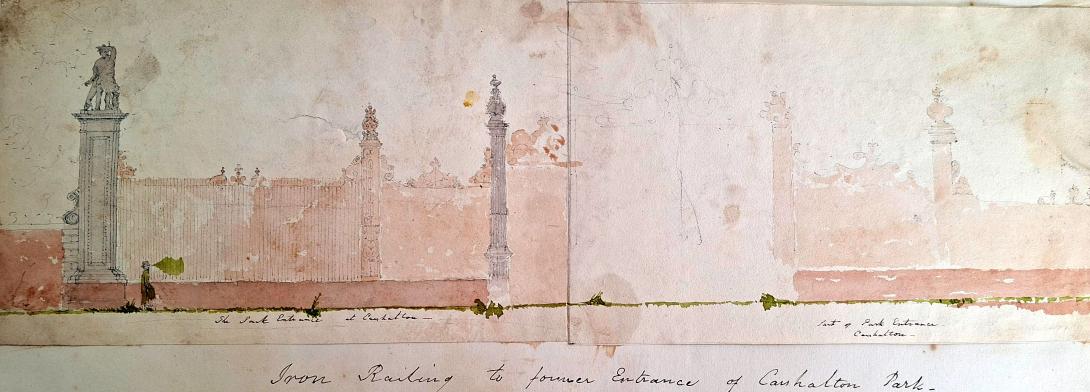
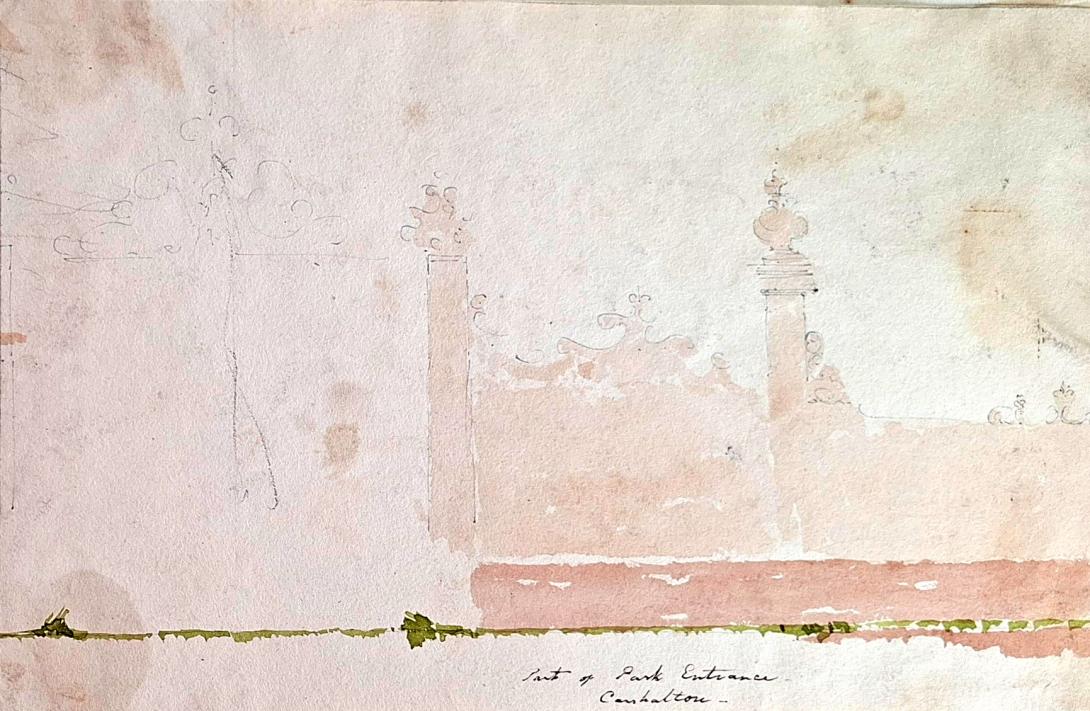
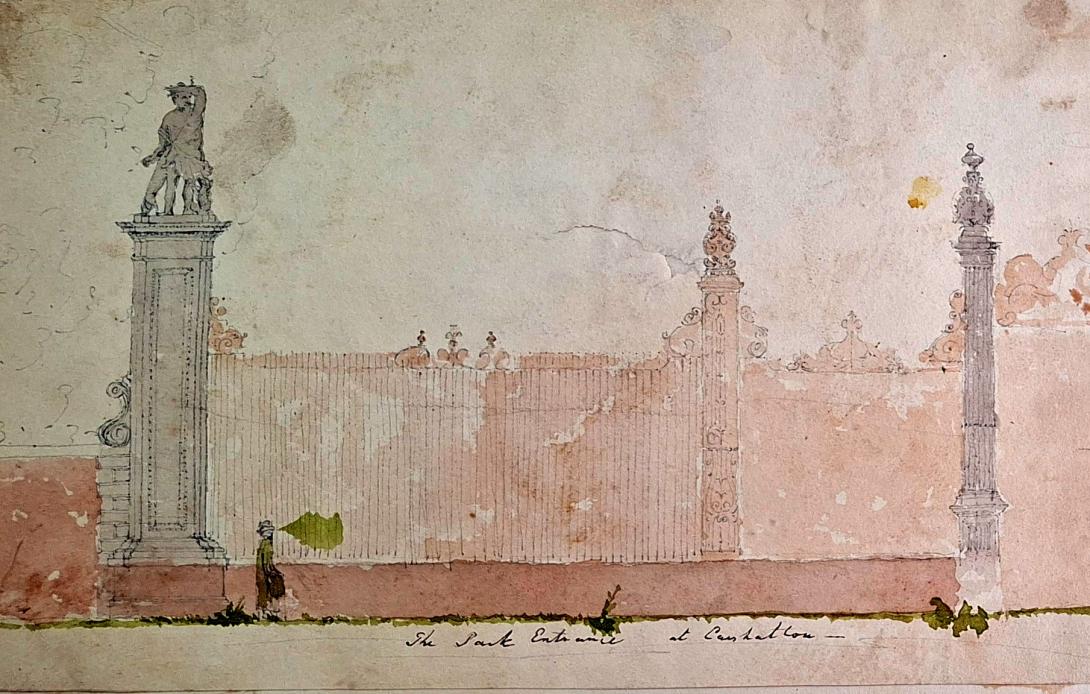
inscribed "The Park Entrance at Carshalton / Part of Park Entrance Carshalton/ 1835/ Iron Railing to former entrance of Carshalton Park."
The magnificent wrought-iron gates of 1711, flanked by statues of Diana and Actaeon which formerly stood in east boundary wall to The Park have been removed to Planting Fields, Oyster Bay, New York. The Bedford Lemere daybook records E P Harman as client for this photograph.
The Carshalton Gates, as they are known, were purchased by William Robertson Coe in 1921 from the dealer Charles of London. The gates were originally installed in Carshalton Park and a quick internet search will show several historic photos of the gates in their original location. According to recollections from Coe, he purchased the gates soon after WWI after he saw them lying in a barnyard near Oxford. His purchase price was £3000 and after it became public that an American had purchased the gates, Coe was offered £10000 to cancel the agreement. Ownership of the gates out won any profit Coe stood to make.
Currently, many daytime visitors mark their walking route with a stop at the Carshalton Gates, which are nearly a mile from the main visitor parking lot. Upon a next visit, take notice of the remarkable trophies below the two statues that depict a decorative assortment of hunting paraphernalia and game. The iron gates date to the early eighteenth century and the sculptures of Diana and Aceton that flank the gates are attributed to John Nost, a Flemish sculptor who lived and worked in England. Found in Ovid’s Metamorphoses, the story of Diana and Acteon is often featured in sculptures, paintings and decorative ornamentation. In the myth, Acteon the hunter stumbles upon a bathing Diana and her nymphs. Startled by the encounter, Diana transforms Acteon into a stag who upon running away is chased down by his own hounds and killed. The hunter becomes the hunted in this story. Allegorical representations abound, but our Acteon is captured right at the moment of transformation and upon closer inspection, one can see antlers growing from his forehead as he stands in contrapposto repose.
There is much to see at Planting Fields and as the trees become bare this season, drive a little slower and enjoy the view past Chicken Valley Road.
Richard Suter (1797–1883).
Richard Suter was born in Greenwich, Kent on 30th March 1798, to William Suter and his wife Sarah Knights. On 7th January 1825 he married Anne Ruth Burn.
English architect. As Surveyor to The Fishmongers' Company he designed the severe Presbyterian churches for Ballykelly (1825–7) and Banagher (1825) on the Company's Estate in County Londonderry, drawings of which were exhibited at the Royal Academy in 1827. He was also responsible for the Model Farm (1823–4), the Lancasterian Schools (1828–30), the Company Agent's House (1830–2—now a hotel, much altered), a range of houses on the south side of the main road (1823–4), the lodge in the Presbyterian churchyard (1828), and the Dispensary (1829), all at Ballykelly, and all Classical. As Surveyor to Trinity House Corporation, he designed houses that were erected by Thomas Cubitt in 1821–3 on a site adjoining Trinity House. For The Fishmongers' Company he designed St Peter's Almshouses, Wandsworth, London (1849–51), and The Old School-House, Gresham's School, Holt, Norfolk(1859), in an Elizabethan style.
On the 1841 Census Richard, an architect and lawyer, can be found living in London with his wife Ann (listed as Ruth) and their two children, Richard George and Andrew Burn. Living with them is Edward D Suter. 1851 finds the family living in Tottenham Court in London, by this time Andrew had left the home, but I am unable to trace him on the 1851 Census. In 1860 Andrew marries Amelia Damaris Harrison. Both Richard George and Andrew were to become ordained ministers, with Andrew later becoming a Bishop and emigrating to New Zealand. Sadly in 1854 Anne Ruth was to pass away. In 1861, widowed Richard, Justice of the Peace for Maidenhead, is living at Castle Hill, Maidenhead, Berkshire. In 1862 he married Elizabeth Anne Pocock. In 1871 and 1881 Richard and Elizabeth are still living in Castle Hill. Richard was to pass away on 1st March1883.
Richard Suter & Annesley Voysey, architects, had their office at number 35 Fenchurch Street, but they did not have it all to themselves as they shared the premises with W.C. Franks, a tea broker, who will get a separate post some other time. The earliest mention I found of Richard Suter in Fenchurch Street is in 1832 when he is listed at that address in a list of contributing members of the Society for the Propagation of the Gospel in Foreign Parts. It says that he had been a member since 1829, but that does not mean he was already at 35 Fenchurch Street in that year.(1) In fact, that seems unlikely as the Sun Fire Office records give Messrs. Short and Co., merchants, as paying the insurance premium on the premises in May 1830. The Directory of British Architects 1834-1914 give the year 1827, but I do not know on what evidence. When Suter and Voysey became partners is also uncertain, but they had known each other since at least 1825 as Suter is named as one of the executors of Voysey’s will which was dated 22 July, 1825. The address given for Suter in the will is Suffolk Street, Southwark. Voysey then lives at Conway Street, Fitzroy Square.