
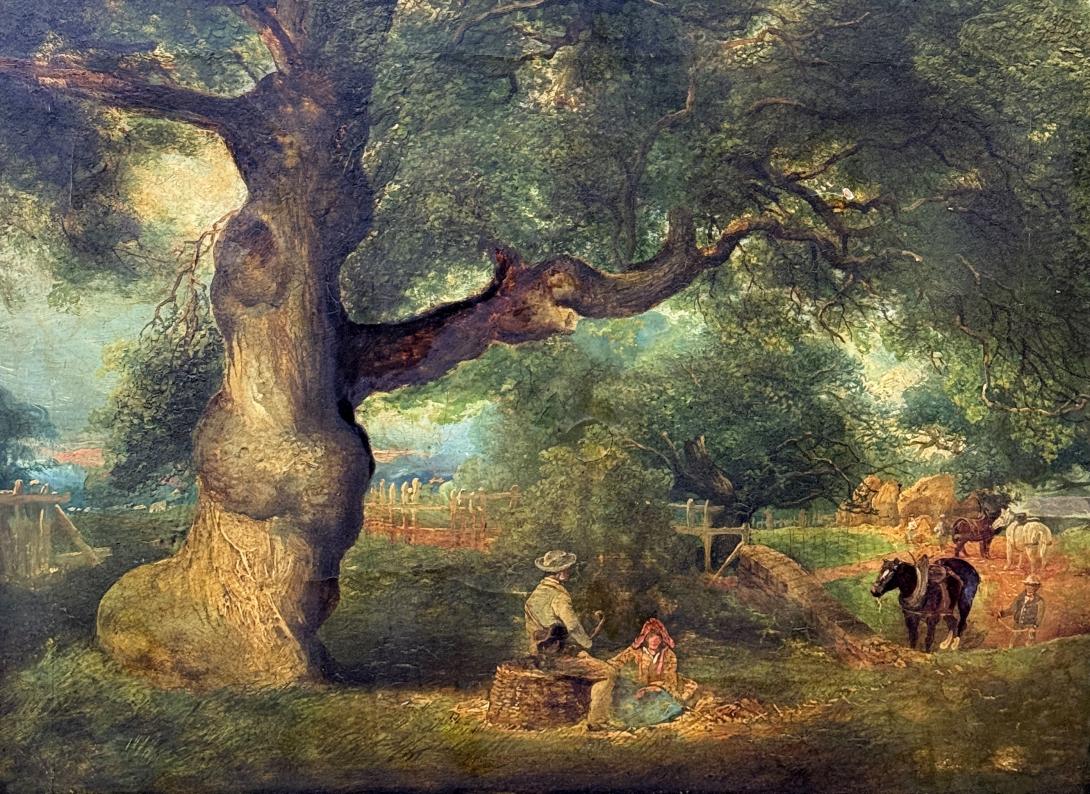
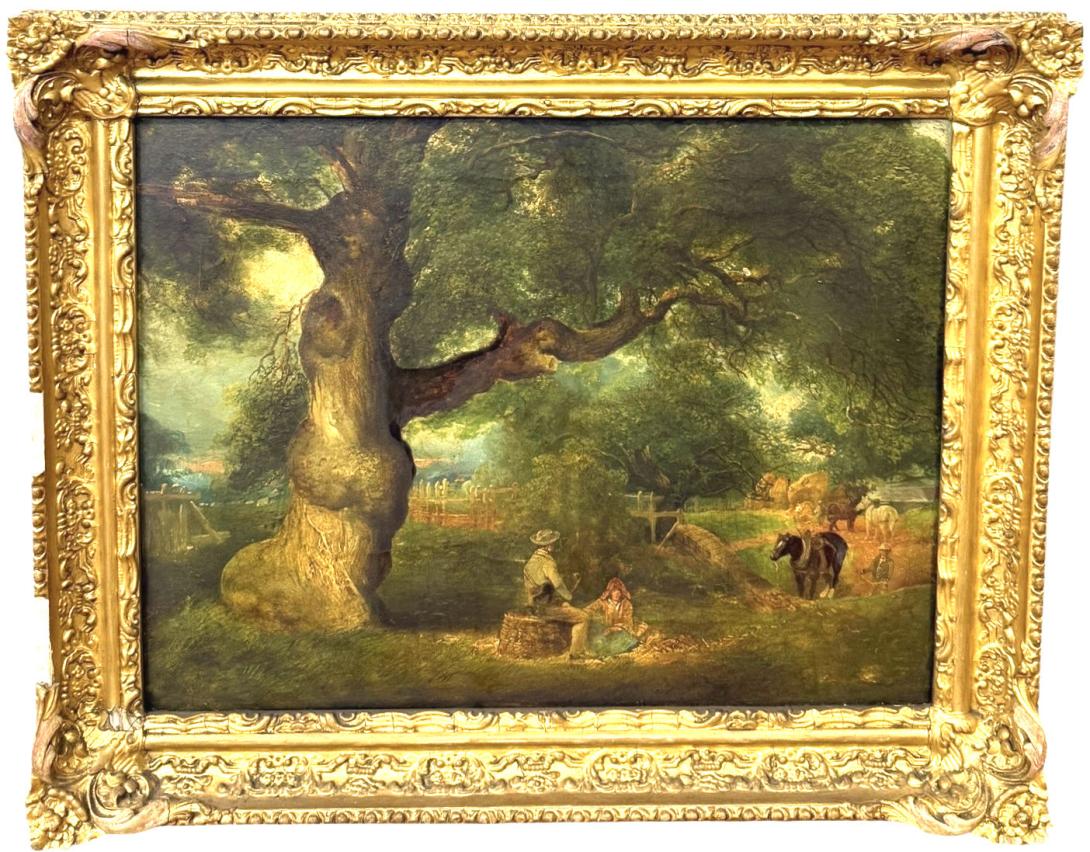
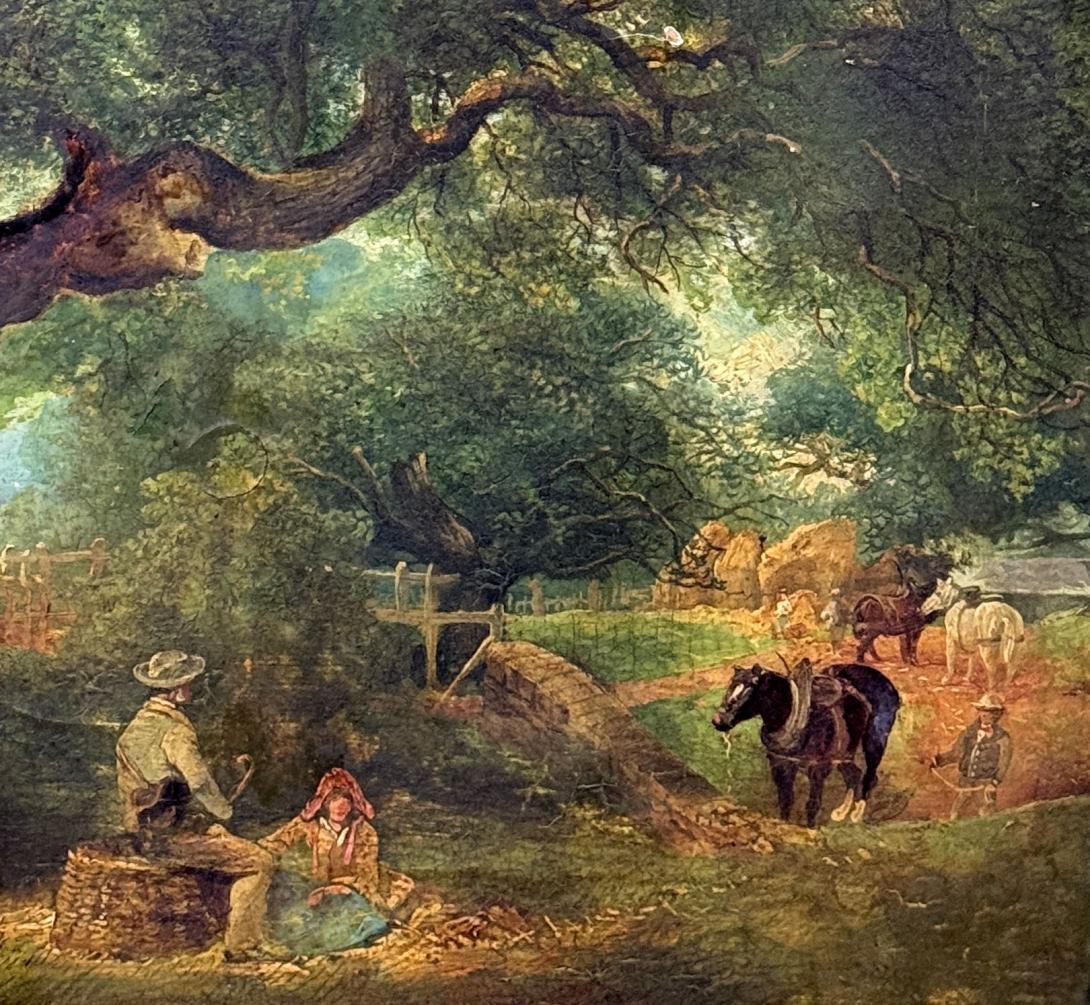
The painting depicts Labourers resting under an ancient Oak Tree at Harvest time while a Shire Horse drinks at the Wagon Wash and other Cart Horses rest in between jobs at the Farm. Hay stacks are being built in the distance. The activity in the back ground looks like they were bringing in the hay harvest.Before the days of mechanical baler machines, hay was built into round stacks. A pole was sunk into the ground (a bit like a tall fence post) and the loose hay was packed tightly hand in a circle around the pole. The stacks were then thatched at the top to help keep the weather out. In the painting one stack is finished and another being made. The hay would have been used as winter feed for the cattle, sheep and horses on the farm. It is generally accepted that a third of the crops produced on farms, were used to feed the horses that the farms needed for doing the work. The colours of the horses in the picture suggest they are shires, or forerunners of what were eventually recognised as shires. Shires were not officially recognised as a breed until 1878 .
Carthorse, work horse or heavy horse, is a large horse bred to be a working animal hauling freight and doing heavy agricultural tasks such as plowing. There are a number of breeds, with varying characteristics, but all share common traits of strength, patience, and a docile temperament.
While indispensable to generations of pre-industrial farmers, draft horses are used today for a multitude of purposes, including farming, draft horse showing, logging, recreation, and other uses. Draft breeds have been crossbred with light riding breeds such as the Thoroughbred to create sport horses or warmbloods. While most draft horses are used for driving, they can be ridden and some of the lighter draft breeds are capable performers under saddle.
Draft horses are recognizable by their extremely muscular build. They tend to have broad, short backs with powerful hindquarters. In general, they are taller and tend to have heavier bone and a more upright shoulder than riding horses, producing conformation that is well suited for pulling. Many draft breeds have heavier hair, called feathering on their lower legs. Draft breeds range from approximately 163 to 193 cm (16 to 19 hands) high and from 640 to 910 kg (1,400 to 2,000 lb).
Background
Humans domesticated horses and used them to perform a variety of duties. One type of horse-powered work was the hauling of heavy loads, plowing fields, and other tasks that required pulling ability. A heavy, calm, patient, and well-muscled animal was desired for this work. Conversely, a light, more energetic horse was needed for riding and rapid transport. Thus, to the extent possible, a certain amount of selective breeding was used to develop different types of horse for different types of work.
It is a common misunderstanding that the Destrier that carried the armoured knight of the Middle Ages had the size and conformation of a modern draft horse, and some of these Medieval war horses may have provided some bloodlines for some of the modern draft breeds. The reality was that the high-spirited, quick-moving Destrier was closer to the size, build, and temperament of a modern Andalusian or Friesian. There also were horses of more phlegmatic temperaments used for pulling military wagons or performing ordinary farm work which provided bloodlines of the modern draft horse. Records indicate that even medieval drafts were not as large as those today. Of the modern draft breeds, the Percheron probably has the closest ties to the medieval war horse.
By the 19th century horses weighing more than 730 kilograms (1,600 lb) that also moved at a quick pace were in demand. Tall stature, muscular backs, and powerful hindquarters made the draft horse a source of horsepower for farming, hauling freight and moving passengers. The advent of railroads increased demand for working horses, as a growing economy still needed transport over the 'last mile' between the goods yard or station and the final customer.Even in the 20th century, until motor vehicles became an affordable and reliable substitute, draft horses were used for practical work.
Over half a million draft horses were used during World War I. The British were importing American draft horses to supplement their dwindling stock even before America joined the war, preferring Percheron crosses which they said had "great endurance, fine physique, soundness, activity, willingness to work, and almost unfailing good temper". British buyers were buying 10,000 to 25,000 American horses and mules a month, eventually making up about two-thirds of British Army war horses.
In the late 19th century and early 20th century, thousands of draft horses were imported from Western Europe into the United States. Percherons came from France, Belgians from Brabant, Shires from England, Clydesdales from Scotland. Many American draft breed registries were founded in the late 19th century. The Percheron, with 40,000 broodmares registered as of 1915, was America's most numerous draft breed at the turn of the 20th century. A breed developed exclusively in the U.S. was the American Cream Draft, which had a stud book established by the 1930s.
Beginning in the late 19th century, and with increasing mechanization in the 20th century, especially following World War I in the US and after World War II in Europe, the popularity of the internal combustion engine, and particularly the tractor, reduced the need for the draft horse. Many were sold to slaughter and a number of breeds went into significant decline.
Modern uses

Today, draft horses can be seen in horse shows, pulling competitions, heavy horse trials, parades pulling large wagons, pulling tourist carriages, and they are still seen on some smaller farms in the US and Europe. They are still used by agrarian groups such as the Amish and Mennonites. Draft horses are used for logging in dense woodland where there is insufficient space for mechanized vehicles or for other conservation considerations.
Draft horse breeds have played a significant role in the development of many warmblood breeds, popular today in advanced level equine sports.
Small areas still exist where draft horses are widely used as transportation due to legislation preventing automotive traffic, such as on Mackinac Island in the United States.
The Shire is a breed of draught horse originally from England. The Shire has a great capacity for weight-pulling; it was used for farm work, to tow barges at a time when the canal system was the principal means of goods transport, and as a cart-horse for road transport. One traditional use was for pulling brewer's drays for delivery of beer, and some are still used in this way; others are used for forestry, for riding and for commercial advertising. Shires have held some of the world records for the largest horse and for the tallest horse.
The Shire breed was established in the mid-eighteenth century in England, and a breed society and stud-book were established in the 1870s. Today, there are stud-books and breed associations in the United Kingdom, Australia, the United States, and Canada.
In the late nineteenth and early twentieth centuries, there were large numbers of Shires, and many were exported to the United States. With the progressive mechanisation of agriculture and of transport, the need for draught horses decreased rapidly and by the 1960s numbers had fallen from a million or more to a few thousand. Numbers began to increase again from the 1970s, but the breed is still considered "at risk" by the Rare Breeds Survival Trust.
Though oxen were used for most farm work into the eighteenth century, horses "fit for the dray, the plough, or the chariot" were on sale at Smithfield Market in London as early as 1145.
The English Great Horse was valued during the reign of Henry VIII, when stallions measuring less than "fifteen handfuls" were not allowed, but the increasing role of gunpowder brought an end to the use of heavy horses in battle. Oliver Cromwell's cavalry favoured lighter, faster mounts and the big horses began to be used for draught work instead. During the sixteenth century, Dutch engineers brought Friesian horses with them when they came to England to drain the fens, and these horses may have had an influence on what became the Shire breed.
From this medieval horse came an animal called the Old English Black Horse in the seventeenth century. The horse was improved by Robert Bakewell of Leicestershire, resulting in a horse sometimes known as the "Bakewell Black" or "Lincolnshire Black". Bakewell imported six Dutch or Flanders mares, notable since breeders tended to concentrate on improving the male line. Two different types of horses developed: the Lincolnshire fens type formerly mentioned, and the Leicester or Midlands type. The Fen type tended to be larger, with more bone and hair, while the Midlands type tended to have more endurance while being of a finer appearance.
The term "Shire horse" was first used in the mid-seventeenth century, and incomplete records begin to appear near the end of the eighteenth century. The "Packington Blind Horse", from Leicestershire, is one of the best-known horses of the era, with direct descendants being recorded from 1770 to 1832. This horse is usually recognised as the foundation stallion for the Shire breed, and he stood at stud from 1755 to 1770. During the nineteenth century, Shires were used extensively as cart horses to move goods from the docks through the cities and countryside. The rough roads created a need for massive horses with great strength.

In 1878, the English Cart Horse Society was formed, and in 1884 changed its name to the Shire Horse Society. The Society published a stud book, with the first edition in 1878 containing 2,381 stallions and records dating back to 1770. Between 1901 and 1914, 5,000 Shires were registered each year with the society.
The first Shires were imported to the United States in 1853, with large numbers of horses being imported in the 1880s. The American Shire Horse Association was established in 1885 to register and promote the breed. The Shire soon became popular in the United States, and almost 4,000 Shires were imported between 1900 and 1918. Approximately 6,700 Shires were registered with the US association between 1909 and 1911.
Around the time of the Second World War, increasing mechanisation and strict regulations on the purchase of livestock feed reduced the need for and ability to keep draught horses. Thousands of Shires were slaughtered and several large breeding studs closed. The breed fell to its lowest point in the 1950s and 1960s, and in 1955 fewer than 100 horses were shown at the annual British Spring Show.
In the 1970s, the breed began to be revived through increased public interest. Breed societies have been established in the United States, Canada, the Netherlands, France, and Germany, and in 1996 the first World Shire Horse Congress was held in Peterborough. The first use within the breed of artificial insemination through frozen semen was with several Australian mares in 1997.
Between the 1920s and 1930s and today, the Shire has changed in conformation. The Clydesdale was used for cross-breeding in the 1950s and 1960s, which changed the conformation of the Shire and most notably changed the feathering on the lower legs from a mass of coarse hair into the silky feathering associated with modern Shires.
At the peak of their population, Shires numbered over a million. In the 1950s and 1960s, this number declined to a few thousand. In the United States, the Shire population dropped significantly in the early part of the twentieth century, and continued to decline in the 1940s and 1950s. Between 1950 and 1959, only 25 horses were registered in the United States. However, numbers began to increase, and 121 horses were registered in the US by 1985.
The National Shire Horse Spring Show is held annually and is the largest Shire show in Great Britain.
The conservation status of the Shire is listed by the Rare Breeds Survival Trust as "at risk", meaning that population numbers are estimated to be under 1500 head. In the United States, the Livestock Conservancy lists it as "critical", while the Equus Survival Trust calls it "vulnerable".
John Linnell (16 June 1792 – 20 January 1882) was an English engraver, portrait painter, and landscape painter. He was a naturalist and a rival to the artist John Constable. He had a taste for Northern European art of the Renaissance, particularly Albrecht Dürer. He also associated with the amateur artist Edward Thomas Daniell, and with William Blake, to whom he introduced the painter and writer Samuel Palmer and others of the Ancients.
Life and work

John Linnell was born in Bloomsbury, London on 16 June 1792, where his father was a carver and gilder. He was in contact with artists from an early age, and by the age of ten was drawing and selling portraits in chalk and pencil. His first art teacher was the American-born artist Benjamin West, and he spent a year in the house of the painter John Varley, where William Hunt and William Mulready were also pupils, and made the acquaintance of Shelley, Godwin and others. In 1805 he was admitted to study at the Royal Academy, where he obtained medals for drawing, modelling and sculpture. He was trained as an engraver, and executed a transcript of Varley's "Burial of Saul."

In 1808, the 16-year-old Linnell moved into Mulready's house, whose wife had accused him of infidelity with both other women and boys. Linnell's association with Mulready may have caused the breakup of Mulready's marriage.
In 1817 Linnell married Mary Ann Palmer in Scotland and they had nine children together including their first born, Hannah Linnell, who later married the landscape painter Samuel Palmer.
In later life Linnell occupied himself with the burin, publishing, in 1833, a series of outlines from Michelangelo's frescoes in the Sistine Chapel, and, in 1840, superintending the issue of a selection of plates from the pictures in Buckingham Palace, one of them, a Titian landscape, which he engraved in mezzotint. At first he supported himself mainly by miniature painting and execution of larger portraits, such as the likenesses of Mulready, Richard Whately, Peel and Thomas Carlyle. Several of his portraits he engraved in line and mezzotint.
He painted many subjects like the "St John Preaching", the "Covenant of Abraham", and the "Journey to Emmaus", in which, while the landscape is usually prominent the figures are of sufficient importance to supply the title of the work. However, it is mainly in connection with paintings of pure landscapes that his name is known. His works commonly deal with some scene of typical uneventful English landscape, which is made impressive by a gorgeous effect of sunrise or sunset. They are full of true poetic feeling, and are rich and glowing in colour.
Linnell commanded large prices for his pictures, and about 1850 he purchased a property at Redhill, Surrey, where he lived until his death on 20 January 1882, painting with unabated powers until within the last few years of his life. He devoted himself to painting landscapes notably of the North Downs and Kentish Weald. His leisure was occupied with a study of the Bible in the original language. He also published several pamphlets and treatises of Biblical criticism. Linnell was one of the best friends and kindest patrons of William Blake. He gave him the two largest commissions he received for single series of designs—£150 for drawings and engravings of The Inventions to the Book of Job, and a like sum for those illustrative of Dante Alighieri.
He was a friend of the painter Edward Thomas Daniell. A blue plaque commemorates Linnell at Old Wyldes' at North End, Hampstead. The plaque mentions that William Blake stayed with Linnell as his guest.
His eldest son William Linnell (1826 – 1906) was also an artist most noted for his 1840 drawing of Smugglerius, which is an écorché sculpture of a man posed in imitation of the ancient Roman sculpture known as the Dying Gaul.