
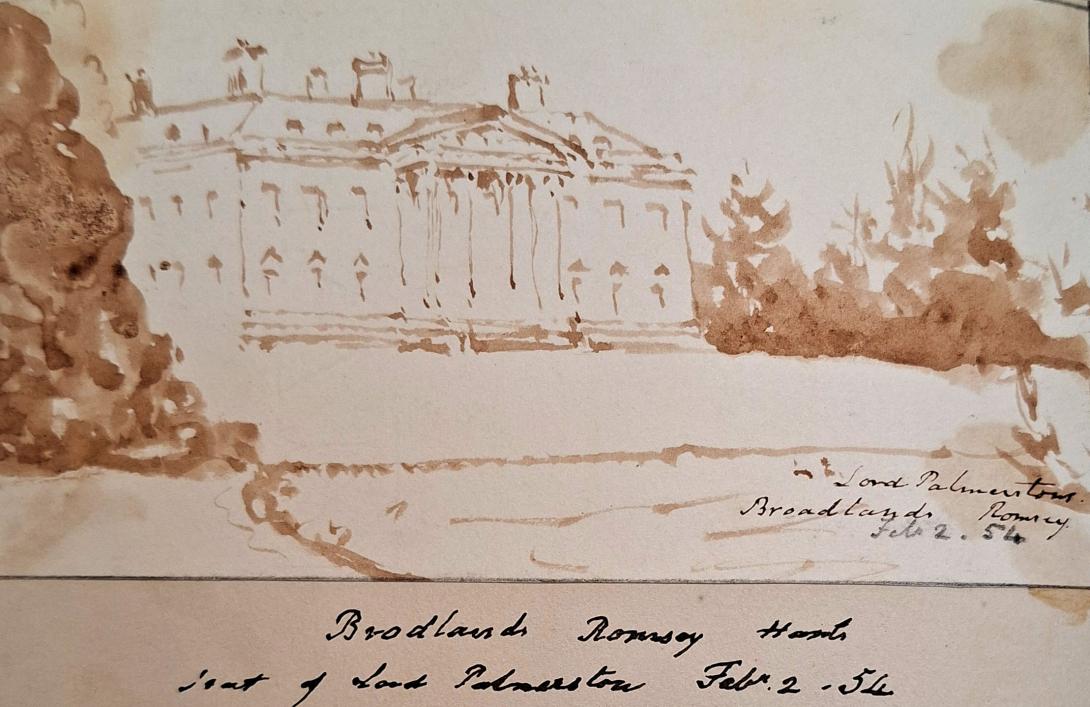
inscribed and dated " Lord Palmerstons/Broadlands Romsey/Feb 2 1854"
By descent from the architect and artist's family
Broadlands is a country house located in the civil parish of Romsey Extra, near the town of Romsey in the Test Valley district of Hampshire, England. Its formal gardens and historic landscape are Grade II* listed on the Register of Historic Parks and Gardens. The house itself is Grade I listed.
History
The original manor and area known as Broadlands belonged to Romsey Abbey since before the Norman Conquest.
In 1547, after the dissolution of the monasteries, Broadlands was sold to Sir Francis Fleming. His granddaughter married Edward St Barbe, and the manor remained the property of the St Barbe family for the next 117 years. Sir John St Barbe, 1st Baronet (c. 1655–1723) made many improvements to the property but died without children, bequeathing his estate to his cousin Humphrey Sydenham of Combe, Dulverton. In the chancel of Ashington Church, Somerset, is a monument of grey and white marble, inscribed:
Here lies Sir John St. Barbe, Bart. possessed of those amiable qualities, which birth, education, travel, greatness of spirit, and goodness of heart, produce. Interred in the same vault lies his second wife Alice Fiennes, aunt to the present Lord Say and Sele. His first was Honour, daughter of Colonel Norton. He died at his seat of Broadlands in Hampshire Sept. 7, 1723, leaving for his only heir and executor Humphrey Sydenham, esq., of Combe in Somersetshire, who ordered this marble to his memory.
Having been ruined by the 18th-century South Sea Bubble, Sydenham sold Broadlands in 1736, with its Tudor and Jacobean manor house, to Henry Temple, 1st Viscount Palmerston, for £26,500. The Viscount began the deformalisation of the gardens between the river and the house and produced the broad-lands, a "gentle descent to the river". In 1767, a major architectural "transformation" of the house and garden was begun by Capability Brown, the celebrated architect and landscape designer, and completed by the architect Henry Holland, which made Broadlands the Palladian-style country house seen today. Henry Temple, 2nd Viscount Palmerston had requested that Brown go there and seize upon the "capabilities" of the earlier manor house. Between 1767 and 1780, William Kent's earlier "deformalising work" was completed, as well as further landscaping, planting, clearing and riverside work.
Broadlands was the country estate of the 19th-century British prime minister Henry John Temple, 3rd Viscount Palmerston. After his death, the estate was inherited by his step-son, William Cowper-Temple, 1st Baron Mount Temple (1811–1888). A devout Christian, he held public prayer meetings in the grounds and also banned all blood-sports on the property. On his death, the estate passed to his nephew, Evelyn Ashley (1836-1907), a younger son of Anthony Ashley-Cooper, 7th Earl of Shaftesbury (1801-1885) and Lord Mount Temple's sister Lady Emily Cowper (1810-1872). Subsequently, Broadlands passed to Evelyn Ashley's son Wilfrid Ashley, 1st Baron Mount Temple, who died in 1939 and left it to his daughter Edwina Ashley, the wife of Lord Louis Mountbatten.
Elizabeth II (then Princess Elizabeth) and Prince Philip spent their honeymoon at Broadlands in November 1947; the first Earl Mountbatten of Burma, whose home Broadlands was at the time, was Philip's uncle. In 1981, the newly married Prince (later Charles III) and Princess of Wales also spent the first three days of their honeymoon at Broadlands, travelling to the estate by train from London Waterloo.
Richard Suter (1797–1883).
Richard Suter was born in Greenwich, Kent on 30th March 1798, to William Suter and his wife Sarah Knights. On 7th January 1825 he married Anne Ruth Burn.
English architect. As Surveyor to The Fishmongers' Company he designed the severe Presbyterian churches for Ballykelly (1825–7) and Banagher (1825) on the Company's Estate in County Londonderry, drawings of which were exhibited at the Royal Academy in 1827. He was also responsible for the Model Farm (1823–4), the Lancasterian Schools (1828–30), the Company Agent's House (1830–2—now a hotel, much altered), a range of houses on the south side of the main road (1823–4), the lodge in the Presbyterian churchyard (1828), and the Dispensary (1829), all at Ballykelly, and all Classical. As Surveyor to Trinity House Corporation, he designed houses that were erected by Thomas Cubitt in 1821–3 on a site adjoining Trinity House. For The Fishmongers' Company he designed St Peter's Almshouses, Wandsworth, London (1849–51), and The Old School-House, Gresham's School, Holt, Norfolk(1859), in an Elizabethan style.
On the 1841 Census Richard, an architect and lawyer, can be found living in London with his wife Ann (listed as Ruth) and their two children, Richard George and Andrew Burn. Living with them is Edward D Suter. 1851 finds the family living in Tottenham Court in London, by this time Andrew had left the home, but I am unable to trace him on the 1851 Census. In 1860 Andrew marries Amelia Damaris Harrison. Both Richard George and Andrew were to become ordained ministers, with Andrew later becoming a Bishop and emigrating to New Zealand. Sadly in 1854 Anne Ruth was to pass away. In 1861, widowed Richard, Justice of the Peace for Maidenhead, is living at Castle Hill, Maidenhead, Berkshire. In 1862 he married Elizabeth Anne Pocock. In 1871 and 1881 Richard and Elizabeth are still living in Castle Hill. Richard was to pass away on 1st March1883.
Richard Suter & Annesley Voysey, architects, had their office at number 35 Fenchurch Street, but they did not have it all to themselves as they shared the premises with W.C. Franks, a tea broker, who will get a separate post some other time. The earliest mention I found of Richard Suter in Fenchurch Street is in 1832 when he is listed at that address in a list of contributing members of the Society for the Propagation of the Gospel in Foreign Parts. It says that he had been a member since 1829, but that does not mean he was already at 35 Fenchurch Street in that year.(1) In fact, that seems unlikely as the Sun Fire Office records give Messrs. Short and Co., merchants, as paying the insurance premium on the premises in May 1830. The Directory of British Architects 1834-1914 give the year 1827, but I do not know on what evidence. When Suter and Voysey became partners is also uncertain, but they had known each other since at least 1825 as Suter is named as one of the executors of Voysey’s will which was dated 22 July, 1825. The address given for Suter in the will is Suffolk Street, Southwark. Voysey then lives at Conway Street, Fitzroy Square.