
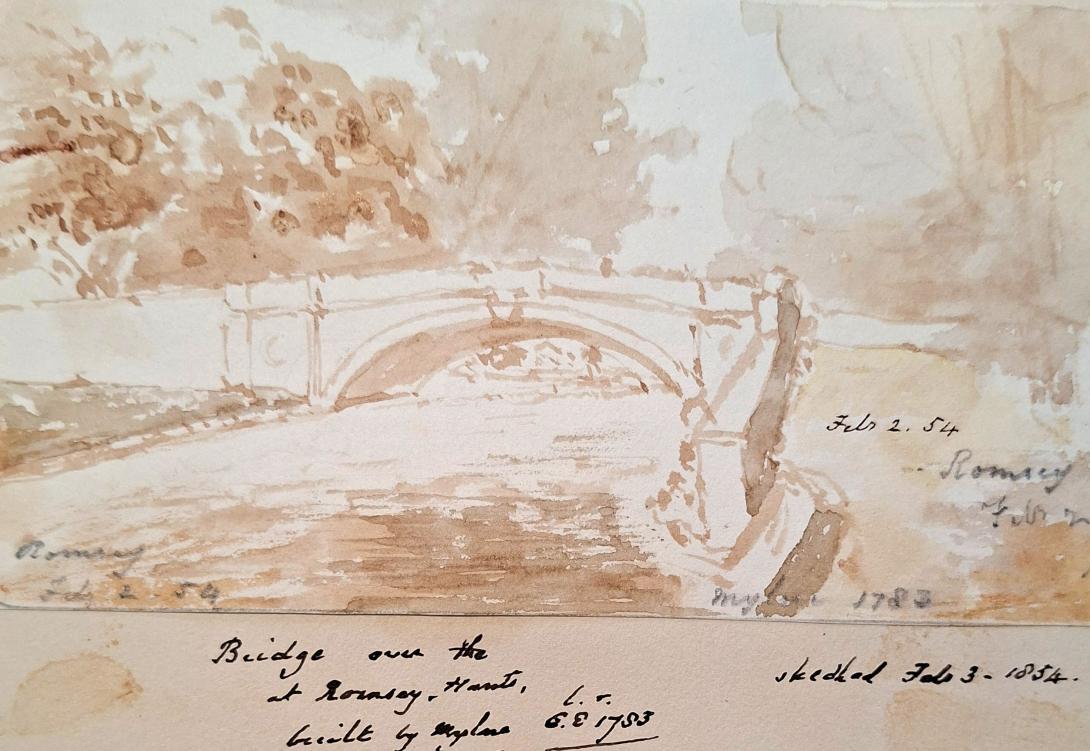
"Bridge over the at Romsey Hants built by Mylne 1783 sketched feb 3rd 1854"
The eighteenth-century Middle Bridge. This bridge was replaced in 1931 as part of the proposed Romsey By-Pass with a reconstruction bridge designed by W.J.Taylor but similar in lines and using the stone from the earlier bridge. Although it is not certain when the first bridge was built, it is possible there was one on the site from the thirteenth century. By the late eighteenth century the bridge was again in disrepair and it was on the recommendation of the second Viscount Palmerston that the architect and engineer Robert Mylne was commissioned by the Justices of the Peace for the County of Southampton to survey the condition of the bridge. Mylne’s report to the Justices of Peace for the County of Southampton set out in great detail both his assessment of the old bridge and his recommendations for a replacement: "…Agreeable to the said order, I did take the earliest opportunity to inspect and survey the present state of the said bridge and the nature and intention of the works hitherto carried on for the purpose of repairing the same.
The result of that inspection and survey and of the enquiry of all circumstances relating to the state, situation, form and figure of the said bridge is, that it is highly improper to proceed to repairing the same on account of the general bad state in which the whole of the work is at present, either on account of its old age or other circumstances and that to repair it, in its present form of 2 arches and piers, standing in such deep water, and in so violent a current will cost as much if not more money than if it was rebuilt of a proper form, less bulky and more convenient to the passage over it and under it and after all if it was repaired it would still be liable hereafter to the same disorder which have brought it to ruin without one single improvement in the passage of the publick over it which the business and traffick of the present age require…”
The Justices of the Peace decided after considering Mylne’s report that a new bridge was necessary and gave the order for a stone bridge to be built. Work began in 1782 and the bridge was completed in 1784. In his report of 26 September 1784, Mylne set out in detail the work that was undertaken and the cost of the construction work:
“In consequence of various orders made at different sessions of adjournment thereof, I have erected and compleated a new bridge over the Test at Romsey and agreeable to your particular order of the 9th April 1782 have to the best of my power and abilitys finished an undertaking of as much difficulty as I have generally met.
The total expense of it by the account hereunto annexed amounts to £3039 -18s – 3 d.
At first setting of I reported to you the old bridge could not possibly stand any longer and it was pulled down to its foundations.
I reported pointedly that the bridge works could only be contracted for from the surface of the water upwards and by drawing confined to the limits of 4 points one at each corner since at that period of time it was impossible to know how the wings could be extended beyond and through the various incumbrances that then fettered its enlargement for the publick convenience and above these and within their benefit (as to the extent of the work). Contracts were formed for £960 including a temporary bridge.
The old bridge required very little pulling down. It was a compleat ruin for when the new foundations were sunk inclosing the old ones they were found totally incapable of repair.
On forming the scheme for rebuilding the bridge the intelligence most to be depended on represented that there was a stratum of gravel or other hard substance at a certain depth. The fact turned out quite otherwise there is nothing but an endless depth of peat and on that substance the new bridge is erected and stands very well. But then the means to make it stand securely became of course a material cause of expense in addition to all that was to have been and is under water.
The bridge being erected attention was paid on the wings of its in order to support the road leading to and from it. On getting out of some of the difficulty wings of a quarter of a circle were adopted as the best in form and least in expense. They were built in that manner all except one and in rather a slight manner to save expense.
Lord Palmerston on seeing the difficulty’s which the publick convenience laboured under by the property (which we could not touch) being so near the old work very generously came forward and gave us every assistance that publick spirit could exhibit.
The passage of the old bridge within the parapetts was only 13 1/2 feet and the entrance leading to it was but 26 feet barely. The present bridge being made to the enlarged dimensions of 18 feet for the advantage of the publick the approach or entrance to it required a suitable width or opening. Lord Palmerston gave up entirely a bark mill house over it, and a kiln for drying bark besides divesting himself of this piece of property he pulled it all down at his own expense and surrendered the site thereof for the opening of the South East Quarter and for the wing wall extending 50 feet from the contract part of the structure.
At the north east quarter he purchased at a considerable expense two dwelling houses and pulled them down and surrendered up as much of the site thereof as was necessary for a similar opening on the west side and for the same sort of circular wall on that quarter.
At the south west side he allowed me to take as much ground of a field as amounted to 100 yards in length and 30 feet broad next the bridge so that the wing on that quarter was extended to the same form and limits as the others already mentioned. This enabled the road at the west end to be raised by being thus widened which never could have been done by reason of the lowness of the old houses on the north side thereof.
To those instances of solid and permanent good done to the publick in this work it is necessary to and that his lordship has paid for all the additional ornament and embellishment on the side fronting to Broadlands where the same is an expence over and above the work contracted for.
The bark mill being totally removed an opportunity was thereby obtained of removing the mill stream at some distance from the bridge and to throw the discharge of its water at a distance from the foundations.
This removal making a proper bed for it and arching it over was a considerable cause of expence but gave a security to the work at all times thereafter which could not otherwise have been obtained.
In this manner and for these reasons the works have been conducted and in lieu of the narrow confined passage across the River Teste in which the publick was much hampered the publick will hereafter enjoy a wide and easy access better suited to the great traffick and business carried out on in this quarter of the country.”
[Typescript copy of Robert Mylne report of 26 September 1784, c. 1930s, MS62 BR135/8]
Robert Mylne (1733-1811) had been born and raised in Edinburgh before travelling to Europe and studying architecture in Rome under Piranesi. He made his name by being the first Briton to win the triennial architecture competition at the Accademia San Luca. He became known in the UK after winning the competition to design the Blackfriars Bridge. In the wake of this he designed a number of other bridges. However, despite his early successes and his body of work, as an architect Mylne was never to achieve the status of his contemporaries Robert Adam and James Wyatt.
His bridge in Romsey was to prove his qualities as an engineer building a solid construction on such bad subsoil whilst also producing what was described as “a bridge on a very simple and pleasing lines admired by all, and it could not be bettered”. [MS62 BR135/1]
Indeed the Middle Bridge was to inspire the poetry of the Rural Rider, whose verses appeared in print in 1934.
So whilst the original Robert Mylne bridge no longer exists, it is still possible to enjoy some of its features and to consider that for a considerable period of time Romsey enjoyed an engineering feat designed by the individual lauded for his design of Blackfriars Bridge in London.
Richard Suter (1797–1883).
Richard Suter was born in Greenwich, Kent on 30th March 1798, to William Suter and his wife Sarah Knights. On 7th January 1825 he married Anne Ruth Burn.
English architect. As Surveyor to The Fishmongers' Company he designed the severe Presbyterian churches for Ballykelly (1825–7) and Banagher (1825) on the Company's Estate in County Londonderry, drawings of which were exhibited at the Royal Academy in 1827. He was also responsible for the Model Farm (1823–4), the Lancasterian Schools (1828–30), the Company Agent's House (1830–2—now a hotel, much altered), a range of houses on the south side of the main road (1823–4), the lodge in the Presbyterian churchyard (1828), and the Dispensary (1829), all at Ballykelly, and all Classical. As Surveyor to Trinity House Corporation, he designed houses that were erected by Thomas Cubitt in 1821–3 on a site adjoining Trinity House. For The Fishmongers' Company he designed St Peter's Almshouses, Wandsworth, London (1849–51), and The Old School-House, Gresham's School, Holt, Norfolk(1859), in an Elizabethan style.
On the 1841 Census Richard, an architect and lawyer, can be found living in London with his wife Ann (listed as Ruth) and their two children, Richard George and Andrew Burn. Living with them is Edward D Suter. 1851 finds the family living in Tottenham Court in London, by this time Andrew had left the home, but I am unable to trace him on the 1851 Census. In 1860 Andrew marries Amelia Damaris Harrison. Both Richard George and Andrew were to become ordained ministers, with Andrew later becoming a Bishop and emigrating to New Zealand. Sadly in 1854 Anne Ruth was to pass away. In 1861, widowed Richard, Justice of the Peace for Maidenhead, is living at Castle Hill, Maidenhead, Berkshire. In 1862 he married Elizabeth Anne Pocock. In 1871 and 1881 Richard and Elizabeth are still living in Castle Hill. Richard was to pass away on 1st March1883.
Richard Suter & Annesley Voysey, architects, had their office at number 35 Fenchurch Street, but they did not have it all to themselves as they shared the premises with W.C. Franks, a tea broker, who will get a separate post some other time. The earliest mention I found of Richard Suter in Fenchurch Street is in 1832 when he is listed at that address in a list of contributing members of the Society for the Propagation of the Gospel in Foreign Parts. It says that he had been a member since 1829, but that does not mean he was already at 35 Fenchurch Street in that year.(1) In fact, that seems unlikely as the Sun Fire Office records give Messrs. Short and Co., merchants, as paying the insurance premium on the premises in May 1830. The Directory of British Architects 1834-1914 give the year 1827, but I do not know on what evidence. When Suter and Voysey became partners is also uncertain, but they had known each other since at least 1825 as Suter is named as one of the executors of Voysey’s will which was dated 22 July, 1825. The address given for Suter in the will is Suffolk Street, Southwark. Voysey then lives at Conway Street, Fitzroy Square.