
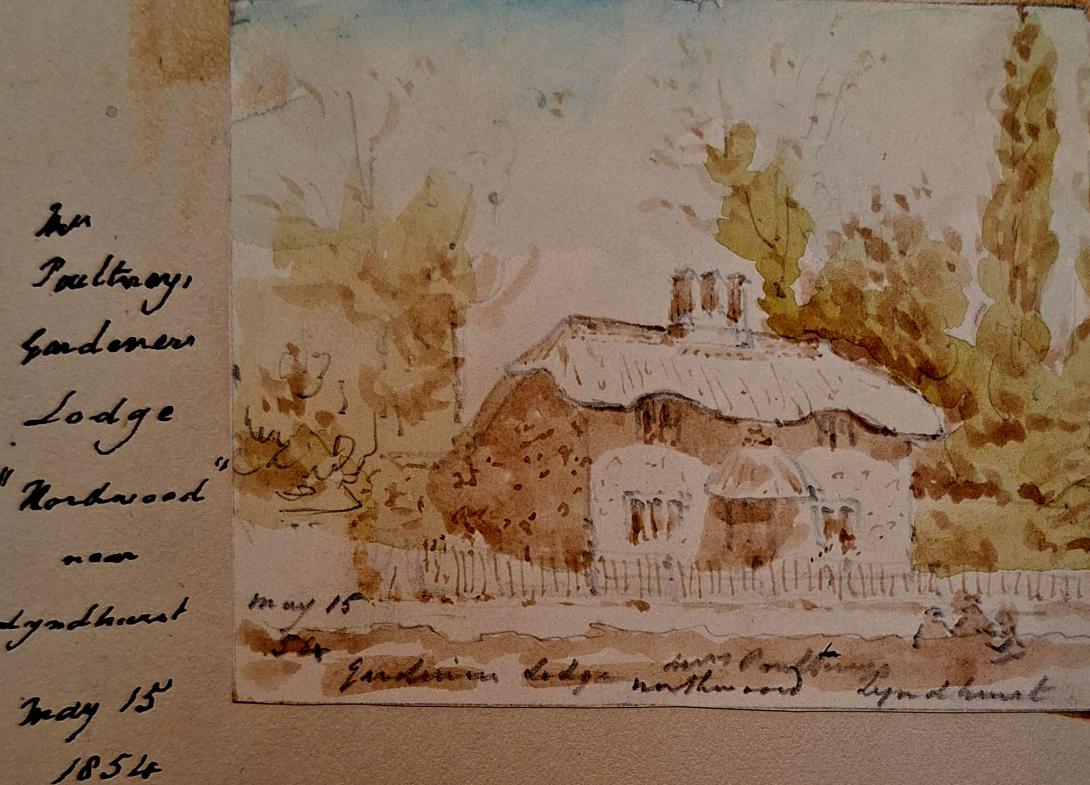
inscribed and dated " Mrs Poultney's Gardners Cottage Northerwood near Lyndhurst May 15 1854"
Overlooked by picturesque thatched cottages, and the home of a well-used cricket pitch, it’s not surprising that Swan Green is one of the most photographed locations in the New Forest. Indeed, some of the earliest postcards of the area depict Swan Green, including the single-storey blacksmith’s forge that was present until the 1930s.
Before the introduction of the motor car, of course, blacksmiths were in great demand, particularly in busy villages such as Lyndhurst. The smithy was shown on the 1870s and 1898 Ordnance Survey maps, together with, on the 1870s map, another at the beginning of Romsey Road, close to today’s traffic lights in Lyndhurst village centre. In 1898, a third is marked, this at the bottom of Lyndhurst High Street, close to the position of today’s post office.
Richardson, King and Driver show Swan Green as a wooded area on their late 18th century map of the New Forest - the cricket pitch, so familiar today, did not appear until the 1880s, when it was commissioned by Lord Londesborough of nearby Northerwood House.
The detached thatched cottage by the green was built, probably in 1833, to house James Young, the newly appointed gardener of the adjoining Northerwood estate. In ‘Seats of the Nobility and Gentry of 1833’ is an entry for Northerwood House that says: ‘The pleasure grounds are kept with great care by Mr. J. Young, a Scots artist of great skill, zeal and activity.’
Once known as Northerwood Cottage, the house is now called Beehive Cottage. (The adjacent row of thatched cottages is of considerably greater age than Beehive Cottage, and once housed forestry workers).
The White Swan inn, across the main A35 road from the green, shows on the Richardson, King and Driver map as the Swan Alehouse, which somehow does not quite have the cachet of the current name. Contemporary with the old map, the 1789 Rate Books have the publican as Andrew Eastram.
Looking now at the neat and tidy traditional building that is the White Swan, it’s difficult to imagine that it was all-but destroyed by fire in early 2006, and almost completely rebuilt.
And fire is something of a recurring theme here. In April 2007, an arsonist tried to burn down Swan Green’s wooden cricket pavilion - the blaze destroyed an internal wall, wrecked the electrical system and damaged fixtures and fittings, but otherwise left the building largely unscathed.
Surely, though, one of the most interesting stories associated with the pavilion is not cricket-related at all. W.S. Swayne, one-time curate to the vicar of nearby Emery Down, in his 1885 book Parson’s Pleasure, recalled acquaintance with Brusher Mills, the renowned New Forest snake-catcher of old.
‘Sometimes we were privileged to go with Brusher Mills on his snake-catching expeditions, said Swayne. ‘He caught snakes for the Zoological Gardens in London. Brusher lived in a widwan (a makeshift hut in the woods) he had made for himself not far from Bank on the edge of the New Forest. I remember one day he came into the cricket pavilion at Lyndhurst and someone said: ‘Got any snakes, Brusher?’ Brusher put his hands in his pockets and produced a writhing tangle of snakes, some of them vipers, and threw them on the table.’
Even in the New Forest, it’s difficult to see that happening today!
But other animals and events are also forever associated with Swan Green, for here, from around the 1840s, were held the popular local pony sales and associated fair. The sales eventually switched to the yard of the Swan Inn, opposite, whilst fairground attractions continued across the road on the green. A print published in the Illustrated London News of 1871 depicts the seemingly chaotic nature of the event, whilst the photograph of 1918 (above) shows an altogether less riotous affair.
By 1922, however, in the face of increasing road traffic, both pony sales and fair had moved to the site of the old race course, to the north-east of Lyndhurst, before, after the Second World War, another move was made to the current site near Beaulieu Road station.
Richard Suter (1797–1883).
Richard Suter was born in Greenwich, Kent on 30th March 1798, to William Suter and his wife Sarah Knights. On 7th January 1825 he married Anne Ruth Burn.
English architect. As Surveyor to The Fishmongers' Company he designed the severe Presbyterian churches for Ballykelly (1825–7) and Banagher (1825) on the Company's Estate in County Londonderry, drawings of which were exhibited at the Royal Academy in 1827. He was also responsible for the Model Farm (1823–4), the Lancasterian Schools (1828–30), the Company Agent's House (1830–2—now a hotel, much altered), a range of houses on the south side of the main road (1823–4), the lodge in the Presbyterian churchyard (1828), and the Dispensary (1829), all at Ballykelly, and all Classical. As Surveyor to Trinity House Corporation, he designed houses that were erected by Thomas Cubitt in 1821–3 on a site adjoining Trinity House. For The Fishmongers' Company he designed St Peter's Almshouses, Wandsworth, London (1849–51), and The Old School-House, Gresham's School, Holt, Norfolk(1859), in an Elizabethan style.
On the 1841 Census Richard, an architect and lawyer, can be found living in London with his wife Ann (listed as Ruth) and their two children, Richard George and Andrew Burn. Living with them is Edward D Suter. 1851 finds the family living in Tottenham Court in London, by this time Andrew had left the home, but I am unable to trace him on the 1851 Census. In 1860 Andrew marries Amelia Damaris Harrison. Both Richard George and Andrew were to become ordained ministers, with Andrew later becoming a Bishop and emigrating to New Zealand. Sadly in 1854 Anne Ruth was to pass away. In 1861, widowed Richard, Justice of the Peace for Maidenhead, is living at Castle Hill, Maidenhead, Berkshire. In 1862 he married Elizabeth Anne Pocock. In 1871 and 1881 Richard and Elizabeth are still living in Castle Hill. Richard was to pass away on 1st March1883.
Richard Suter & Annesley Voysey, architects, had their office at number 35 Fenchurch Street, but they did not have it all to themselves as they shared the premises with W.C. Franks, a tea broker, who will get a separate post some other time. The earliest mention I found of Richard Suter in Fenchurch Street is in 1832 when he is listed at that address in a list of contributing members of the Society for the Propagation of the Gospel in Foreign Parts. It says that he had been a member since 1829, but that does not mean he was already at 35 Fenchurch Street in that year.(1) In fact, that seems unlikely as the Sun Fire Office records give Messrs. Short and Co., merchants, as paying the insurance premium on the premises in May 1830. The Directory of British Architects 1834-1914 give the year 1827, but I do not know on what evidence. When Suter and Voysey became partners is also uncertain, but they had known each other since at least 1825 as Suter is named as one of the executors of Voysey’s will which was dated 22 July, 1825. The address given for Suter in the will is Suffolk Street, Southwark. Voysey then lives at Conway Street, Fitzroy Square.