
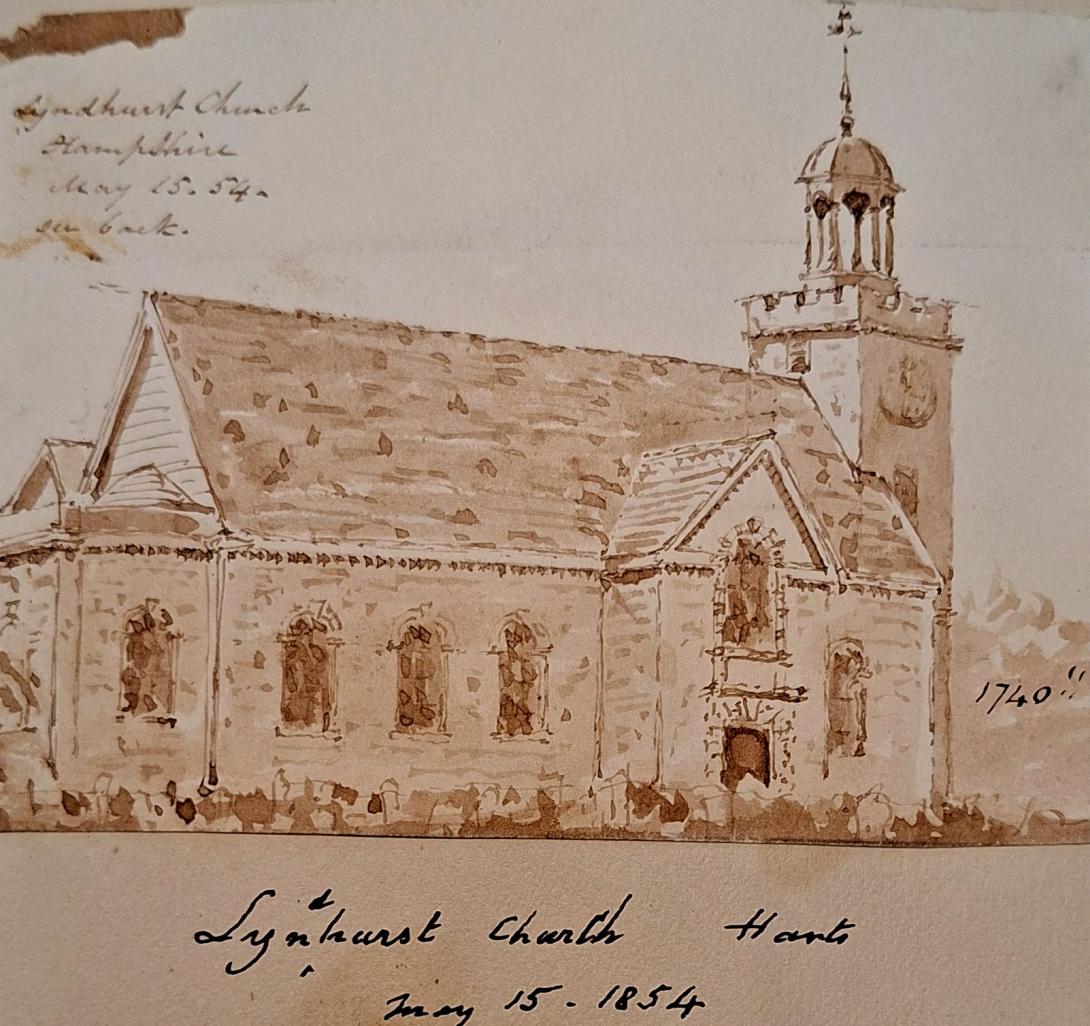
inscribed and dated "Lyndhurst Church Hampshire May 15 1854 seen back /1740"
Richardson, King and Driver on their late-18th century map of the New Forest show a church on the same site as Lyndhurst’s current parish church of St. Michael and All Angels. But the map refers to the present church’s predecessor, which was also dedicated to St. Michael. That had replaced an even earlier, 14th century building sited, maybe, on a Pagan place of worship - the church hillock is said to be a prehistoric man-made mound.
No information survives from Pagan times, and little is known of the 14th century building. But what about the first church of St. Michael?
A relatively modest structure erected in 1741, a sketch of 1784 by Thomas Rowlandson shows it as a fairly rugged, somewhat squat building sitting atop the current hillock, whilst another, probably more realistic, illustration by F.N. Shepherd shows a typically elegant Georgian structure with an equally elegant cupola installed atop the tower.
Its life, though, in Parish Church terms, was relatively short-lived.
By the early 1790s a string and woodwind orchestra accompanied the hymns, but the church was already considered ‘too small to accommodate the increasing inhabitants with proper seating.’ Enlargement proposals at around that time were not, however, progressed.
Mrs. R. Bowden-Smith, grand-daughter of Lady Northesk of Minstead Lodge, lived in Lyndhurst from the 1850s, and recalled asking for use of the family seat in the old church, ‘a large, square pew, quite high, with curtains round it’, being told it was in use by a girls’ school, and having then to use the gallery.
She also left a graphic account of the period of transition from the old church to the current church, revealing a Victorian desire for church ‘improvement’, the influence of local dignitaries, and human nature at its most varied:
‘Sir Charles Burrard and Mr. Lucas (the Curate-in-Charge, who was also Sir Charles’ son-in-law) were very anxious to have a new church but at first there was great opposition to the plan. The tower (of the old church) was voted unsafe and the church very ugly.
In 1858 the demolition began but the building was very strong and the roof very difficult to pull down as it was very well built. Then came the difficulty of extending the space for the foundations of the new church. People whose relations were buried in the churchyard were very angry at the graves being disturbed and some said they would never go to the new church.
I believe the new edifice was begun with only 6,000 pounds …….. We had church services in the school, and Mr. Compton would not allow more to be done until more money was given. (Note: The living was a chapelry, annexed to the rectory of Minstead…in the gift of H. Compton, Squire of Minstead Manor, and held by the Rev. J. Compton. Which of these Comptons held up the works, though, is uncertain).
In 1860 it was consecrated. The roof was supposed to be a temporary one.
Ladies gave money for the carvings on the pedestals and one after another gift arrived. Once an anonymous gift of several hundreds was sent to Mr. Compton with which to build the tower. Mr. Castleman gave 300 pounds for the clock, Mr. Buckworth Powell gave the bells, Mrs. Aitchison gave the east window in memory of her husband, Mr. Pulteney gave the south window in memory of his parents. The north window is the Powell window.
So bit by bit, the Church has been built, many of the congregation quarrelled about the seats, and some time elapsed before peace was restored.’
Then, writing during the period of construction, local author John Wise had this to say:
‘Close by is the new, half-finished, church, standing in the old churchyard……...
It is not fair at present to pass a final judgment. When the tower is added, and time shall have touched the walls with a soberer tone, its two great defects will have disappeared…….
That there are defects in the church its greatest admirers would admit – the poorness of the roof, the harshness produced by the introduction of so much white, as also the bad colour of the bricks, and a heaviness which hangs over the clerestory windows of the nave.’
And then tellingly, Wise captures what seems to have been the whole spirit of the enterprise:
‘But on the whole, it stands as a proof of the great advance during the last ten years of Art, as a cheering sign, too, that, amidst all the failures of Government, some taste and zeal are to be found amongst private persons.’
The new church was finally completed in 1869, but Mrs. Bowden-Smith noted:
‘After some years the roof became faulty and in 1893 there was a large bazaar and entertainment at Glasshayes (now the Lyndhurst Park Hotel) to raise 1,000 pounds for a new roof. The bazaar did not produce sufficient but the money did come in and the new roof was erected’.
Richard Suter (1797–1883).
Richard Suter was born in Greenwich, Kent on 30th March 1798, to William Suter and his wife Sarah Knights. On 7th January 1825 he married Anne Ruth Burn.
English architect. As Surveyor to The Fishmongers' Company he designed the severe Presbyterian churches for Ballykelly (1825–7) and Banagher (1825) on the Company's Estate in County Londonderry, drawings of which were exhibited at the Royal Academy in 1827. He was also responsible for the Model Farm (1823–4), the Lancasterian Schools (1828–30), the Company Agent's House (1830–2—now a hotel, much altered), a range of houses on the south side of the main road (1823–4), the lodge in the Presbyterian churchyard (1828), and the Dispensary (1829), all at Ballykelly, and all Classical. As Surveyor to Trinity House Corporation, he designed houses that were erected by Thomas Cubitt in 1821–3 on a site adjoining Trinity House. For The Fishmongers' Company he designed St Peter's Almshouses, Wandsworth, London (1849–51), and The Old School-House, Gresham's School, Holt, Norfolk(1859), in an Elizabethan style.
On the 1841 Census Richard, an architect and lawyer, can be found living in London with his wife Ann (listed as Ruth) and their two children, Richard George and Andrew Burn. Living with them is Edward D Suter. 1851 finds the family living in Tottenham Court in London, by this time Andrew had left the home, but I am unable to trace him on the 1851 Census. In 1860 Andrew marries Amelia Damaris Harrison. Both Richard George and Andrew were to become ordained ministers, with Andrew later becoming a Bishop and emigrating to New Zealand. Sadly in 1854 Anne Ruth was to pass away. In 1861, widowed Richard, Justice of the Peace for Maidenhead, is living at Castle Hill, Maidenhead, Berkshire. In 1862 he married Elizabeth Anne Pocock. In 1871 and 1881 Richard and Elizabeth are still living in Castle Hill. Richard was to pass away on 1st March1883.
Richard Suter & Annesley Voysey, architects, had their office at number 35 Fenchurch Street, but they did not have it all to themselves as they shared the premises with W.C. Franks, a tea broker, who will get a separate post some other time. The earliest mention I found of Richard Suter in Fenchurch Street is in 1832 when he is listed at that address in a list of contributing members of the Society for the Propagation of the Gospel in Foreign Parts. It says that he had been a member since 1829, but that does not mean he was already at 35 Fenchurch Street in that year.(1) In fact, that seems unlikely as the Sun Fire Office records give Messrs. Short and Co., merchants, as paying the insurance premium on the premises in May 1830. The Directory of British Architects 1834-1914 give the year 1827, but I do not know on what evidence. When Suter and Voysey became partners is also uncertain, but they had known each other since at least 1825 as Suter is named as one of the executors of Voysey’s will which was dated 22 July, 1825. The address given for Suter in the will is Suffolk Street, Southwark. Voysey then lives at Conway Street, Fitzroy Square.