
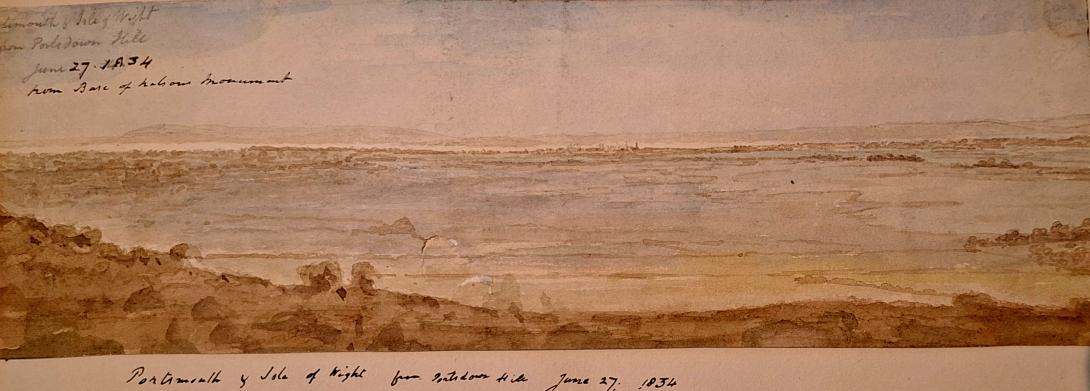
extensively signed and dated " Portsmouth and the Isle of Wight from Portsdown Hill June 27 1834 from the base of Harbour (Nelson) Moument
By direct descent from the Architect and Artist
Early views of Portsmouth from Portsdown Hill reveal a growing naval city and harbor, with historical paintings (c.1778) showing early fortifications and the harbor's importance, while later photos (mid-20th century) capture the iconic Nelson Monument and the expansion of the city, with the Isle of Wight always a stunning backdrop, showcasing the ever-present military and maritime significance from this famous vantage point.
Portsdown Hill provides magnificent views over Portsmouth and beyond. The slopes are home to impressive shows of wildlife that can be explored through miles of paths.
Portsdown Hill is a chalk ridge that overlooks Portsmouth and provides a stunning viewpoint over the city, the harbours and over to the Isle of Wight. The hill's open network of paths take walkers through flowery grassland and other wildlife-rich habitats.
Much of Portsdown's extensive chalk grassland is a Site of Special Scientific Interest. The grassland is home to fantastic displays of colourful wildflowers that change through the spring, summer and autumn. It is an excellent place to spot bees, butterflies and hundreds of other pollinating insects. This flower-rich grassland is now a rare habitat as most has been lost from the countryside.
The view is looking out towards Portsmouth Harbour where numerous ships are moored or with their sails up. General confusion and chaos reigns on the Point with sailors just returned or about to leave (a sailor is saying goodbye to his family in the doorway on the right, whilst in the window above an officer is looking towards the harbour with his telescope).
The power station chimney seen in the 1949 photo was just to the left of the above photo, the area is now covered with housing.
Portsmouth harbour opens out into the Solent, the water that runs around the north of the Isle of Wight.
Although the Isle of Wight is now an island, this was not always the case. The Solent was once part of a large river system that drained part of southern England, including Portsmouth, Langstone and Chichester Harbours, along with Southampton Water.
The west of the Isle of Wight was connected to Dorset during the time of the Solent river system, however the land was breached around 7,000 years ago as sea levels rose following the end of the last glacial period and melting of large sheets of ice.
There is so much history to be discovered around Portsmouth. In the above photo, there are some round objects visible in the sea to the left of the photo. These are what have become known as Palmerston Forts, or Palmerston Follies:
These were built between 1865 and 1880 following a Royal Commision that raised concerns regarding the risk of a French invasion. They were intended to defend Portsmouth from an attack from the east.
They were named after Lord Palmerston who was Prime Minister at the time, and who championed the idea of the forts. They became known as Palmerston Follies as they were never used as a French invasion never materialised, and they quickly became outdated following advances in weapons technology.
Three additional land based forts were also built along Portsdown Hill which can still be seen when travelling along the road that runs along the top of the hill.
The following print from 1823 shows a view from Portsdown Hill, further to the west of my father’s 1949 photo (© The Trustees of the British Museum).
Portchester Castle was originally a Roman fort, built in the 3rd century as one of a number of shore forts to defend the area against Saxon raids.
The old Roman fort seems to have been occupied from the ending of the Roman period to the Norman conquest, when the site became a Norman castle, with a 12th century keep. The castle continued to be in use and further fortified due to its strategic position, and what seems to have been an almost continuous threat of invasion by the French.
Charles I sold the castle to a local landowner in 1632, and for periods during the next two centuries, the castle was rented to the Government as a prison to hold prisoners of war, including during the Napoleonic wars of 1793 to 1815, when the castle was home to thousands of prisoners.
Portchester Castle is still owned by descendants of the landowner who purchased the castle from Charles I, and is now managed by English Heritage.
Portchester Castle from the air, facing onto Portsmouth Harbour:
Portsmouth's history can be traced to Roman times and has been a significant Royal Navy dockyard and base for centuries. Portsmouth was founded c. 1180 by Anglo-Norman merchant Jean de Gisors in the south-west area of Portsea Island, a location now known as Old Portsmouth. Around this time, de Gisors ordered the construction of a chapel dedicated to St Thomas Becket. This became a parish church by the 14th century. Portsmouth was established as a town with a royal charter on 2 May 1194. The city is home to the first drydock ever built. It was constructed by Henry VII in 1496.
Portsmouth has the world's oldest dry dock, "The Great Stone Dock"; originally built in 1698, rebuilt in 1769 and presently known as "No.5 Dock".The world's first mass production line was established at the naval base's Block Mills which produced pulley blocks for the Royal Navy fleet. By the early-19th century, Portsmouth was the most heavily fortified city in the world, and was considered "the world's greatest naval port" at the height of the British Empire throughout Pax Britannica. By 1859, a ring of defensive land and sea forts, known as the Palmerston Forts, had been built around Portsmouth in anticipation of an invasion from continental Europe.
Richard Suter (1797–1883).
Richard Suter was born in Greenwich, Kent on 30th March 1798, to William Suter and his wife Sarah Knights. On 7th January 1825 he married Anne Ruth Burn.
English architect. As Surveyor to The Fishmongers' Company he designed the severe Presbyterian churches for Ballykelly (1825–7) and Banagher (1825) on the Company's Estate in County Londonderry, drawings of which were exhibited at the Royal Academy in 1827. He was also responsible for the Model Farm (1823–4), the Lancasterian Schools (1828–30), the Company Agent's House (1830–2—now a hotel, much altered), a range of houses on the south side of the main road (1823–4), the lodge in the Presbyterian churchyard (1828), and the Dispensary (1829), all at Ballykelly, and all Classical. As Surveyor to Trinity House Corporation, he designed houses that were erected by Thomas Cubitt in 1821–3 on a site adjoining Trinity House. For The Fishmongers' Company he designed St Peter's Almshouses, Wandsworth, London (1849–51), and The Old School-House, Gresham's School, Holt, Norfolk(1859), in an Elizabethan style.
On the 1841 Census Richard, an architect and lawyer, can be found living in London with his wife Ann (listed as Ruth) and their two children, Richard George and Andrew Burn. Living with them is Edward D Suter. 1851 finds the family living in Tottenham Court in London, by this time Andrew had left the home, but I am unable to trace him on the 1851 Census. In 1860 Andrew marries Amelia Damaris Harrison. Both Richard George and Andrew were to become ordained ministers, with Andrew later becoming a Bishop and emigrating to New Zealand. Sadly in 1854 Anne Ruth was to pass away. In 1861, widowed Richard, Justice of the Peace for Maidenhead, is living at Castle Hill, Maidenhead, Berkshire. In 1862 he married Elizabeth Anne Pocock. In 1871 and 1881 Richard and Elizabeth are still living in Castle Hill. Richard was to pass away on 1st March1883.
Richard Suter & Annesley Voysey, architects, had their office at number 35 Fenchurch Street, but they did not have it all to themselves as they shared the premises with W.C. Franks, a tea broker, who will get a separate post some other time. The earliest mention I found of Richard Suter in Fenchurch Street is in 1832 when he is listed at that address in a list of contributing members of the Society for the Propagation of the Gospel in Foreign Parts. It says that he had been a member since 1829, but that does not mean he was already at 35 Fenchurch Street in that year.(1) In fact, that seems unlikely as the Sun Fire Office records give Messrs. Short and Co., merchants, as paying the insurance premium on the premises in May 1830. The Directory of British Architects 1834-1914 give the year 1827, but I do not know on what evidence. When Suter and Voysey became partners is also uncertain, but they had known each other since at least 1825 as Suter is named as one of the executors of Voysey’s will which was dated 22 July, 1825. The address given for Suter in the will is Suffolk Street, Southwark. Voysey then lives at Conway Street, Fitzroy Square.